Maryland Learners Permit Practice Test 9

4.8 out of 5 (133 votes)
80% Passing score
20 Questions
4 Mistakes allowed
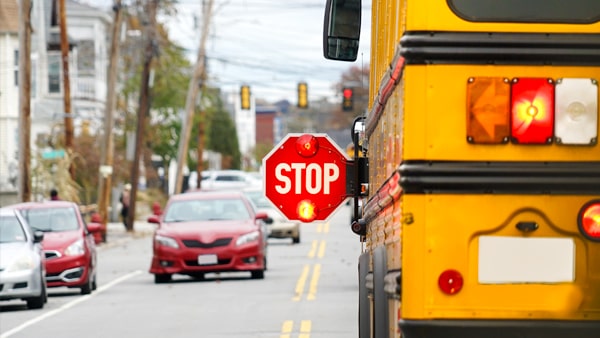
This Maryland MVA learners practice test gets very specific, very quickly: school buses, stopping laws, flashing red lights, stop arms, and the kind of question wording that makes you reread the sentence even though, yes, you technically know what a school bus is. That is the point. School bus rules are one of those permit-test topics that seem basic until the scenario starts adding opposite lanes, divided roads, traffic directions, and the one detail you skimmed because it looked harmless. This MVA permit practice test will check whether you know that Maryland requires drivers to stop at least 20 feet from a school bus when its red lights are flashing and the stop arm is extended, unless a roadway exception applies. The questions here work through those details in plain driving situations: stopping behind a bus, recognizing the bus signals, knowing when traffic in the other direction must stop, and not getting cute with the rules just because the road layout looks slightly different. The official Maryland noncommercial learner’s permit knowledge test is given by the Maryland Department of Transportation Motor Vehicle Administration, or just MVA if you are not trying to make the name take up half the paragraph. It is based on the Maryland Driver’s Manual and covers the bigger spread of material: traffic laws, road signs and signals, safe driving habits, defensive driving, sharing the road, and graduated licensing rules. For learner’s permit applicants, the test is typically 25 multiple-choice questions. You need 22 correct answers to pass, which is an 88% score, and the whole thing is timed at 20 minutes. So, no, it is not exactly a leisurely stroll through Maryland traffic law with a snack break in the middle. You can retake this Maryland practice permit test as many times as you need. That is not a loophole; that is how the material actually sticks. Scoring 16 out of 20 is a good sign that you are getting comfortable with this section, but the real win is being able to answer these questions without mentally flipping through the manual in a panic. School bus laws are not just test material, either. They are there because kids are unpredictable, drivers are impatient, and Maryland would very much prefer that everyone behave like they noticed both of those facts.
FREE DMV Practice Test App
Study for your Maryland permit test or driver’s license with the NextDoorDriving app. 700+ DMV questions and answers, 100% free!
Download on the App Store

Sample Maryland Permit Test Questions

Question 1

Why may a minimum speed limit be posted on part of a highway?

  1. A To prevent unusually slow driving from impeding normal traffic movement
  2. B To report changing weather conditions
  3. C To identify a future traffic-signal location
  4. D To establish a pedestrian crossing speed

Correct answer: A – To prevent unusually slow driving from impeding normal traffic movement

Maryland may establish a minimum speed after an engineering and traffic investigation finds that slow speeds impede normal and reasonable traffic movement. Unless a lower speed is necessary for safety or required by law, drivers may not travel below a posted minimum. The restriction becomes effective when appropriate signs are posted.

Source: Md. Code, Transp. § 21-804(a), (b) — Minimum Speed Regulation
Question 2

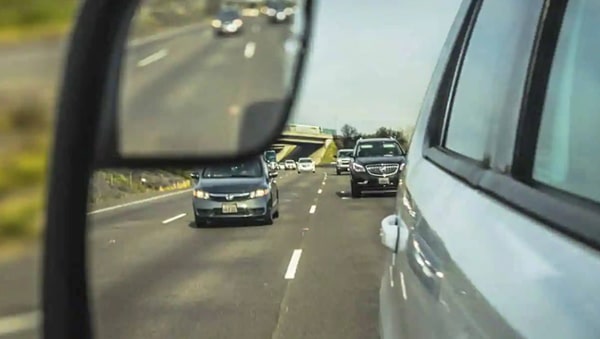
What is one important reason to monitor traffic in your mirrors while driving?

You should check traffic behind you:
  1. A Mirror checks are needed only on interstate highways
  2. B They help you recognize a vehicle approaching rapidly or following too closely
  3. C Mirrors should be checked only before slowing
  4. D Rear traffic matters only when no passengers are present

Correct answer: B – They help you recognize a vehicle approaching rapidly or following too closely

A safe visual search includes the front, sides, and rear of your vehicle. Regularly monitoring the mirrors helps you identify traffic approaching from behind, including a driver who is following too closely. Knowing about the developing hazard gives you more time to make a safe adjustment if necessary.

Source: Maryland Driver’s Manual — § 3.A, “Visual Search/Driver Awareness”

Question 3

Which practice is part of defensive driving?

  1. A Watch only the center of your lane
  2. B Stay alert and scan traffic ahead, beside, and behind you
  3. C Trust other drivers to correct your mistakes
  4. D Wait until a hazard is close before reacting

Correct answer: B – Stay alert and scan traffic ahead, beside, and behind you

Safe driving requires continuous attention to the roadway and surrounding traffic. The driver’s manual tells drivers to remain alert and repeatedly check vehicles ahead, behind, and beside them. Fixing your gaze only straight ahead can cause you to miss developing hazards, while last-second reactions leave less time and space to avoid a crash.

Source: Maryland Driver’s Manual — Section 6.C, “Distracted Driving”

Question 4

Why should you check your blind spots carefully when driving near bicyclists?

  1. A Bicyclists always have priority over motor vehicles
  2. B A bicycle may be beside your vehicle where it is difficult to see
  3. C Bicyclists must ride facing approaching traffic
  4. D Bicyclists are exempt from posted speed limits

Correct answer: B – A bicycle may be beside your vehicle where it is difficult to see

Bicycles are smaller and quieter than motor vehicles, and a rider can be difficult to notice beside a car. Before turning right, the manual directs drivers to check for a bicycle on the right or in the right blind spot. A bicyclist must obey traffic rules, but that does not make the rider easy to see.

Source: Maryland Driver’s Manual — Section 7.F, “Be Careful at Intersections, Bridges and Driveways”

Question 5

Traffic is backed up beyond a stop-sign-controlled intersection. When may you proceed?

  1. A Immediately after making a complete stop
  2. B Only when it is safe to enter and continue through the intersection
  3. C When cross traffic has enough room to go around you
  4. D Whenever no vehicle is waiting behind you

Correct answer: B – Only when it is safe to enter and continue through the intersection

At a stop sign, the Maryland manual requires a complete stop and yielding to vehicles and pedestrians in the intersection. You must remain stopped until it is safe to enter and continue through. If congestion leaves no room beyond the intersection, you cannot yet continue through and should wait.

Source: Maryland Driver’s Manual — Section 4.B, “Regulatory Signs — 8-Sided Sign, White Letters on Red”

Question 6

On an undivided road, a stopped school bus is displaying alternately flashing red lights. What must you do?

What does it mean when a school bus is stopped and its red lights are flashing?
  1. A Pass if no children are visible
  2. B Stop at least 20 feet away and remain stopped as required
  3. C Pass if you are approaching the front of the bus
  4. D Proceed if the bus driver motions you forward

Correct answer: B – Stop at least 20 feet away and remain stopped as required

Maryland requires drivers meeting or overtaking a stopped school vehicle with alternating red lights to stop at least 20 feet away. They may not proceed until the bus moves again or the red lights are turned off. The rule does not apply on the opposite roadway of a divided highway; a violation is punishable by a fine up to $1,000.

Source: Md. Code, Transp. § 21-706(a)–(d) — Overtaking and Passing School Vehicle