Maryland MVA Sign Test 4

4.9 out of 5 (103 votes)
80% Passing score
20 Questions
4 Mistakes allowed
A road sign does not give you much time to think. That is sort of the whole arrangement. It appears, gives its instruction in a color, shape, symbol, or few blunt words, and expects you to understand it before traffic gets any more interesting. This Maryland MVA road sign practice test is built around that exact skill: recognizing what a sign means quickly enough to answer correctly on the knowledge test and, more importantly, to react properly when the sign is sitting beside an actual Maryland road. The practice test includes 20 multiple-choice questions covering the sign details that tend to matter most on the Maryland permit test. You will see warning signs, regulatory signs, guide signs, common shapes, and color meanings. Red is not just “important”; it usually means stop, yield, wrong way, or another serious restriction. Yellow gives warning before the road changes or a hazard appears. Green points drivers toward routes, exits, directions, and permitted movement. It sounds simple when laid out neatly like that, which is usually where people get a little too comfortable. Then the answer choices start looking close, and suddenly the difference between a warning sign and a regulatory sign is not so decorative after all. This MD road sign test also fits into the bigger Maryland licensing process, especially for new drivers in the Rookie Driver program. Maryland uses three main stages: learner’s instructional permit, provisional license, and full driver’s license. The learner’s permit can begin at 15 years and 9 months, once the applicant passes the vision screening and knowledge test. Before moving to a provisional license, new drivers must complete an MVA-approved driver education course with 30 classroom hours and 6 behind-the-wheel hours. Drivers under 25 generally need 60 supervised practice hours, including 10 at night, while drivers 25 and older usually need 14 supervised hours, including 3 at night. A passing score on this Maryland practice permit test is 16 out of 20. Treat that number as a useful checkpoint, not a trophy. The real value is in the missed questions, the almost-right answers, and the signs you thought you knew because you have seen them a thousand times from the passenger seat. Work through the test carefully, review what you miss, and the actual MVA knowledge test should feel less like a cold read and more like something you have already rehearsed properly.
FREE DMV Practice Test App
Study for your Maryland permit test or driver’s license with the NextDoorDriving app. 700+ DMV questions and answers, 100% free!
Download on the App Store

Sample Maryland Permit Test Questions

Question 1

Which color pavement lines separate traffic lanes moving in the same direction?

  1. A Yellow
  2. B White
  3. C Red
  4. D Black

Correct answer: B – White

On Maryland roads, white lines separate lanes carrying traffic in the same direction. A broken white line permits lane changes, while a single solid white line indicates that changing lanes is discouraged. A solid white line may also mark the right edge of the roadway.

Source: Maryland Driver’s Manual — § 4.C, “Types of Line Markings”
Question 2

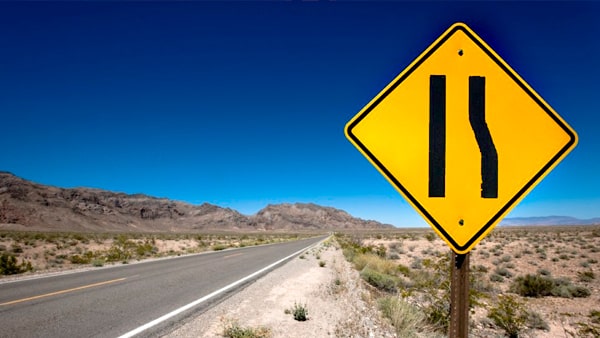
What condition does the warning sign shown indicate?

This sign means:
  1. A The right lane ends ahead
  2. B A divided highway begins ahead
  3. C A steep hill is ahead
  4. D Trucks enter the roadway ahead

Correct answer: A – The right lane ends ahead

This Lane Ends warning sign indicates that the right lane will not continue. Drivers using that lane should prepare to merge left. Maryland law requires a driver to determine that a lane change can be completed safely before moving from the current lane.

Source: Md. Code, Transp. § 21-309(b), Maryland Driver’s Manual — § 4.B, “Warning Signs”

Question 3

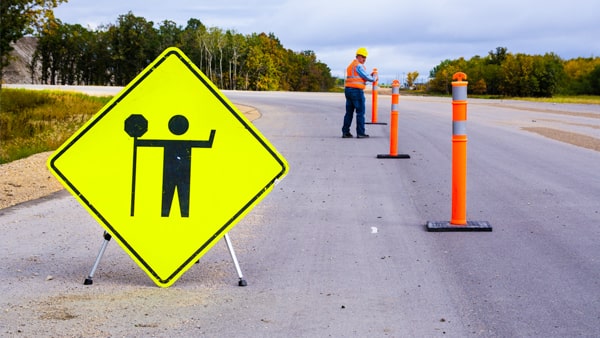
What does the orange diamond-shaped sign shown warn drivers about?

This sign means:
  1. A A pedestrian crossing
  2. B The end of a work zone
  3. C A school crossing
  4. D A flagger directing traffic ahead

Correct answer: D – A flagger directing traffic ahead

The sign means Flagger Ahead. In a Maryland work zone, a flagger may be directing vehicles through a temporary traffic pattern or lane closure. Stay alert, reduce speed as required, and obey the flagger’s directions.

Source: Maryland Driver’s Manual — § 4.B, “Colors & Shapes” and “Warning Signs”, Maryland Driver’s Manual — § 5.H, “Work Zone Safety”

Question 4

Your signal changes from red to green. What must you do before entering the intersection?

  1. A Accelerate before cross traffic begins moving
  2. B Check the intersection and yield to anyone already in it
  3. C Require pedestrians to wait because you have a green light
  4. D Proceed immediately if you are traveling straight

Correct answer: B – Check the intersection and yield to anyone already in it

A circular green signal permits you to proceed, but you must first check that it is safe. Yield to pedestrians and vehicles lawfully within the intersection or an adjacent crosswalk. Enter only after traffic already in the intersection has cleared your path.

Source: Md. Code, Transp. § 21-202(b), (c), Maryland Driver’s Manual — § 4.A, “Vehicle Signals”

Question 5

How must a driver respond to a flashing yellow traffic signal?

  1. A Merge with approaching traffic
  2. B Slow down and proceed with caution
  3. C Stop for an automatic pedestrian crossing
  4. D Come to a complete stop before proceeding

Correct answer: B – Slow down and proceed with caution

A flashing yellow signal permits a driver to continue only with caution. Slow down, observe the intersection or roadway ahead, and proceed carefully. Unlike a flashing red signal, it does not require a complete stop.

Source: Md. Code, Transp. § 21-204(a), (f), Maryland Driver’s Manual — § 4.A, “Vehicle Signals”

Question 6

At a stop sign with a marked stop line, where must you make your first stop?

  1. A Where you can see all cross traffic
  2. B After entering the crosswalk
  3. C At the stop line before the crosswalk
  4. D Five feet before the stop sign

Correct answer: C – At the stop line before the crosswalk

Maryland’s stop-sign rule requires a driver to stop at the clearly marked stop line. If there is no stop line, stop before entering the crosswalk. If neither is present, stop at the nearest point before the intersection that provides a view of approaching traffic.

Source: Md. Code, Transp. § 21-707(a)–(c)