


Maryland Road Signs Test Simulator

4.6 out of 5 (155 votes)
80% Passing score
25 Questions
5 Mistakes allowed
Maryland’s permit test is not there to admire your good intentions. It gives you 25 questions, a 20-minute limit, and a passing score of 22 correct answers, which means three missed questions is the whole cushion. Three. That is not exactly a wide safety net, especially when road signs, traffic rules, and those small licensing details all show up inside the same computerized MVA knowledge test. This MD DMV permit practice test gives you a steadier way to prepare before the real thing. It uses 20 questions per round and asks for 16 correct answers to pass, so the format is manageable without turning into pretend studying. The point is not to make the Maryland MVA test feel dramatic. It is to make it familiar enough that you stop wasting energy on the format and start paying attention to the material—sign shapes, sign colors, right-of-way rules, safe driving judgment, and the details people tend to skim because they look simple at first glance. Bad idea, usually. Each attempt pulls from a large question bank, so you are not just memorizing one neat little sequence and calling it preparation. You will see different wording, different signs, and different rule situations, which is exactly what you want from a Maryland MVA permit practice test. When you miss an answer, the explanations and hints give you the part that actually matters: why the correct answer is correct. A wrong answer by itself teaches very little. A wrong answer with a clear explanation can save you from making the same mistake when the MVA clock is running. It also helps to remember where this test fits in the larger Maryland licensing process. You can apply for a learner’s permit at 15 years and 9 months, but the permit test is only the first gate. Driver education, supervised practice hours, permit holding periods, provisional license restrictions, nighttime rules, passenger limits, and the under-21 no-measurable-alcohol rule all come later in one form or another. Fine, that is a lot. But for now, the knowledge test is the immediate hurdle. Use this free Maryland practice permit test as often as you need. No appointment pressure, no fee, no one watching you over a counter. Just a practical, repeatable way to sharpen your road sign knowledge, get comfortable with the test format, and walk into the real Maryland MVA permit test with fewer weak spots.
FREE DMV Practice Test App
Study for your Maryland permit test or driver’s license with the NextDoorDriving app. 700+ DMV questions and answers, 100% free!
Download on the App Store

Sample Maryland Permit Test Questions

Question 1

What does a red-and-white WRONG WAY sign tell a driver?
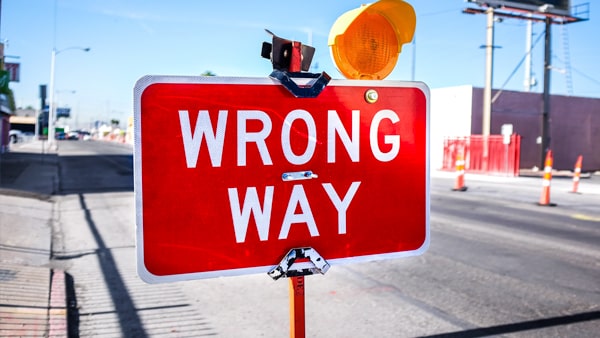
This red and white sign means:
  1. A Enter only after yielding to other traffic
  2. B The roadway is closed in every direction
  3. C U-turns are prohibited at this location
  4. D The vehicle is traveling against the permitted direction of traffic

Correct answer: D – The vehicle is traveling against the permitted direction of traffic

The WRONG WAY sign warns that you are traveling opposite the permitted direction on a one-way roadway or ramp. Maryland commonly uses it beyond a DO NOT ENTER sign where wrong-way entry is possible. It does not indicate that the entire road is closed or merely prohibit a particular turn.

Source: Maryland Manual on Uniform Traffic Control Devices — § 2B.38, “WRONG WAY Sign (R5-1a)”, Maryland Driver’s Manual — § 4.B, “Regulatory Signs”

Question 2

What is the general purpose of a diamond-shaped traffic sign?

  1. A To warn of a condition or hazard ahead
  2. B To identify an interstate route
  3. C To mark only school crossings
  4. D To establish a speed limit

Correct answer: A – To warn of a condition or hazard ahead

Diamond-shaped signs are warning signs. They alert drivers to special conditions or possible hazards ahead, such as curves, intersections, merging traffic, or changing roadway conditions. Be ready to reduce speed or take another appropriate action based on the specific symbol or message displayed.

Source: Maryland Driver’s Manual — § 4.B, “Colors & Shapes”, Maryland Driver’s Manual — § 4.B, “Warning Signs”

Question 3

What must you do when facing a STOP sign?

This sign means:
  1. A Slow down and stop only when another vehicle approaches
  2. B Make a complete stop, yield as required, and proceed when safe
  3. C Continue slowly if the intersection appears clear
  4. D Stop only for traffic on the intersecting road

Correct answer: B – Make a complete stop, yield as required, and proceed when safe

At a STOP sign, make a complete stop at the stop line. If there is no line, stop before the crosswalk or before entering the intersection. Under Maryland rules, you must yield to vehicles and pedestrians in the intersection and remain stopped until it is safe to proceed.

Source: Md. Code, Transp. § 21-707, Maryland Driver’s Manual — § 4.B, “8-Sided Sign, White Letters on Red”

Question 4

How should you respond to a red-and-white triangular YIELD sign?

  1. A Slow only when an emergency vehicle is approaching
  2. B Continue after looking in both directions
  3. C Always make a complete stop
  4. D Slow down, yield, and stop if necessary

Correct answer: D – Slow down, yield, and stop if necessary

A YIELD sign requires you to slow down and give the right-of-way to pedestrians, bicyclists, and vehicles that have priority. Stop if necessary to yield. If the way is clear after you have slowed and checked for conflicts, you may proceed without making a complete stop.

Source: Md. Code, Transp. § 21-707, Maryland Driver’s Manual — § 4.B, “3-Sided Sign, Red Letters on White”

Question 5

Which pavement marking normally identifies the right edge of a roadway?

  1. A A broken white line
  2. B A solid yellow line
  3. C A solid white line
  4. D A broken yellow line

Correct answer: C – A solid white line

A single solid white line marks the right edge of the road. Solid white lines may also separate lanes moving in the same direction where changing lanes is discouraged. A solid yellow line is commonly used along the left edge of divided highways, one-way roads, and ramps.

Source: Maryland Driver’s Manual — § 4.C, “Types of Line Markings”

Question 6

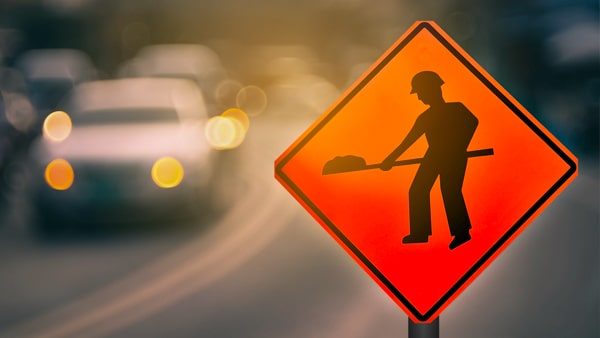
An orange diamond sign showing a person performing roadwork warns that:

This sign means that:
  1. A A volunteer group is collecting litter
  2. B Workers may be in or near the roadway ahead
  3. C Children may be playing near the road
  4. D A pedestrian crosswalk is ahead

Correct answer: B – Workers may be in or near the roadway ahead

The Workers sign alerts drivers that workers may be in or near the roadway. In Maryland work zones, watch for orange signs, temporary lane changes, equipment, and directions from flaggers. Slow down as required, remain alert, and be prepared for traffic ahead to stop.

Source: Maryland Manual on Uniform Traffic Control Devices — § 6F.33, “Workers Signs (W21-1, W21-1a)”, Maryland Driver’s Manual — § 5.H, “Work Zone Safety”