


Massachusetts CDL General Knowledge Practice Test (MA) 2

4.8 out of 5 (154 votes)
80% Passing score
20 Questions
4 Mistakes allowed
As a Bay Stater gearing up to take your Massachusetts CDL General Knowledge Practice Test in 2026, you've made a smart move by choosing our second RMV practice test. This particular assessment is designed to mirror the real CDL permit test, making it an essential step in your preparation. Packed with 20 challenging CDL test questions, our test requires a minimum score of 16 correct answers to pass. The topics are diverse and comprehensive, covering everything from pre-trip vehicle inspection to drug and alcohol awareness. Our MA CDL general knowledge practice test is uniquely structured to mirror the requirements of both Class A and Class B driver's licenses, including any endorsements you might be aiming for. It's crucial to remember that no matter the class of license you're pursuing, the Massachusetts general knowledge test is your starting point. This ensures that you have a strong foundation in all the necessary areas, regardless of your specific driving goals. One of the standout features of this MA RMV practice test is its randomized question sets. Each time you take the CDL practice test, you'll encounter a different set of permit test questions. This approach is beneficial in two ways: it prevents the simple memorization of question order and promotes a deeper understanding of the material. You won't just be recalling answers; you'll be learning the principles behind them. The variety of sample RMV test questions also plays a key role. By drawing from a large pool of potential questions and answers, we ensure that you are exposed to a wide breadth of topics. This extensive coverage is crucial for thorough preparation for the DMV CDL test in 2026. Lastly, our Massachusetts RMV general knowledge practice test follows the same multiple-choice and true/false format as the actual written permit test. This helps you get comfortable with the process of eliminating incorrect answers to zero in on the right one. It's not just about knowing the material; it's about mastering the test format. Prepare to enhance your understanding and boost your confidence for the actual DMV test with our comprehensive Massachusetts RMV CDL practice test in 2026!
FREE CDL Practice Test App
Pass your Massachusetts CDL General Knowledge test with the NextDoorDriving app. Real questions and answers—100% free and ad-free.
Download on the App Store

Sample Massachusetts CDL Test Questions - General Knowledge

Question 1

Which shipment does not require a hazardous-materials endorsement solely because of its cargo?

  1. A A shipment that requires no placards and contains no select agent or toxin listed in 42 CFR part 73
  2. B Any shipment transported entirely within one state
  3. C A placarded shipment in a vehicle weighing less than 26,001 pounds
  4. D A placarded shipment when an endorsed passenger accompanies the driver

Correct answer: A – A shipment that requires no placards and contains no select agent or toxin listed in 42 CFR part 73

Federal CDL rules require an H endorsement for designated hazardous material that must be placarded and for any quantity of a select agent or toxin listed in 42 CFR part 73. Vehicle weight and intrastate travel do not eliminate that requirement. Another person’s endorsement does not authorize an unendorsed driver to operate the vehicle.

Source: Massachusetts Commercial Driver’s License Manual, Version March 2025 — § 1, “CDL Endorsements and Restrictions—Hazardous Materials (H)”, 49 CFR § 383.5 — Definitions
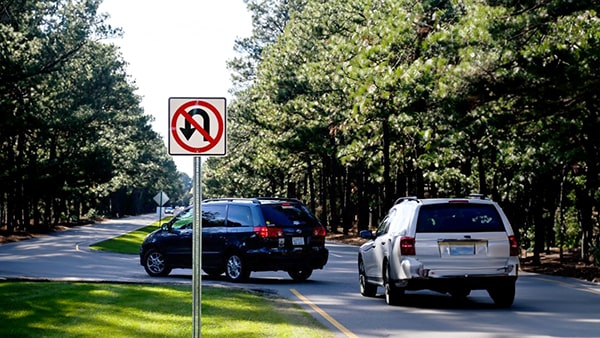
Question 2

A regulatory sign displays a U-shaped turning arrow crossed by a red circle and slash. What does the sign mean?

This sign indicates that ______________.
  1. A All turns are prohibited
  2. B U-turns are prohibited
  3. C The road is closed to through traffic
  4. D Traffic moves in one direction only

Correct answer: B – U-turns are prohibited

In Massachusetts, this regulatory sign prohibits drivers from making a U-turn at the posted location. It does not prohibit every type of turn or indicate that the road is one-way. A commercial driver must recognize and obey regulatory signs while operating on public roads.

Source: Manual on Uniform Traffic Control Devices for Streets and Highways, 11th ed. — Part 2B, “Regulatory Signs, Barricades, and Gates”

Question 3

How far ahead should a commercial driver generally scan while driving?

  1. A 2 to 5 seconds
  2. B 5 to 10 seconds
  3. C 12 to 15 seconds
  4. D 15 to 25 seconds

Correct answer: C – 12 to 15 seconds

Drivers should generally look at least 12 to 15 seconds ahead, covering the distance the vehicle will travel during that time. This is approximately one block at lower speeds and one-quarter mile at highway speeds. Continue shifting attention between nearby conditions and the roadway farther ahead.

Source: Massachusetts Commercial Driver’s License Manual, Version March 2025 — § 2.4.1, “Seeing Ahead”

Question 4

Which item is checked as part of the suspension system rather than the steering system?

  1. A Missing fasteners on the steering box
  2. B A leaking shock absorber
  3. C Power-steering hoses, pump, and fluid level
  4. D A power-steering fluid leak

Correct answer: B – A leaking shock absorber

A leaking shock absorber is a suspension-system defect, not a steering-system item. Steering checks include the steering box and its mounting hardware, power-steering hoses and pump, fluid level, and leaks. Shocks are inspected with other suspension components such as springs and air bags.

Source: Massachusetts Commercial Driver’s License Manual, Version March 2025 — § 11, “Steering System”; “Springs and Air Bags and Shocks”

Question 5

The radiator cap may be removed regardless of the engine’s temperature.

  1. A TRUE
  2. B FALSE

Correct answer: B – FALSE

Never remove the radiator or coolant cap while the engine is hot. The cooling system may be under pressure, and opening it can release hot coolant or steam and cause serious burns. Wait until the engine and cooling system have cooled before removing the cap.

Source: Massachusetts Commercial Driver’s License Manual, Version March 2025 — § 11, “Fluid Levels”

Question 6

When carrying Division 1.1, 1.2, or 1.3 explosives, which locations are subject to a 300-foot no-parking rule?

  1. A A bridge or tunnel
  2. B A dwelling or place where people work, congregate, or assemble
  3. C An open fire
  4. D All of the above

Correct answer: D – All of the above

Federal rules generally prohibit parking a vehicle containing Division 1.1, 1.2, or 1.3 explosives within 300 feet of a bridge, tunnel, dwelling, or place where people work, congregate, or assemble. A limited operational-necessity exception applies to that rule. A separate federal rule prohibits any hazardous-material vehicle from parking within 300 feet of an open fire.

Source: 49 CFR § 397.7 — Parking, 49 CFR § 397.11 — Fires