


Massachusetts RMV Practice Test 6

4.8 out of 5 (468 votes)
80% Passing score
20 Questions
4 Mistakes allowed
A good Massachusetts RMV practice test should do more than toss 20 questions at you and call it studying. This one is built around the official driver’s manual, which matters, because the real Massachusetts permit test pulls from that same source. If the manual does not cover it, it should not be sneaking into your prep like some weird extra assignment nobody asked for. This free Mass RMV practice test includes 20 questions, and you’ll need 16 correct answers to pass. The questions focus on the kind of knowledge the RMV actually expects from a new driver: safe driving rules, road awareness, and the proper use of turn signals. That last one sounds simple, almost too simple, until you remember that signaling is how other drivers figure out what you are about to do before you do it. A missed signal is not just a small technical slip. It is a tiny communication failure with a car attached to it, which is maybe an overdone way to say “learn the signals,” but still accurate. There is no timer, so you can work through the RMV practice permit test at a reasonable pace. Read the question, think it through, check what you missed, and keep going. That slower rhythm is especially useful for first-time drivers, adults returning to the licensing process, seniors refreshing their knowledge, and anyone who wants to feel less foggy before the actual permit exam. The practice test also sits inside a larger Massachusetts licensing process, and knowing that process helps. Under the Work and Family Mobility Act, eligible Massachusetts residents may apply for a Standard Class D or M driver’s license regardless of immigration status, with the usual fees still applying, including the learner’s permit exam fee, road test fee, and Class D license fee. For the Class D road test, applicants need a valid learner’s permit, a qualified sponsor, and a completed road test application. The road test fee may still be charged if you are late, unprepared, missing the right vehicle or sponsor, fail, do not show, or cancel too close to the appointment. Junior operators need to be even more careful. Massachusetts can impose tougher JOL penalties, including retraining courses, reinstatement fees, and in some cases a full retest. So, yes, this Massachusetts permit test practice helps you prepare for the exam. More importantly, it helps you build the rule knowledge you will keep needing after the permit is no longer the main event.
FREE DMV Practice Test App
Study for your Massachusetts permit test or driver’s license with the NextDoorDriving app. 700+ DMV questions and answers, 100% free!
Download on the App Store

Sample Massachusetts Permit Test Questions

Question 1

Under Massachusetts pavement-marking guidance, which centerline prohibits passing by traffic in both directions?

  1. A One solid and one broken yellow line
  2. B A single broken yellow line
  3. C Two solid yellow lines
  4. D A single broken white line

Correct answer: C – Two solid yellow lines

Two solid yellow lines separate traffic moving in opposite directions and prohibit drivers on either side from crossing them to pass. The lines may be crossed to make a left turn when that movement is permitted and safe. A broken yellow line allows passing when conditions permit.

Source: Massachusetts Driver’s Manual — Ch. 4, “Yellow Lane Lines”
Question 2

A conviction for operating under the influence may result in which consequences?

  1. A A fine
  2. B Imprisonment
  3. C Loss of driving privileges
  4. D All three consequences

Correct answer: D – All three consequences

Massachusetts treats operating under the influence as a criminal offense. For a first conviction, M.G.L. c. 90, § 24(1)(a)(1) authorizes a fine of $500 to $5,000, imprisonment for up to two and one-half years, or both. Section 24(1)(b) generally requires a one-year license revocation, subject to the statute’s alternative-disposition provisions.

Source: M.G.L. c. 90, § 24(1)(a)(1), (1)(b) – Driving while under influence of intoxicating liquor, etc.; punishment

Question 3

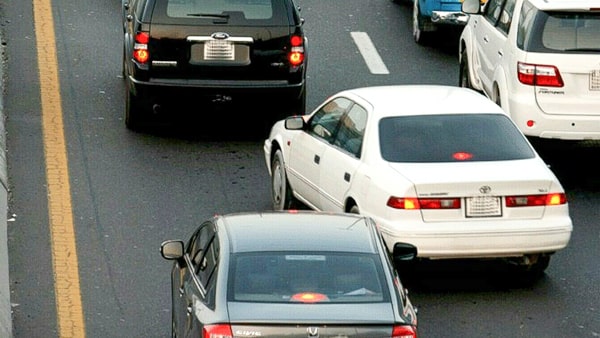
Which condition must you confirm before moving into another lane?

Before changing lanes, you must:
  1. A The lane is clear and the movement can be completed safely
  2. B Your signal has given you the right-of-way
  3. C You are traveling faster than every nearby vehicle
  4. D You have begun moving before checking your mirrors

Correct answer: A – The lane is clear and the movement can be completed safely

Massachusetts law requires a driver to remain within one lane and not move from it until the movement has been determined safe. Check your mirrors, look over the appropriate shoulder for vehicles or bicycles in the blind spot, and signal before changing lanes. Make sure there is sufficient room for your entire vehicle.

Source: M.G.L. c. 89, § 4A – Driving vehicles in a single lane; motorcycles, riding and passing, Massachusetts Driver’s Manual — Ch. 4, “Changing Lanes”

Question 4

On a Massachusetts street with two lanes traveling in each direction, a permitted U-turn should begin from:

  1. A Any center left-turn lane, whether or not one is present
  2. B The left lane nearest the centerline
  3. C The far-right lane
  4. D Any lane without traffic

Correct answer: B – The left lane nearest the centerline

A U-turn is a left-turn maneuver that reverses your direction. Begin from the lane closest to the centerline, make sure the path is clear, and confirm that you have enough room to finish the turn safely. Do not make the maneuver where a NO U-TURN sign prohibits it.

Source: Massachusetts Driver’s Manual — Ch. 4, “U-Turns”

Question 5

Before crossing a single broken lane line to change lanes or pass, what must be true?

  1. A The movement can be completed safely without interfering with traffic
  2. B You are within 100 feet of an intersection
  3. C A driver behind you has sounded a horn
  4. D The pavement marking has begun to fade

Correct answer: A – The movement can be completed safely without interfering with traffic

A broken white line separates traffic moving in the same direction, while a broken yellow line separates opposing traffic. Either type may be crossed for an appropriate maneuver when it is safe. State law also requires a driver to determine that a lane movement can be made safely before leaving the current lane.

Source: M.G.L. c. 89, § 4A – Driving vehicles in a single lane; motorcycles, riding and passing, Massachusetts Driver’s Manual — Ch. 4, “White Lane Lines”, Massachusetts Driver’s Manual — Ch. 4, “Yellow Lane Lines”
Question 6

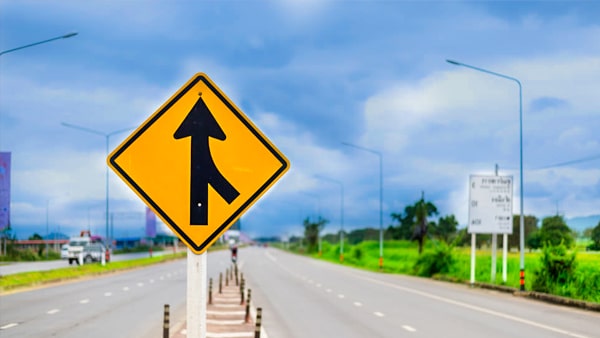
A yellow diamond sign showing another roadway joining yours from the right warns that:

This sign means:
  1. A Two-way traffic begins ahead
  2. B Your roadway becomes narrower
  3. C Traffic may merge into your lane ahead
  4. D A divided highway begins

Correct answer: C – Traffic may merge into your lane ahead

A merge warning sign alerts you that vehicles may enter your roadway from another road or ramp. Check the traffic around your vehicle and be prepared to adjust speed or lane position safely. The sign warns of the merging area; it does not direct you to stop.

Source: Massachusetts Driver’s Manual — Ch. 4, “Warning Signs”