Massachusetts RMV Practice Test 7

4.8 out of 5 (380 votes)
80% Passing score
20 Questions
4 Mistakes allowed
Massachusetts gives new drivers a fairly clear path to a learner’s permit, but clear does not always mean casual. The official Class D learner’s permit exam is 25 questions in 25 minutes, with 18 correct answers needed to pass. Seven missed questions is the limit. That sounds like breathing room, and in one sense it is, but it disappears faster than people expect when the questions move from basic signs into insurance rules, permit restrictions, and the small legal details that Massachusetts expects you to know before you get behind the wheel. This Massachusetts RMV practice test is built to make that material feel familiar before the real exam starts counting. It gives you 20 focused questions covering road rules, safe driving judgment, legal responsibilities, and state-specific licensing requirements. You are not just practicing random trivia. You are getting used to the kind of thinking the MA RMV written test rewards: reading carefully, knowing what applies to permit holders, and not brushing past details just because they sound administrative. For teen drivers, those details matter a lot. A learner’s permit is available at 16, while a Junior Operator License can come at 16½ after holding the permit for 6 consecutive months and completing the required driver education. That includes 30 classroom hours, 12 hours of on-road instruction, 6 hours of observation, and 40 hours of supervised driving, or 30 with an approved driver skills development program. Permit holders under 18 cannot drive from 12:00 a.m. to 5:00 a.m., and JOL drivers have their own 12:30 a.m. to 5:00 a.m. restriction. There is also the passenger rule during the first 6 months of a JOL: no passengers under 18 unless they are siblings, immediate family, or a qualified supervising driver is in the car. And then, because licensing is never just one neat little test, there are the extras: original identity and Massachusetts residency documents, Social Security number requirements when applicable, REAL ID paperwork if you choose that route, plus the vision standard of at least 20/40 in either eye for full license privileges. Fees are part of it too — $30 for the permit exam, $35 for the road test, and $50 for the Class D license. Use this MA DMV practice test as a steady, low-pressure way to sharpen what you know. Retake it, slow down on the wording, notice what you miss, and get comfortable before the official Massachusetts RMV permit test makes it count.
FREE DMV Practice Test App
Study for your Massachusetts permit test or driver’s license with the NextDoorDriving app. 700+ DMV questions and answers, 100% free!
Download on the App Store

Sample Massachusetts Permit Test Questions

Question 1

After passing another vehicle on the left, when is there normally enough clearance to return to the right lane?
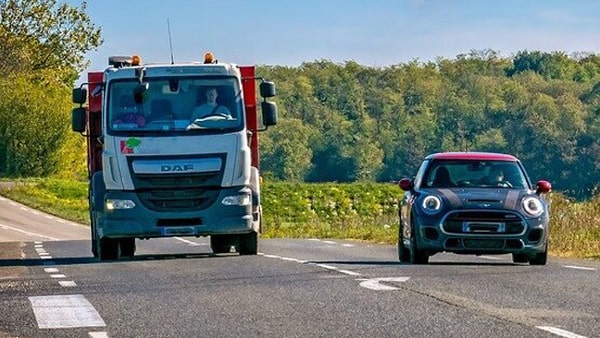
After passing a car, it is safe to return to your driving lane when:
  1. A. When you have signaled for four seconds
  2. B. When the other driver flashes their headlights
  3. C. When you can see the passed vehicle’s headlights in your inside mirror
  4. D. As soon as the vehicle appears in a side mirror

Correct answer: C. – When you can see the passed vehicle’s headlights in your inside mirror

The Massachusetts manual advises waiting at least until the passed vehicle’s headlights are visible in your mirror before returning right. Signal before moving back and make sure sufficient clearance remains. A driver being overtaken must slow down, stay right, allow the pass, and not increase speed, but the passing driver remains responsible for returning safely.

Source: Massachusetts Driver’s Manual (rev. Apr. 2026) — Ch. 3, “Passing on the Left” and “Being Passed”


Question 2

A five-sided warning sign displaying two people walking identifies what type of area?

This road sign means:
  1. A. A stop sign ahead
  2. B. A school area or school crossing
  3. C. A shopping district
  4. D. A sidewalk closed to pedestrians

Correct answer: B. – A school area or school crossing

Five-sided signs are used to identify school areas and school crossings. Reduce speed as required by posted signs and watch carefully for children, crossing guards, and school safety patrols. Children may enter the roadway unexpectedly or be difficult to see near parked vehicles.

Source: Massachusetts Driver’s Manual (rev. Apr. 2026) — Ch. 3, “Traffic Signs” and “School Zones”

Question 3

What should you anticipate when orange warning signs and traffic cones appear on an expressway?

  1. A. An unrestricted passing area
  2. B. Workers, equipment, or altered traffic patterns ahead
  3. C. A school zone with a permanent 20-mph limit
  4. D. The end of all speed restrictions

Correct answer: B. – Workers, equipment, or altered traffic patterns ahead

Orange signs and channelizing devices warn of highway construction or maintenance. In a Massachusetts work zone, lanes may shift or narrow, and workers, equipment, flaggers, or temporary traffic controls may be present. Follow posted instructions, remain alert, and adjust your speed for the conditions ahead.

Source: Massachusetts Driver’s Manual (rev. Apr. 2026) — Ch. 3, “Work Zones”

Question 4

In Massachusetts, what must you do when a school bus is stopped with its red signal lamps flashing?

When a school bus has its lights flashing and its Stop arm extended, you must:
  1. A. Stop before reaching the bus and wait until the signals are deactivated
  2. B. Pass after the last child boards the bus
  3. C. Stop when approaching from the opposite side of a divided highway
  4. D. Reduce speed and pass without stopping

Correct answer: A. – Stop before reaching the bus and wait until the signals are deactivated

Stop before reaching the bus and remain stopped until its red warning signals are deactivated, unless a police officer directs otherwise. The rule does not require a driver approaching from the opposite direction on a divided highway to stop. A first passing violation carries a fine of at least $250; a second carries $500–$1,000 and a six-month license revocation.

Source: Mass. Gen. Laws c. 90, § 14

Question 5

Dense fog prevents you from seeing the pavement or roadside signposts. What should you do?

  1. A. Turn on high beams and maintain speed
  2. B. Slow down and use road-edge markings as a guide
  3. C. Stop immediately in the travel lane
  4. D. Continue at the speed limit with hazard lights on

Correct answer: B. – Slow down and use road-edge markings as a guide

The Massachusetts manual directs drivers who cannot see pavement or signposts to slow down and look for road-edge markings. Use low beams in fog to reduce glare and be prepared to stop within the distance you can see. If you must leave the roadway, choose a safe location completely outside the travel lane.

Source: Massachusetts Driver’s Manual (rev. Apr. 2026) — Ch. 2, “Driving in Rain or Fog”

Question 6

Which statement about medicines and driving is correct?

Which of these statements is true about driving and taking drugs?
  1. A. Only illegal drugs can affect driving ability
  2. B. Prescription and over-the-counter medicines can impair driving
  3. C. A prescribed medicine is always safe before driving
  4. D. Medicine cannot affect reaction time unless alcohol is also used

Correct answer: B. – Prescription and over-the-counter medicines can impair driving

The Massachusetts manual warns that illegal drugs, prescription medicines, and over-the-counter medicines can make driving dangerous. Some medications cause drowsiness or otherwise affect the skills needed to drive. Read warning labels and do not drive after taking a medication that affects your alertness or ability to operate safely.

Source: Massachusetts Driver’s Manual (rev. Apr. 2026) — Ch. 3, “Illegal Drugs, Medicine, and Other Controlled Substances”, Massachusetts Driver’s Manual (rev. Apr. 2026) — Ch. 2, “Your Health and Physical Condition”