Massachusetts Road Signs Test

4.7 out of 5 (490 votes)
80% Passing score
10 Questions
2 Mistakes allowed
Massachusetts road signs deserve their own study time, even though the RMV does not give them their own separate Class D test. That little detail trips people up more than it should. On the real Massachusetts learner’s permit exam, sign questions are mixed into the full 25-question test, alongside motor vehicle laws, safe driving practices, rules of the road, impaired-driving penalties, bicyclist safety, and the state’s hands-free driving rules. You get 25 minutes, and you need 18 correct answers to pass. Miss too many “easy” sign questions, and suddenly the rest of the exam has to do extra work for you. This MA road signs practice test is built for that exact slice of the exam: roadway signage. Not the whole manual, not every law ever printed in RMV language, just the signs you are expected to recognize quickly and correctly. The questions focus on shape, color, symbols, and meaning, because that is how signs work on the road. A driver does not get a paragraph of explanation under a warning sign. You see yellow, red, green, orange, a symbol, maybe a few words, and you are supposed to understand what is being asked of you before traffic makes the decision for you. And yes, some signs are more obvious than others. A stop sign is not usually where things fall apart. It is the signs that look familiar enough to invite a lazy answer — lane-use signs, regulatory signs, work-zone warnings, pedestrian and bicycle-related signs, that sort of thing. This Mass street signs test gives you room to sort those out without the pressure of the official timer clicking away in the background. At the end, the review matters as much as the score. You can see which signs you handled cleanly and which ones need another look in the Massachusetts Driver’s Manual. That is the part people tend to skip, and then, well, they discover on exam day that “I’ve seen that sign before” is not the same as knowing what it means. A Massachusetts learner’s permit is valid for 2 years, but if it expires, you do not just renew it and move along. You have to apply again and retake the permit exam. So it is worth being deliberate now. Use this Massachusetts RMV road signs practice test to tighten up your sign recognition before the real test folds those questions into everything else.
FREE DMV Practice Test App
Study for your Massachusetts permit test or driver’s license with the NextDoorDriving app. 700+ DMV questions and answers, 100% free!
Download on the App Store

Sample Massachusetts Permit Test Questions

Question 1

A steady yellow left arrow appears as you approach the intersection. Which action is required?

  1. A Stop even if doing so would be unsafe
  2. B Accelerate to complete the turn before the signal changes
  3. C Stop at the line if you can do so safely
  4. D Continue turning because you retain a protected right-of-way

Correct answer: C – Stop at the line if you can do so safely

Traffic facing a steady yellow arrow must stop at the marked stop line or before the intersection unless it is too close to stop safely. The arrow does not give permission to accelerate through the turn. If you cannot safely stop, continue through the intersection with appropriate care.

Source: 700 CMR 9.06(10)(e) – Obedience to Traffic Control Signals: Steady Right and Left Yellow Arrows
Question 2

Even after your signal changes to a steady green circle, why should you scan left and right before entering?

  1. A A driver on the cross street may disobey a red signal
  2. B You must look only straight ahead after entering
  3. C Cross traffic normally receives a green arrow at the same time
  4. D All pedestrians on the cross street may enter your path

Correct answer: A – A driver on the cross street may disobey a red signal

A green signal permits you to proceed, but only with due regard for people already in the intersection. The driver’s manual specifically warns drivers to watch for motorists who disobey traffic signals or rush through intersections. Scanning both directions can reveal a hazard before you enter its path.

Source: 700 CMR 9.06(10) – Obedience to Traffic Control Signals, Massachusetts Driver’s Manual — Ch. 4, “Traffic Signals—Motor Vehicle Signals”

Question 3

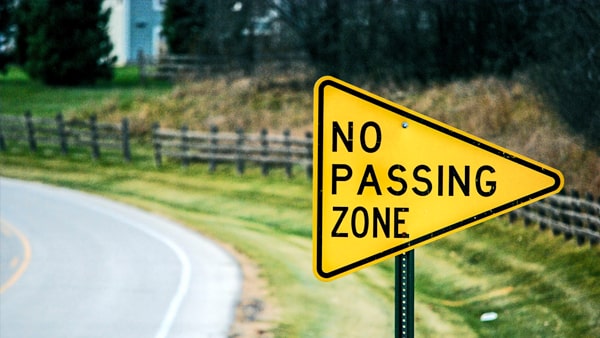
What does a yellow, pennant-shaped warning sign indicate?

The sign with this shape and color is a _____________ sign.
  1. A The beginning of a no-passing zone
  2. B Traffic is traveling the wrong way
  3. C A railroad crossing is ahead
  4. D A complete stop is required

Correct answer: A – The beginning of a no-passing zone

The yellow pennant-shaped sign warns that a no-passing zone begins ahead. Yellow signs generally warn of roadway hazards or changing conditions. A railroad warning sign is round, while a STOP sign is octagonal and a WRONG WAY sign is rectangular.

Source: Massachusetts Driver’s Manual — Ch. 4, “Traffic Signs—Warning Signs”

Question 4

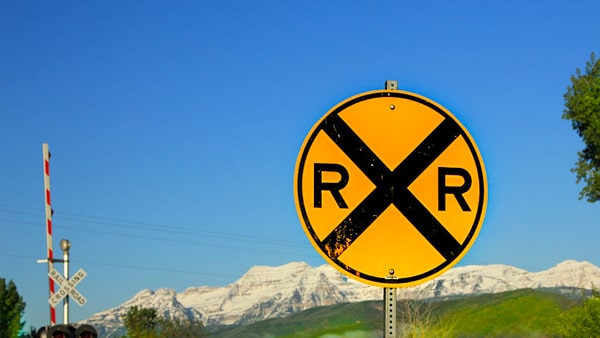
A round yellow sign displaying a black X and the letters “RR” warns of:

This sign is a warning that you are approaching:
  1. A An ordinary intersection
  2. B A pedestrian crosswalk
  3. C A railroad crossing ahead
  4. D A blasting area

Correct answer: C – A railroad crossing ahead

A round railroad warning sign is normally posted in advance of a highway-rail crossing. When you see it, reduce speed and prepare to stop. Look and listen for a train, and never attempt to race an approaching train across the tracks.

Source: Massachusetts Driver’s Manual — Ch. 4, “Traffic Signs—Railroad Crossings”

Question 5

What does a broken white line between travel lanes allow?

A broken white center line on the roadway means:
  1. A Turning is prohibited from either lane
  2. B Drivers must reduce speed immediately
  3. C Passing and lane changes are prohibited
  4. D A lane change after verifying that it can be made safely

Correct answer: D – A lane change after verifying that it can be made safely

A broken white line separates lanes of traffic traveling in the same direction and may be crossed for a lane change. Before moving from your lane, you must determine that the movement can be completed safely. A solid or double solid line carries a different restriction.

Source: Mass. Gen. Laws ch. 89, § 4A – Driving vehicles in a single lane; motorcycles, riding and passing, Massachusetts Driver’s Manual — Ch. 4, “Pavement Markings—White Lane Lines”

Question 6

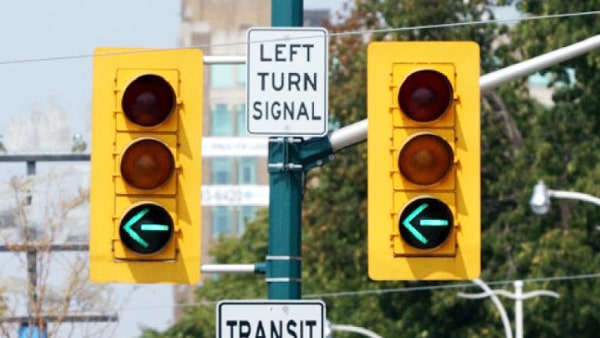
A steady green arrow points left at an intersection. What movement does it permit?

On the intersection, if you see a green arrow pointing to the left, you can:
  1. A Travel in any direction
  2. B A protected left turn after confirming the intersection is clear
  3. C Either a left turn or straight travel from the turn lane
  4. D A left turn only after yielding to moving oncoming traffic

Correct answer: B – A protected left turn after confirming the intersection is clear

A steady green left arrow permits traffic to turn left and ordinarily provides a protected turn. The Massachusetts manual explains that oncoming traffic and pedestrians should be stopped by red signals during this phase. Drivers must still watch for anyone remaining in the intersection and complete the movement with due care.

Source: 700 CMR 9.06(10)(b) – Obedience to Traffic Control Signals: Steady Right, Left, and Vertical Green Arrows, Massachusetts Driver’s Manual — Ch. 4, “Traffic Signals—Motor Vehicle Signals”