Massachusetts Road Signs Test 2

4.8 out of 5 (242 votes)
80% Passing score
20 Questions
4 Mistakes allowed
Road signs are one of those parts of the Massachusetts permit exam that people tend to rush through because they look familiar. That confidence is partly earned since everyone knows a Stop sign (hopefully) but the RMV does not stop at the obvious ones. The Class D learner’s permit exam includes roadway signage alongside Massachusetts traffic laws, rules of the road, safe driving practices, impaired-driving penalties, bicyclist safety, and hands-free driving rules, so the sign questions have to be treated like real test material, not filler. The official Massachusetts learner’s permit exam has 25 questions, a 25-minute time limit, and a passing score of 18 correct answers. This Massachusetts RMV practice permit test gives you 20 multiple-choice road sign questions to help tighten up that piece of the exam before you sit for the real thing. It covers the signs drivers actually need to recognize: regulatory signs, warning signs, work-zone signs, lane-use signs, school-zone signs, pedestrian crossings, slippery-road warnings, and the color-and-shape clues that tell you what kind of instruction or hazard is coming. The useful thing about a focused MA road signs practice test is that it catches the gaps that plain confidence misses. A sign may look familiar, sure, but knowing whether it is warning you, ordering you, restricting you, or guiding you is what matters on the permit test and on the road. That is especially true in Massachusetts, where you may move from city traffic to older neighborhood streets to highways and coastal roads in the same week, with signs doing a lot of quiet work along the way. This practice test also fits into the larger Massachusetts licensing process. Applicants start the permit process online, then go to an RMV Service Center or participating AAA location for identity documents, photo capture, and the required vision screening. After that, the permit exam may be taken online with RMV credentials or in person at an RMV location. Drivers under 18 take the same Class D permit exam, but Junior Operator License requirements come next, including driver education, supervised driving, passenger limits, and nighttime restrictions. When you finish the Mass road signs test, you will see which signs you knew cleanly and which ones deserve another pass. A score of 16 out of 20 is a strong practice benchmark, though the real RMV permit test still requires 18 correct out of 25 overall.
FREE DMV Practice Test App
Study for your Massachusetts permit test or driver’s license with the NextDoorDriving app. 700+ DMV questions and answers, 100% free!
Download on the App Store

Sample Massachusetts Permit Test Questions

Question 1

An orange diamond sign showing a person holding a flag warns of:
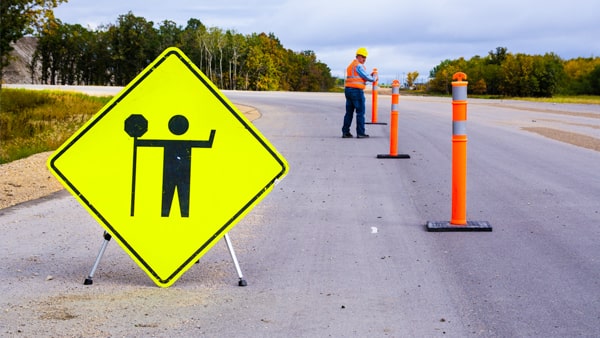
This sign means:
  1. A. A pedestrian crossing
  2. B. The end of a work zone
  3. C. A school crossing
  4. D. A flagger ahead

Correct answer: D. – A flagger ahead

The symbol warns that a flagger may be directing traffic ahead. The Massachusetts manual instructs drivers approaching work zones to reduce speed and obey the directions of police officers and civil flaggers. Watch carefully for instructions controlling when traffic must stop or proceed.

Source: Massachusetts Driver’s Manual — Ch. 4, “Roadway Construction/Maintenance (Work Zones)”
Question 2

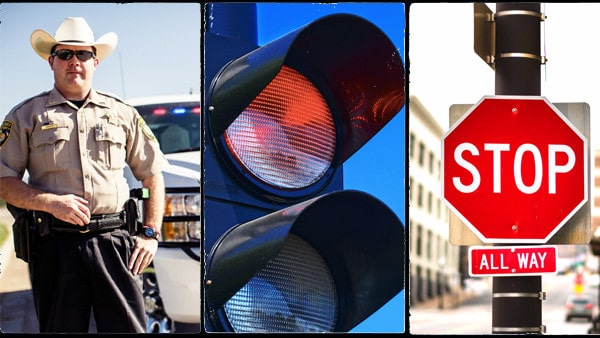
In Massachusetts, which instruction takes priority over the other choices?

Which of the following must you obey over the other three?
  1. A. A steady red signal
  2. B. A police officer’s direction
  3. C. A STOP sign
  4. D. A flashing red signal

Correct answer: B. – A police officer’s direction

Drivers must follow a traffic officer’s directions even when those directions temporarily overrule a sign, signal, or pavement marking. For example, an officer may require traffic to stop at a green light or proceed despite a red light. Pay attention to the officer’s signals and follow them carefully.

Source: Massachusetts Driver’s Manual — Ch. 4, “Roadway Construction/Maintenance (Work Zones)”

Question 3

What may you do when facing a steady green signal?

  1. A. Slow down and prepare to stop automatically
  2. B. Stop before entering every intersection
  3. C. Proceed after yielding, if there is room to clear the intersection
  4. D. Proceed without checking for pedestrians or bicycles

Correct answer: C. – Proceed after yielding, if there is room to clear the intersection

A steady green signal permits you to proceed, but you must first yield to vehicles, bicycles, and pedestrians already in your path. Enter only when enough space is available to clear the intersection. A green light does not permit a driver to block the intersection.

Source: M.G.L. c. 89, § 9 – Designation of highways as through ways; traffic control signs and devices, Massachusetts Driver’s Manual — Ch. 4, “Motor Vehicle Signals”

Question 4

A yellow diamond sign displaying a black cross warns of:

This sign means:
  1. A. A church nearby
  2. B. A first-aid station
  3. C. A crossroad ahead
  4. D. A railroad crossing

Correct answer: C. – A crossroad ahead

This is a crossroad warning sign. It alerts you that another roadway crosses your route ahead and that cross traffic may be present. Watch the roadway and adjust your speed for the approaching intersection and its traffic controls.

Source: Massachusetts Driver’s Manual — Ch. 4, “Warning Signs”

Question 5

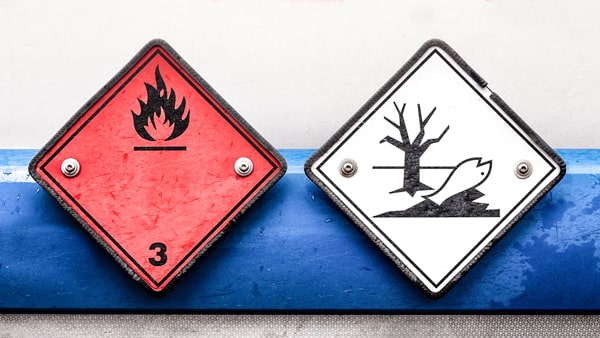
Under Massachusetts law, which statement applies to a vehicle carrying explosives or flammable liquids as cargo?

Which of the following is true about vehicles displaying a diamond-shaped sign (indicating a hazardous load)?
  1. A. It may not use an expressway
  2. B. It may never travel faster than 35 mph
  3. C. It must stop before an at-grade railroad crossing
  4. D. It has priority over other traffic

Correct answer: C. – It must stop before an at-grade railroad crossing

A vehicle carrying explosive substances or flammable liquids as cargo must stop between 15 and 50 feet from the nearest rail at an at-grade crossing. It may proceed only when crossing is safe. A violation is punishable by a fine of at least $500 or 100 hours of community service, which may include Operation Lifesaver service.

Source: M.G.L. c. 90, § 15 – Precautions at railroad crossings

Question 6

What do yellow pavement lines normally separate?

  1. A. Traffic traveling in opposite directions
  2. B. Lanes traveling in the same direction
  3. C. Parking spaces from a sidewalk
  4. D. A bicycle lane from the adjacent lane

Correct answer: A. – Traffic traveling in opposite directions

Yellow lines separate lanes carrying traffic in opposite directions. A broken yellow line may be crossed for a safe pass, while solid-line arrangements restrict passing. Drivers should identify both the color and pattern before crossing any centerline.

Source: Massachusetts Driver’s Manual — Ch. 4, “Yellow Lane Lines”