


Massachusetts DMV Sign Test 3

4.9 out of 5 (243 votes)
80% Passing score
20 Questions
4 Mistakes allowed
Massachusetts road signs do a lot of work before you ever get close enough to read the smaller print. The shape, the color, the placement, even the way a sign interrupts your attention on a busy stretch of road — all of it matters. That is why this Massachusetts road signs practice test puts sign recognition where it belongs: near the center of your permit prep, not tossed in at the end after you have memorized a few speed limits and called it studying. This MA RMV signs practice test includes 20 questions focused on the visual language drivers are expected to understand quickly. A stop sign is not just red; it is an octagon for a reason. A yield sign does not politely suggest that you maybe slow down if the mood strikes. Rectangular signs often regulate or guide, warning signs give you a heads-up before the road changes its mind, and, yes, the RMV expects you to know the difference without taking a long dramatic pause in traffic. The real Massachusetts Class D learner’s permit exam has 25 questions and gives you 25 minutes to answer them. You need 18 correct answers to pass, which leaves room for 7 missed questions — not a huge cushion, but not impossible either. Applicants must be at least 16 to get a learner’s permit, and drivers under 18 have the longer route: holding the permit for 6 consecutive months, completing 30 hours of classroom driver education, 12 hours of on-road instruction, 6 hours of observation, and either 40 hours of supervised driving or 30 hours with an approved driver skills development program. There are also nighttime restrictions, passenger rules for Junior Operators, and the usual paperwork waiting in the background, because apparently no licensing process is complete without a document checklist. This Massachusetts permit test practice uses material tied to the official driver’s manual, so the questions stay close to what the state actually tests. It is not a cheat sheet, and it is not trying to be clever for the sake of being clever. It gives you a steady, realistic way to work through road sign shapes, meanings, and traffic cues before you sit for the RMV permit test, pay the $30 exam fee, and start dealing with the next steps toward a license. Learn the signs now, while nothing is moving around you. That part helps more than people admit.
FREE DMV Practice Test App
Study for your Massachusetts permit test or driver’s license with the NextDoorDriving app. 700+ DMV questions and answers, 100% free!
Download on the App Store

Sample Massachusetts Permit Test Questions

Question 1

A diamond-shaped traffic sign generally provides what type of information?

  1. A. A warning about a hazard or changing condition
  2. B. An interstate route number
  3. C. A posted speed limit
  4. D. A parking regulation

Correct answer: A. – A warning about a hazard or changing condition

Diamond-shaped signs are generally warning signs. They alert drivers to hazards or changes ahead, such as curves, intersections, merging traffic, or narrowing lanes. Most general warning signs are yellow, while similar work-zone warnings use orange.

Source: Massachusetts Driver’s Manual — Ch. 4, “Warning Signs”
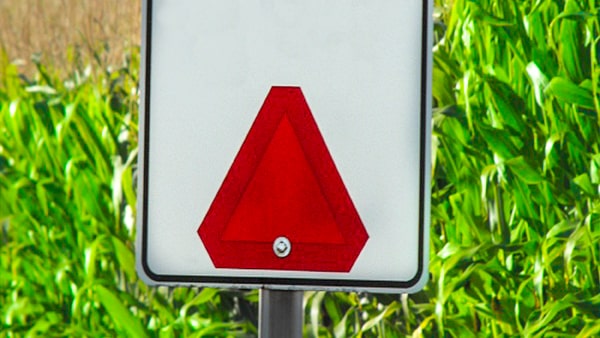
Question 2

In Massachusetts, an orange triangle with a red border on the rear of a vehicle identifies:

An orange and red sign of this shape always means:
  1. A. A vehicle carrying hazardous cargo
  2. B. A vehicle with automatic right-of-way
  3. C. A slow-moving vehicle
  4. D. An emergency response vehicle

Correct answer: C. – A slow-moving vehicle

The emblem identifies a slow-moving vehicle. State law requires it on the rear of horse-drawn vehicles, vehicles designed to operate at 25 mph or less, farm tractors, implements of husbandry, specified machinery, and low-speed vehicles traveling on public ways. The emblem supplements any other required lights or flags.

Source: M.G.L. c. 90, § 7 – Brakes, braking systems, mufflers, horns, lights, audible warning systems, and other equipment; compliance with safety standards; stickers and emblems, Massachusetts Commercial Driver’s License Manual — § 2.8, “Seeing Hazards”

Question 3

A yellow warning sign showing the right lane tapering into the left means:

This sign means:
  1. A. The right lane ends and the road narrows
  2. B. A divided highway begins
  3. C. A steep hill is ahead
  4. D. Trucks enter from the right

Correct answer: A. – The right lane ends and the road narrows

The sign warns that the right lane ends and the roadway narrows. It provides advance notice of a lane reduction. Check surrounding traffic and adjust your speed early enough to handle the changing roadway safely.

Source: Massachusetts Driver’s Manual — Ch. 4, “Warning Signs”

Question 4

Solid yellow centerlines are used between:

  1. A. A center turn lane and same-direction traffic
  2. B. A bicycle lane and a travel lane
  3. C. Two lanes on a one-way street
  4. D. Traffic moving in opposite directions

Correct answer: D. – Traffic moving in opposite directions

Yellow centerlines divide traffic moving in opposite directions. A solid yellow pattern restricts crossing for passing. Two solid yellow lines may still be crossed to make a left turn when that movement can be completed safely.

Source: Massachusetts Driver’s Manual — Ch. 4, “Yellow Lane Lines”

Question 5

A yellow-and-black chevron or sharp-turn arrow warns that:

When you see this black and yellow sign, it means:
  1. A. The road on the right carries one-way traffic
  2. B. A construction detour begins to the right
  3. C. The roadway changes direction sharply
  4. D. A crossroad enters from the right

Correct answer: C. – The roadway changes direction sharply

This warning identifies a sharp change in the roadway’s direction. Reduce speed before reaching the bend and follow the direction indicated by the arrow or chevrons. Warning signs provide advance notice so drivers can adjust to the roadway condition ahead.

Source: Massachusetts Driver’s Manual — Ch. 4, “Warning Signs”

Question 6

In Massachusetts, which conditions must be met before turning right at a steady red signal?

  1. A. Stop completely, obey any prohibition sign, and yield to pedestrians and traffic
  2. B. Wait until a red arrow appears
  3. C. Begin the turn from the left lane
  4. D. Slow down without stopping if the crosswalk is empty

Correct answer: A. – Stop completely, obey any prohibition sign, and yield to pedestrians and traffic

After stopping at a steady red signal, a driver may turn right unless a posted sign prohibits the turn. The driver must yield to pedestrians and other traffic proceeding as directed by the signal. A violation of the statutory red-turn rule carries a fine of not less than $35.

Source: M.G.L. c. 89, § 8 – Right-of-way at intersecting ways; turning on red signals, Massachusetts Driver’s Manual — Ch. 4, “Motor Vehicle Signals”