Michigan DMV Practice Test 3

4.9 out of 5 (394 votes)
80% Passing score
20 Questions
4 Mistakes allowed
This Michigan DMV practice test is meant to do one thing well: give you a realistic way to practice before the real permit test starts counting your answers. It includes 20 questions covering Michigan road rules, safe driving habits, signs, right-of-way situations, and the kind of licensing details that have a way of showing up when you were hoping for something simpler. You can take it again and again, with no time limit, which is the whole point. Rushing through once is not studying. Missing a question, seeing why, and then catching it the next time—that is where the useful work happens. The questions are designed to feel closer to the actual Michigan permit test than a quick skim of a cheat sheet ever will. And honestly, that matters. A good Michigan DMV permit practice test should not just help you memorize answers; it should make the wording, the rule logic, and the Michigan-specific details feel familiar enough that you are not decoding everything from scratch on test day. Some questions may deal with everyday driving decisions, like yielding or safe following distance. Others may pull from the licensing process itself, where the details get a little crowded but still matter. For teen drivers, Michigan’s system starts with Segment 1 driver education, which can begin at 14 years and 8 months. A Level 1 Learner’s License can be issued at 14 years and 9 months after Segment 1 is completed, along with a vision and health screening and an application at a Secretary of State office with a parent or guardian. From there, the state’s Graduated Driver Licensing program keeps building in stages, not all at once, and yes, there are several numbers to keep straight. Before Segment 2, a teen must hold a Level 1 License for at least 3 consecutive months and complete at least 30 supervised driving hours, including 2 at night. Before moving toward Level 2, the requirements grow: Segment 2 must be completed, the Level 1 License must be held for 6 consecutive months, and the teen must log 50 supervised driving hours, including 10 at night. Level 2 then brings restrictions on late-night driving, passengers under 21, and cell phone use. Kelsey’s Law also bans Level 1 drivers from using a phone while driving except in an emergency. So, yes, this Michigan driving test practice helps with the permit test. But it also helps you sort out the licensing path around it, which is half the battle.
FREE DMV Practice Test App
Study for your Michigan permit test or driver’s license with the NextDoorDriving app. 700+ DMV questions and answers, 100% free!
Download on the App Store

Sample Michigan Permit Test Questions

Question 1

A reverse-curve warning sign showing the first curve to the right indicates:
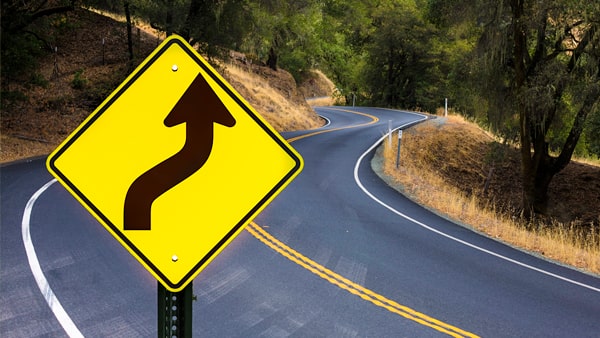
This sign means:
  1. A One sharp right turn
  2. B A right curve followed by a left curve
  3. C A left curve followed by a right curve
  4. D The paved roadway ends

Correct answer: B – A right curve followed by a left curve

This sign warns that the roadway first curves to the right and then reverses to the left. It prepares drivers for two changes in direction rather than one turn. Reduce speed as necessary to maintain control through both curves.

Source: What Every Driver Must Know — Ch. 5, “Traffic sign challenge answers”
Question 2

On a two-way roadway, where should you position your vehicle when approaching a left turn at an intersection?

  1. A In the lane nearest the right edge
  2. B Directly over the roadway centerline
  3. C In the portion of your side nearest the centerline
  4. D In whichever lane has the least traffic

Correct answer: C – In the portion of your side nearest the centerline

Under Michigan law, the approach for a left turn must be made from the portion of the right half of the roadway nearest the centerline. Signs, signals, or pavement markings may direct a different turning path at a particular intersection. Use the correct lane, signal, and remain within the permitted turning path.

Source: MCL § 257.647(1)(b), (e) — Turning at intersection; violation as civil infraction, What Every Driver Must Know — Ch. 4, “Left turns”

Question 3

At a pedestrian crossing, what must you do for a person using a white cane or guide dog?

  1. A Yield only when the person is at a street corner
  2. B Take necessary precautions and stop or yield the right-of-way
  3. C Yield only at an intersection controlled by signals
  4. D Wait for another pedestrian to assist the person

Correct answer: B – Take necessary precautions and stop or yield the right-of-way

Michigan’s driver manual requires drivers to stop or yield for a pedestrian using a white cane or guide dog. Approach carefully and take the precautions needed to prevent a collision or injury. Avoid unnecessary horn or engine noise because it can interfere with audible information used by a person with a visual impairment.

Source: What Every Driver Must Know — Ch. 6, “Sharing the Road”

Question 4

If you must slow or stop where following drivers may not expect it, which action provides the normal visible warning?

  1. A Applying the parking brake
  2. B Checking the blind spot over your shoulder
  3. C Applying the service brake so the rear stop lamps illuminate
  4. D Preparing to sound the horn

Correct answer: C – Applying the service brake so the rear stop lamps illuminate

Michigan law requires a driver to signal before stopping or turning from a direct line when other traffic may be affected. Applying the service brake activates the vehicle’s rear stop lamps, providing a visible warning to following drivers. Brake smoothly and maintain control of the vehicle.

Source: MCL § 257.648(1) — Operation of vehicle or bicycle; signals for stopping or turning; signal lamp or mechanical signal device on commercial motor vehicle; violation as civil infraction, MCL § 257.697b — Rear stop lamps

Question 5

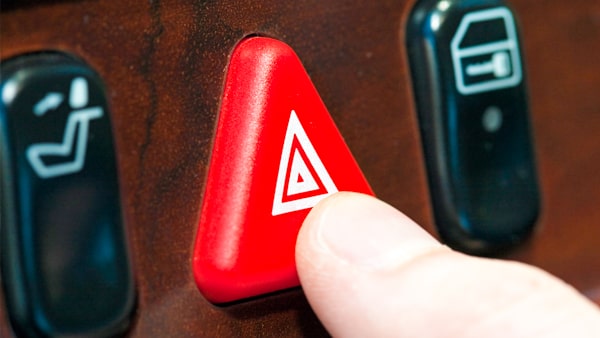
When should you activate your vehicle’s four-way emergency flashers?

You should always use your emergency flashers when:
  1. A While stopping in a traffic lane to pick up a passenger
  2. B While driving normally in light rain
  3. C When a breakdown leaves your vehicle stopped where traffic may approach
  4. D Whenever you become tired while driving at night

Correct answer: C – When a breakdown leaves your vehicle stopped where traffic may approach

If a breakdown forces you to stop, move the vehicle away from traffic if that can be done safely. Activate the four-way emergency flashers to warn approaching drivers that the vehicle is disabled or stopped. Flashers do not substitute for moving to a safer location when one is available.

Source: What Every Driver Must Know — Ch. 7, “Emergency situations”

Question 6

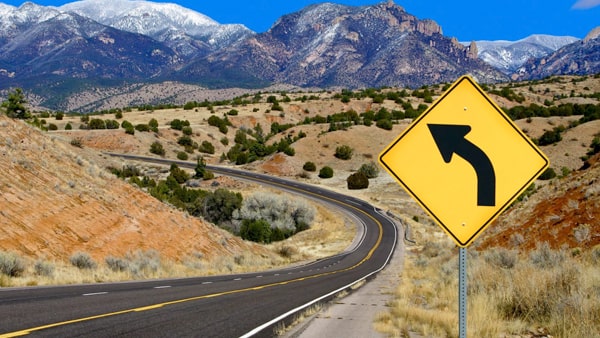
A yellow diamond sign showing a black arrow bending sharply left warns of:

This sign is used to warn drivers about:
  1. A An intersection ahead
  2. B A work zone
  3. C A sharp left turn or curve
  4. D A lane ending

Correct answer: C – A sharp left turn or curve

This warning sign indicates that the roadway turns or curves sharply to the left. Reduce speed as needed before reaching the change in direction and remain within your lane. An advisory speed plaque may be posted beneath the sign to identify a recommended speed for the curve.

Source: What Every Driver Must Know — Ch. 5, “Warning signs”