


Michigan DMV Practice Test 4

4.9 out of 5 (317 votes)
80% Passing score
20 Questions
4 Mistakes allowed
This Michigan driving test practice is for the stage where you are still learning the rules, still sorting out the signs, and still figuring out which details the state actually expects you to remember. It gives you 20 multiple-choice questions on general driving knowledge, with a focused look at child safety seats — installation, proper use, and the small details that matter when a young passenger is in the vehicle. That may sound like a narrow topic, but Michigan’s permit test does not only care whether you can recognize a stop sign. It cares whether you understand safe vehicle operation in the ordinary, practical sense. For adults 18 and older, the real Michigan driver knowledge test is a 50-question exam. Half of it covers operator rules and safe driving, and the other half covers road signs. You need 80% to pass, which works out to 20 correct answers out of 25 in each section, or 40 correct overall. The online version is the same as the test offered at Secretary of State offices, with the operator section taking about 45 minutes and the signs portion taking about 15. So, yes, this shorter Michigan DMV permit practice test is not the full thing. It is a cleaner, more focused way to get your footing before you deal with the full exam. There is no timer here, which is good, because rushing through permit practice questions is one of those choices that feels efficient for about twelve seconds. Take the extra moment. Read the wording. Notice where you guessed. A score of at least 16 out of 20 is a solid sign that you are moving in the right direction, especially if you are using missed questions to tighten up the weak spots instead of just clicking through again and hoping muscle memory does the work. Once an adult applicant passes the written knowledge test, the licensing process still has a few more pieces attached to it. Michigan requires a vision exam, proper documents, a license photo, and then a Temporary Instruction Permit. The TIP lets you practice on public roads with a validly licensed adult, but it is not a driver’s license. It is valid for 180 days, and you must practice for at least 30 days before taking the on-road driving skills test with an authorized testing business. Teens follow a different path through Segment 1 driver education before applying for a Level 1 Learner’s License. Use this Michigan DMV practice test as a serious warm-up, not as a throwaway quiz. The goal is not just passing a screen of questions. It is getting comfortable with the rules before those rules start showing up in real traffic, where the hints are not quite so neatly labeled.
FREE DMV Practice Test App
Study for your Michigan permit test or driver’s license with the NextDoorDriving app. 700+ DMV questions and answers, 100% free!
Download on the App Store

Sample Michigan Permit Test Questions

Question 1

When using a freeway acceleration lane under normal conditions, how should you adjust your speed?
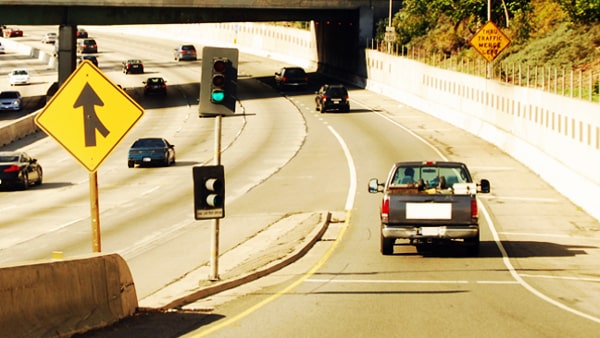
When entering a freeway entrance that allows you to accelerate to merge, you should drive at:
  1. A Remain about 10 mph slower than freeway traffic.
  2. B Approach the speed of freeway traffic while remaining safe and legal.
  3. C Stop at the end of the lane before looking for an opening.
  4. D Drive faster than freeway traffic to force an opening.

Correct answer: B – Approach the speed of freeway traffic while remaining safe and legal.

The acceleration lane allows you to increase speed toward that of traffic already on the freeway. Signal, check mirrors and blind spots, choose a safe opening, and yield to through traffic. Michigan law makes the merging driver responsible for adjusting speed to merge safely without exceeding a lawful and prudent speed.

Source: MCL § 257.649(9) – Right of way; rules; violation as civil infraction, What Every Driver Must Know — Ch. 7, “A word about merging”

Question 2

Which statement about Michigan work zones is false?

  1. A Orange warning signs are commonly used for road work.
  2. B The fine for a moving violation in a work zone is doubled.
  3. C White is the standard background color for road-work warning signs.
  4. D Drivers should reduce speed as required and follow posted directions.

Correct answer: C – White is the standard background color for road-work warning signs.

Road-work warning signs are generally orange with black symbols or lettering; white signs usually communicate regulatory requirements. Michigan doubles the otherwise prescribed fine for a moving violation committed in a work zone. Drivers should watch for changing lanes, speeds, workers, equipment, and temporary traffic controls.

Source: MCL § 257.601b(1) – Moving violation in work zone, emergency scene, school zone, or school bus zone; penalties; exceptions; definitions, What Every Driver Must Know — Ch. 4, “Construction zones”, What Every Driver Must Know — Ch. 5, “Traffic sign challenge answers”

Question 3

A stop sign controls an intersection with no crosswalk but with a marked stop line. Where must you stop?

  1. A Where you can see cross traffic, even if that is past the line
  2. B After your front wheels cross the stop line
  3. C At the marked stop line
  4. D Beside the stop sign

Correct answer: C – At the marked stop line

At a Michigan stop sign, stop before entering a marked crosswalk when one is present. If there is no crosswalk, stop at the clearly marked stop line. If neither exists, stop at the nearest point where you can see approaching traffic before entering the intersecting roadway.

Source: MCL § 257.649(8) – Right of way; rules; violation as civil infraction

Question 4

A stop sign controls an intersection that has a marked crosswalk but no stop line. Where must you stop?

  1. A Before entering the crosswalk
  2. B About 50 feet before the intersection
  3. C Where a stop line would normally be painted
  4. D With the front wheels inside the crosswalk

Correct answer: A – Before entering the crosswalk

When a stop sign controls an intersection and a crosswalk is present, the required stop is before entering that crosswalk. After stopping, yield to vehicles that are already in the intersection or approaching closely enough to create an immediate hazard. Enter only when it is safe.

Source: MCL § 257.649(8) – Right of way; rules; violation as civil infraction

Question 5

A teen driver’s crash risk is especially increased when driving with:

  1. A An experienced adult passenger
  2. B No passengers
  3. C Teenage passengers
  4. D A licensed adult supervisor

Correct answer: C – Teenage passengers

Teenage passengers can distract a young driver and may encourage risky decisions. Official Michigan guidance states that a teen driving with other teens is more likely to crash, with the risk increasing as more teen passengers are added. Limiting passengers gives an inexperienced driver more opportunity to concentrate on driving.

Source: Michigan Parent’s Supervised Driving Guide — “Teens’ biggest dangers – part one,” “Teen passengers”

Question 6

Which statement correctly describes Michigan’s safety-belt requirement?

  1. A Belts are required only when traveling above 25 mph.
  2. B In a covered vehicle, the driver and front-seat passengers must be properly restrained, subject to statutory exceptions.
  3. C Belts are required only on freeways.
  4. D A driver may remove the belt whenever traffic is moving slowly.

Correct answer: B – In a covered vehicle, the driver and front-seat passengers must be properly restrained, subject to statutory exceptions.

Michigan requires each operator and front-seat passenger of a covered motor vehicle to use a properly adjusted and fastened safety belt, with children below the specified age protected under the child-restraint law. The requirement applies on streets and highways regardless of speed. Statutory exceptions include certain vehicles and a documented medical inability to wear a belt.

Source: MCL § 257.710e(1), (3) – Safety belt required