Michigan Permit Practice Test 6

4.9 out of 5 (207 votes)
80% Passing score
20 Questions
4 Mistakes allowed
Michigan drivers learn pretty quickly that signaling is not a minor or optional thing. It is how you tell the person behind you, the driver waiting at the cross street, and the pedestrian already halfway committed to crossing what you are about to do next. In Michigan, where a clear lane can turn into slush, glare, construction barrels, or heavy Metro Detroit traffic without much warning, that small signal carries more weight than people usually give it. This Michigan driving test practice focuses on the correct use of turn signals, but it is not some random one-topic quiz sitting off to the side. It fits into the larger licensing process, where the state is looking for something more useful than memorized lines from the manual. You need to understand what the rule means in traffic. The practice test includes 20 questions written around the kinds of rules, wording, and judgment calls you can expect from the real Michigan permit test. Since the actual permit test questions are not released publicly, the point is not to chase a secret answer key. It is to get comfortable with the way Michigan asks about driving decisions — when to signal, how early to signal, what your signal tells other road users, and why assuming everyone “gets the idea” is not exactly strong road management. You need 16 correct answers to pass this Michigan permit practice test. There is no time limit here, which is helpful. You can slow down, reread the question, notice the detail you almost skipped, and use the explanation to fix the misunderstanding before it follows you into the official test. From there, the licensing process depends partly on your age. Adults usually move toward a Temporary Instruction Permit, or TIP. At a Secretary of State office, that means document review, a photo, the knowledge test, TIP issuance, and the $25 fee. Adults 18 and older may also use Michigan’s official online KnowTo Drive option, though passing online still means visiting a Secretary of State office afterward to receive the TIP. So, yes, the online test can save a step, but it does not erase the office visit. And since turn signals only help when other people can actually see them, Michigan also checks vision as part of the process. For an unrestricted license, the standard is 20/40 visual acuity with a 140-degree peripheral field of vision. Corrective lenses are allowed, and some applicants may qualify with restrictions if an eye specialist provides the required statement. Teen drivers follow a more layered route. A Level 1 Learner’s License comes after Segment 1 driver education, with a parent or guardian involved, required documents ready, and the licensing fee paid. Later, before the road skills test, teens need Segment 2, proof of insurance and registration, and a signed logbook showing at least 50 supervised hours, including 10 at night.  This practice test is not the whole licensing process, clearly. But it is one of the first steps for making the rules into habits.

FREE DMV Practice Test App
Study for your Michigan permit test or driver’s license with the NextDoorDriving app. 700+ DMV questions and answers, 100% free!
Download on the App Store

Sample Michigan Permit Test Questions

Question 1

When two vehicles meet on a narrow two-way road, what does Michigan law require?

  1. A The vehicle traveling uphill must back up
  2. B Both drivers must pass to the right and provide the other about half the traveled roadway
  3. C The larger vehicle may remain in the center
  4. D The vehicle traveling downhill always has priority

Correct answer: B – Both drivers must pass to the right and provide the other about half the traveled roadway

Drivers approaching from opposite directions must pass each other on the right. As nearly as possible, each must give the other at least one-half of the main-traveled portion of the roadway. A violation of this requirement is a civil infraction.

Source: MCL 257.635(1), (2) – Passing vehicle proceeding in opposite direction; violation as civil infraction

Question 2

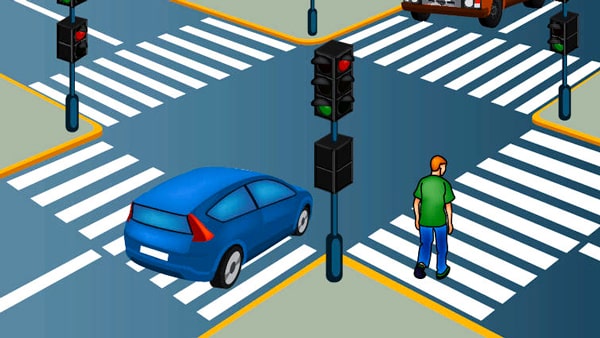
You begin a right turn on green as a pedestrian beside you starts crossing on a lawful signal. What must you do?

You are waiting at a red light to turn right, and a pedestrian on your right is waiting to cross the street you want to enter. Who has the right-of-way when your light turns green?
  1. A Yield and allow the pedestrian to cross
  2. B Proceed first if the crosswalk has no painted lines
  3. C Continue because the green light gives vehicles priority
  4. D Sound the horn and complete the turn

Correct answer: A – Yield and allow the pedestrian to cross

Michigan permits a pedestrian facing a green indication to cross within a marked or unmarked crosswalk. A turning driver facing green must yield to pedestrians lawfully within the intersection or an adjacent crosswalk. Wait until the pedestrian is safely clear of your turning path before proceeding.

Source: MCL 257.612(1)(a), (3) – Traffic control signals; colors; stopping; violations, MCL 257.613(1)(a), (3) – Applicability of regular traffic control signals to pedestrians; special pedestrian control signals; violation as civil infraction

Question 3

Double solid yellow centerlines prohibit a driver from:

  1. A Waiting for oncoming traffic before a left turn
  2. B Entering a driveway when the movement is otherwise permitted
  3. C Using the opposing lane to pass another vehicle
  4. D Turning right at the next intersection

Correct answer: C – Using the opposing lane to pass another vehicle

Double solid yellow lines separate opposing traffic and indicate that passing is prohibited in both directions. Do not enter the opposing lane to overtake another vehicle. Continue following until the pavement markings and roadway conditions permit a lawful pass.

Source: What Every Driver Must Know — Ch. 5, “Pavement markings”

Question 4

On a two-lane road, a curve blocks your view of possible oncoming traffic. What must you do?

  1. A Remain behind the vehicle ahead
  2. B Signal for at least five seconds before passing
  3. C Accelerate and complete the pass quickly
  4. D Sound the horn before entering the opposing lane

Correct answer: A – Remain behind the vehicle ahead

Michigan prohibits driving left of center on a curve when the obstructed view could create a hazard from approaching traffic. A pass also requires the opposing lane to be clearly visible and free for enough distance to complete the maneuver safely. Violating either requirement is a civil infraction.

Source: MCL 257.638(1), (2) – Overtaking and passing on left of another vehicle; violation as civil infraction, MCL 257.639(1)(a), (3) – Driving to left side of roadway; limitations; violation as civil infraction

Question 5

Which lights should you use while driving in fog or heavy rain?

  1. A Parking lights only
  2. B High-beam headlights
  3. C Low-beam headlights

Correct answer: C – Low-beam headlights

Use low-beam headlights when driving in fog, rain, or snow. High beams can reflect from fog or precipitation and increase glare. Reduce speed, allow additional following distance, and be prepared to stop within the area you can see clearly.

Source: What Every Driver Must Know — Ch. 7, “Rain and fog”

Question 6

A vehicle ahead has stopped at a crosswalk for a pedestrian. What should you do?

  1. A Stop behind it and wait until the pedestrian is clear
  2. B Change lanes and pass on the left
  3. C Pass slowly on the right
  4. D Sound the horn and continue

Correct answer: A – Stop behind it and wait until the pedestrian is clear

Do not pass a vehicle that has stopped at a crosswalk or intersection to allow a pedestrian to cross. The vehicle may conceal the pedestrian from your view. Stop behind it and proceed only after the pedestrian has cleared the roadway and movement can be made safely.

Source: What Every Driver Must Know — Ch. 4, “When passing is prohibited”