


Michigan Permit Practice Test 9

4.8 out of 5 (181 votes)
80% Passing score
20 Questions
4 Mistakes allowed
School bus questions deserve more attention than most people give them, mostly because Michigan does not treat them like a tiny footnote in the rules. This ninth Michigan DMV practice test focuses entirely on school bus safety, which means you are working through the situations where drivers need to stop, stay stopped, read the roadway correctly, and not talk themselves into a wrong answer because the bus is “probably far enough away.” That kind of guessing is exactly what this practice is meant to clean up. The quiz includes 20 questions, and you will need 16 correct answers to pass. It is a focused Michigan driving test practice, not a full-length replacement for the official knowledge test, but that is the point. School bus rules are one of those areas where the details matter in a very practical, very real-world way. A bus with flashing lights is not asking for your opinion. Children may be crossing, traffic around you may be reacting badly, and the law expects you to know what to do before the moment gets messy. The real Michigan permit test for adult applicants is handled by the Michigan Department of State, Secretary of State. It covers basic traffic laws, safe vehicle operation, and road signs, using two separate parts: an operator section and a signs segment. Each section has 25 questions, for 50 total, and you need at least 20 correct in each section. So yes, 80% overall matters, but the split matters too. You cannot coast through one half and make up for it somewhere else, which is a small detail people sometimes do not notice until it becomes a problem. This Michigan DMV practice test permit quiz fits into that larger prep by giving you a tighter, more deliberate review of one safety topic. The questions are written to feel close to the format and pressure of the actual DMV permit test, even though Michigan does not release the exact questions from the official exam. You can take it on a phone, computer, or app, which makes it easy to repeat without turning study time into some formal event. For teens, the licensing path starts through Segment 1 driver education. Passing the Segment 1 written exam comes before applying for a Level 1 Learner’s License, so these rules are not just adult-test material. They are part of learning how Michigan expects new drivers to think behind the wheel, especially when a school bus is involved.
FREE DMV Practice Test App
Study for your Michigan permit test or driver’s license with the NextDoorDriving app. 700+ DMV questions and answers, 100% free!
Download on the App Store

Sample Michigan Permit Test Questions

Question 1

At an octagonal red STOP sign, what must a driver do?
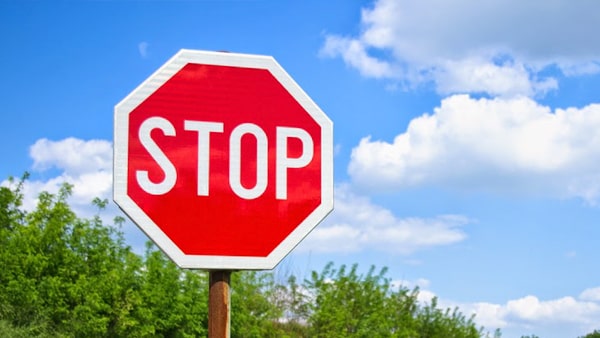
When you see this sign, you must:
  1. A Come to a complete stop and yield as required before proceeding
  2. B Slow down and continue if the road appears clear
  3. C Wait for the sign to be replaced by a green light
  4. D Stop only when cross traffic is visible

Correct answer: A – Come to a complete stop and yield as required before proceeding

A STOP sign requires a complete stop at the marked stop line, before the crosswalk, or at the appropriate point near the intersecting roadway when neither is present. After stopping, yield to traffic already in the intersection or approaching closely enough to create an immediate hazard. Merely slowing down does not satisfy the stop requirement.

Source: MCL § 257.649(6) – Right of way; rules; violation as civil infraction, What Every Driver Must Know — Ch. 5, “Regulatory signs”
Question 2

From what position should a driver ordinarily approach and make a right turn?

  1. A Near the roadway's center line
  2. B Close to the left edge of the roadway
  3. C As close as practicable to the right curb or edge
  4. D From beyond the center of the intersection

Correct answer: C – As close as practicable to the right curb or edge

Michigan requires both the approach and the right turn to be made as close as practicable to the right-hand curb or roadway edge. This positioning helps the driver follow the lawful turning path rather than making an unnecessarily wide turn. Official signs, signals, or pavement markings may direct a different course at a particular intersection.

Source: MCL § 257.647(1)(a), (e) – Turning at intersection; violation as civil infraction

Question 3

Before turning left at an intersection, when may you proceed across oncoming traffic?

  1. A After most approaching vehicles have passed
  2. B Whenever approaching traffic is more than 500 feet away
  3. C Whenever the nearest vehicle is turning right
  4. D After yielding to vehicles that present an immediate hazard

Correct answer: D – After yielding to vehicles that present an immediate hazard

A driver turning left must yield to an oncoming vehicle that is already in the intersection or close enough to constitute an immediate hazard. After yielding and giving the required signal, the driver may complete the turn when permitted. The rule is based on the actual hazard presented, not an arbitrary distance or the number of vehicles that have passed.

Source: MCL § 257.650 – Right-of-way; turning left at intersection; violation as civil infraction

Question 4

Which statement about large commercial trucks is correct?

  1. A They generally require more distance to stop than passenger vehicles
  2. B Their air brakes allow them to stop more quickly than cars
  3. C They can maneuver more quickly than passenger vehicles
  4. D They have no areas hidden from the driver's view

Correct answer: A – They generally require more distance to stop than passenger vehicles

Commercial vehicles cannot stop or maneuver as quickly or easily as passenger vehicles. The driver handbook illustrates that at 55 mph, a passenger vehicle may stop in about 130 feet while a commercial vehicle may require about 400 feet. Large trucks also have substantial blind areas beside, behind, and directly in front of them.

Source: What Every Driver Must Know — Ch. 6, “Commercial vehicles”

Question 5

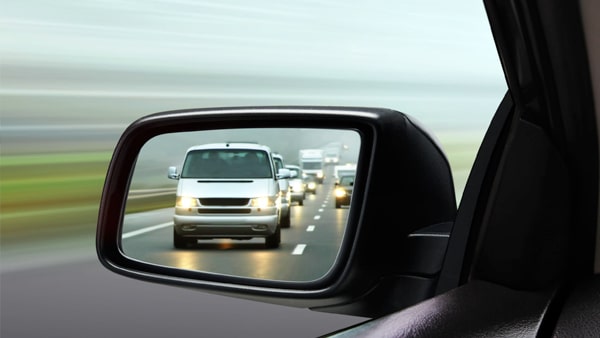
On a Michigan road, another vehicle begins passing you on the left. What should you do?

The car behind you begins to pass you. You should:
  1. A Increase speed to maintain traffic flow
  2. B Stop immediately in the travel lane
  3. C Give way to the right and do not increase speed until passed
  4. D Move left to shorten the passing distance

Correct answer: C – Give way to the right and do not increase speed until passed

The driver being overtaken must give way to the right in favor of the passing vehicle, except when passing on the right is permitted. The overtaken driver must not increase speed until the passing vehicle has completely passed. The law does not require stopping in the roadway or moving toward the passing vehicle.

Source: MCL § 257.636(1)(b) – Overtaking and passing of vehicles proceeding in same direction; overtaking a bicycle proceeding in same direction; violation as civil infraction

Question 6

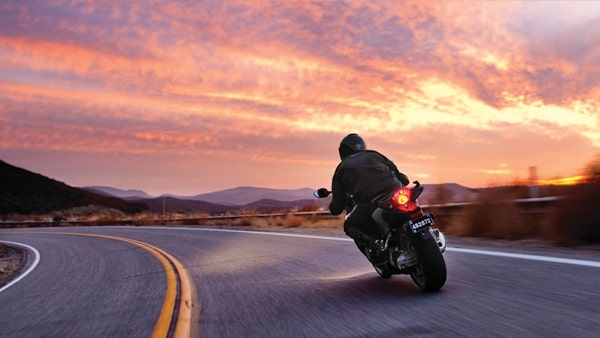
When traveling behind or beside a motorcycle, how much of its lane must you allow the rider to use?

If you are driving behind a motorcycle, you must:
  1. A The full lane
  2. B Only the shoulder portion
  3. C One-half of the lane
  4. D Only enough space to avoid contact

Correct answer: A – The full lane

Michigan law entitles a motorcycle to full use of a traffic lane. A motorist must not drive in a manner that deprives the motorcycle of that full lane. Motorists also should not attempt to pass a motorcycle within the same lane; a pass should use an available adjacent lane when the maneuver is lawful and safe.

Source: MCL § 257.660(2) – Electric personal assistive mobility device, low-speed vehicle, commercial quadricycle; electric skateboard, or moped; operation; limitations; applicability to police officer; regulation by local government; prohibitions; regulation by department of natural resources, What Every Driver Must Know — Ch. 6, “Specifically about motorcyclists”