


Michigan Road Signs Test 2

4.9 out of 5 (188 votes)
80% Passing score
20 Questions
4 Mistakes allowed
Michigan road signs deserve more attention than most people give them, mostly because the state treats them as their own little checkpoint in the adult knowledge testing process. The Signs segment is separate from the Operator section, and both have to be passed before you can get a Temporary Instruction Permit. So this is not just a cute review of stop signs and deer crossings. It is part of the actual licensing path, and it can slow you down if you walk in half-ready. This Michigan road signs practice test gives you a focused way to work through the signs you are expected to recognize on the real test: regulatory signs, warning signs, lane-control signs, railroad crossings, school zones, construction signs, and the shape-and-color clues that are easy to overlook because they seem almost too basic. And, well, that is usually where people get a little too casual. The official Michigan road sign test uses 25 sign questions, and you need 20 correct answers to pass. That is an 80% score, with room to miss only five. Fine on paper, less fine when two answers sound close enough to make you reread the question three times. For adults, Michigan offers the knowledge test at a Secretary of State office or online through the official KnowTo Drive platform. The online version is only for applicants 18 and older, and it requires a desktop or laptop, webcam, keyboard, and mouse. No touchscreen option, which feels oddly strict but there it is. The full online test includes the Operator portion, which takes about 45 minutes, plus the Signs segment, which takes about 15. After passing online, you still have to visit a Secretary of State office for the less exciting but unavoidable parts: vision screening, document review, photo, the $25 TIP fee, and the actual permit issuance. Teen drivers follow a different route, although road signs are still baked into the process early. Signs are covered through Michigan’s driver education curriculum and Segment 1 testing before a teen can apply for a Level 1 Learner’s License. Later on, the skills test brings its own requirements, including insurance and registration, Segment 2 completion, and a parent-signed logbook with 50 supervised hours, 10 of them at night. The practice test is meant to make that signs portion feel less slippery. Hints help when a sign looks familiar but the exact meaning will not quite come forward, and the answer explanations do the useful little cleanup job after a missed question. Use it with the Michigan driver’s handbook, not instead of it, and you will have a much better feel for what the state is actually asking you to know.
FREE DMV Practice Test App
Study for your Michigan permit test or driver’s license with the NextDoorDriving app. 700+ DMV questions and answers, 100% free!
Download on the App Store

Sample Michigan Permit Test Questions

Question 1

A black-and-yellow chevron panel pointing right warns of:

When you see this sign, it means:
  1. A An obstruction in the roadway
  2. B Traffic entering from a side road
  3. C A sharp change in roadway direction to the right
  4. D A merging lane ahead

Correct answer: C – A sharp change in roadway direction to the right

Chevron alignment panels emphasize a sharp change in the roadway’s direction. The point of the chevron shows the direction of the curve, so a panel pointing right marks a rightward change. A series of these panels may be installed around the outside of the curve.

Source: 2025 Michigan Manual on Uniform Traffic Control Devices — Part 2C, “Chevron Alignment Sign (W1-8)”

Question 2

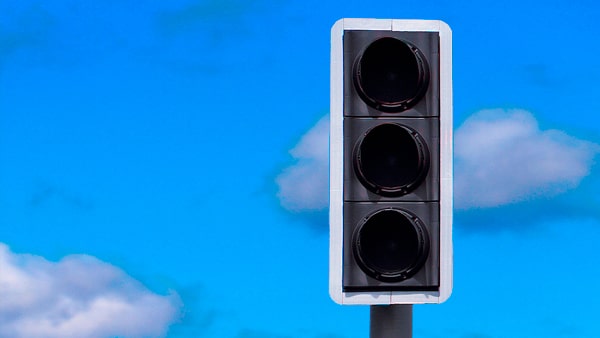
For a standard vertical traffic signal in Michigan, what is the order from top to bottom?

From top to bottom, the following is the proper order for traffic lights:
  1. A Red, yellow, green
  2. B Red, green, yellow
  3. C Green, red, yellow
  4. D Green, yellow, red

Correct answer: A – Red, yellow, green

A standard vertical signal places red at the top, yellow in the middle, and green at the bottom. This consistent arrangement helps drivers recognize an indication even when visibility or color perception is limited. Drivers must still obey the illuminated signal rather than relying only on its position.

Source: 2025 Michigan Manual on Uniform Traffic Control Devices — Part 4D, “Arrangement of Signal Indications”, What Every Driver Must Know — Ch. 5, “Traffic signals”

Question 3

A five-sided school warning sign indicates:

This road sign means:
  1. A A stop sign is ahead
  2. B A school area or school crossing is nearby
  3. C A shopping district begins ahead
  4. D Pedestrians must remain on the sidewalk

Correct answer: B – A school area or school crossing is nearby

The pentagon shape is used for school-related warning signs. Depending on the symbol, it may identify a school area or a school crossing. Watch carefully for children and follow directions from any school crossing guard.

Source: What Every Driver Must Know — Ch. 5, “Traffic signs” and “Traffic sign challenge answers”

Question 4

A roadway has double solid yellow centerlines. Which action is permitted when it can be completed safely?

  1. A Turning left into a private driveway
  2. B Treating the roadway as one-way
  3. C Driving along the centerline as a turn lane
  4. D Crossing the lines to pass a slow vehicle

Correct answer: A – Turning left into a private driveway

Double solid yellow centerlines prohibit passing for traffic in both directions. They may be crossed for certain turns, including a turn into a driveway, crossroad, or parking space. Before turning, check for other road users and yield to opposing traffic that presents an immediate hazard.

Source: MCL § 257.649a(1) — Right-of-way; turning left at location other than intersection; violation as civil infraction, What Every Driver Must Know — Ch. 5, “Yellow lines”

Question 5

What does a red-and-white, downward-pointing triangular sign require?

  1. A Slow only when an emergency vehicle approaches
  2. B Continue after looking in both directions
  3. C Come to a complete stop every time
  4. D Slow down, yield, and stop if necessary

Correct answer: D – Slow down, yield, and stop if necessary

This is a yield sign. Michigan law requires an approaching driver to reduce speed to one that is reasonable for conditions and yield to traffic with the right-of-way. Stop when necessary to avoid interfering with a vehicle that presents an immediate hazard.

Source: MCL § 257.649(6) — Right of way; rules; violation as civil infraction, What Every Driver Must Know — Ch. 5, “Traffic sign challenge answers”

Question 6

A steady yellow arrow appears over your dedicated turn lane. What should you do?

  1. A Prepare for the signal to change and stop if you can do so safely
  2. B Begin the turn after checking only for pedestrians
  3. C Remain stopped regardless of your position
  4. D Accelerate to enter the intersection before the signal changes

Correct answer: A – Prepare for the signal to change and stop if you can do so safely

A steady yellow arrow has the same meaning as a steady circular yellow signal, but it applies only to the movement shown by the arrow. The signal is changing to red. Stop before entering when that can be done safely; if a safe stop is not possible, proceed cautiously.

Source: MCL § 257.612(1)(b) — Traffic control signals; red arrow and yellow arrow indications; colors, What Every Driver Must Know — Ch. 5, “Flashing yellow arrow left-turn signal head”