


Michigan Road Signs Test Simulator

4.9 out of 5 (198 votes)
80% Passing score
25 Questions
5 Mistakes allowed
Michigan road signs deserve more attention than most new drivers give them. For adults, they are not buried quietly somewhere inside the knowledge test and then forgotten. They are treated as their own section, which is the part worth knowing before you sit down and start clicking through answers like it is all going to be obvious. The adult Michigan knowledge test has 50 multiple-choice questions split evenly between the Operator section and the Signs segment. You need 20 correct out of 25 on each part, or 80%, which means you can miss up to 5 in the signs section and no more than that. Close is not close enough here. This Michigan permit practice test is built around that exact pressure point: road signs. Each session gives you 20 questions from a larger road-sign question bank, and the mix changes each time, so you are not just memorizing the same little pattern and congratulating yourself too early. The questions cover the familiar signs, of course — stop, yield, railroad crossing, all the classics — but they also work through the warning, regulatory, and guide signs that people tend to recognize until, well, they have to choose between two answers that both sound halfway reasonable. To pass this DMV practice test, you need 16 correct answers, keeping the same 80% standard used on the official Michigan test. After each practice test, you can review missed questions with hints and explanations, which is where the studying actually starts to become useful instead of just hopeful guessing with better posture. For adult applicants, the official testing process has two pieces: the Operator section, which takes about 45 minutes, and the Signs segment, which takes about 15 minutes. The online test is the same as the one given at Secretary of State offices. Both portions must be passed before a Temporary Instruction Permit can be issued. If you fail the written knowledge test, you will have to reschedule and come back another time. Once you pass, your knowledge test result is valid for one year. Teen drivers take a different route, because Michigan ties permit-stage testing to driver education. Segment 1 includes the written exam, with road signs folded into the curriculum before a teen applies for a Level 1 Learner’s License. Different process, same basic reality: signs show up early, and they count.
FREE DMV Practice Test App
Study for your Michigan permit test or driver’s license with the NextDoorDriving app. 700+ DMV questions and answers, 100% free!
Download on the App Store

Sample Michigan Permit Test Questions

Question 1

What does a white X-shaped crossbuck sign mark?
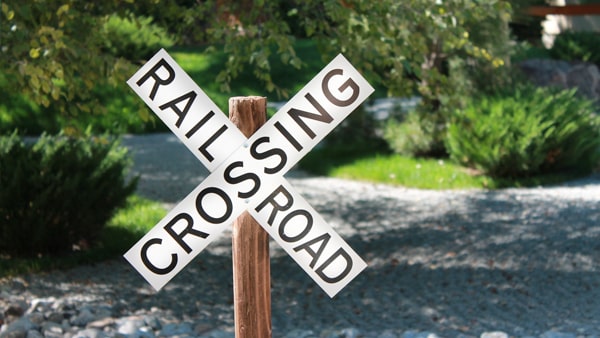
This road sign means:
  1. A An intersection where you stop only for traffic
  2. B A three-way highway intersection
  3. C An ordinary crossroad
  4. D A railroad crossing

Correct answer: D – A railroad crossing

A crossbuck marks a railroad crossing at the tracks. At a passive crossing, look in both directions for rail traffic and slow or stop as necessary. Do not proceed until you have checked that all tracks are clear and can cross safely.

Source: What Every Driver Must Know — Ch. 5, “Traffic signs” and “Traffic sign challenge answers,” RR Crossbuck, What Every Driver Must Know — Ch. 4, “Passive railroad crossing control systems”
Question 2

A solid white line separates lanes traveling in the same direction. What does the marking tell you to do?

  1. A Cross it whenever traffic is light
  2. B Remain in your lane and do not cross the line
  3. C Cross it to pass by using the shoulder
  4. D Treat it like a broken white line

Correct answer: B – Remain in your lane and do not cross the line

The current driver manual instructs drivers not to cross a solid white line separating lanes moving in the same direction. Such lines may identify curves, acceleration or deceleration lanes, and other locations where lane changes are considered dangerous. A broken white line, rather than a solid one, normally permits a lane change when it can be made safely.

Source: What Every Driver Must Know — Ch. 5, “Solid white lines”, What Every Driver Must Know — Ch. 5, “Broken white lines”

Question 3

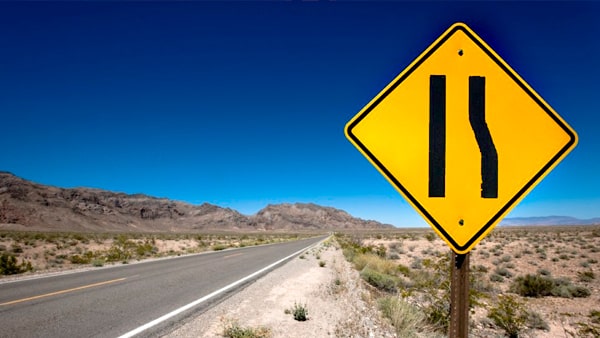
In Michigan, a warning sign showing the right lane ending indicates:

This sign means:
  1. A The roadway narrows and right-lane traffic must merge left
  2. B A divided highway begins ahead
  3. C A steep hill is ahead
  4. D Trucks may be crossing

Correct answer: A – The roadway narrows and right-lane traffic must merge left

This lane-reduction sign warns that the right lane ends ahead. Drivers in that lane must prepare to merge left and yield to traffic already traveling in the open lane. Check surrounding traffic, signal, and move over when there is a safe opening.

Source: What Every Driver Must Know — Ch. 5, “Traffic sign challenge answers”

Question 4

After stopping at an intersection, where should you check before proceeding?

  1. A Ahead and to the left
  2. B To the left and right only
  3. C To the left, right, and straight ahead
  4. D Ahead and to the right

Correct answer: C – To the left, right, and straight ahead

A complete stop is only the first step. Before proceeding, check all approaching traffic and watch for pedestrians and bicyclists. Looking left, right, and ahead helps you identify cross traffic and hazards already within or approaching the intersection.

Source: MCL § 257.649(8) — Right of way; rules; violation as civil infraction, What Every Driver Must Know — Ch. 4, “Left turns”

Question 5

Which maneuver may permit crossing a double solid yellow centerline?

  1. A Passing a vehicle traveling in the same direction
  2. B Passing during daylight hours
  3. C Crossing whenever the road appears clear
  4. D Turning into a driveway or crossroad

Correct answer: D – Turning into a driveway or crossroad

Michigan’s driver manual states that double solid yellow lines prohibit passing in both directions. Crossing them may be permitted to turn into a driveway, onto a crossroad, or into a parking space. A driver turning left must yield to opposing vehicles that are close enough to present an immediate hazard.

Source: MCL § 257.649a(1) — Right-of-way; turning left at location other than intersection; violation as civil infraction, What Every Driver Must Know — Ch. 5, “Yellow lines”

Question 6

Orange signs and cones on a Michigan freeway warn you to:

  1. A Change lanes without reducing speed
  2. B Watch for road workers and construction equipment
  3. C Assume every traffic lane ends ahead
  4. D Accelerate through the area

Correct answer: B – Watch for road workers and construction equipment

Orange signs identify construction and maintenance areas. Workers, equipment, barriers, or changed traffic patterns may be present. Drive carefully and obey all temporary signs and directions controlling traffic through the work area.

Source: What Every Driver Must Know — Ch. 5, “Traffic sign challenge answers”