


Minnesota General Knowledge CDL Prep Test (MN) 4

4.9 out of 5 (121 votes)
80% Passing score
20 Questions
4 Mistakes allowed
Are you gearing up to take the Minnesota CDL test in 2026? Look no further, as this fourth CDL practice test is your ideal starting point. Here, you can fine-tune your knowledge and skills, preparing you to ace the official CDL permit test. This Minnesota general knowledge CDL test practice, comprising 20 sample questions and answers, mirrors the format of the real written knowledge test, ensuring you're not just learning, but you're learning the right way. In this CDL practice test, each question offers multiple choices, just like the actual Minnesota DMV permit test. It's an efficient way to get familiar with the process of identifying and choosing the correct answer among several options. This practice approach is beneficial, especially when dealing with tricky Minnesota DMV test questions. Moreover, some questions are in a true or false format, adding variety and a realistic touch to your practice sessions. The backbone of our sample CDL test questions is the official CDL driver's manual, the same source used for the real Minnesota CDL written test. Rest assured, if it's not in the manual, it won't appear on the general knowledge test. This alignment with the official source material ensures that your preparation is as relevant and accurate as possible. Keeping pace with the times is crucial. That's why our Minnesota CDL practice test is updated regularly, reflecting the most current regulations and scenarios for 2026. This commitment to freshness means you're practicing with the latest information, giving you an edge in your test preparation. With each attempt, you'll encounter the same set of questions, allowing you to measure your progress and focus on areas needing improvement. Remember, to pass, you need to correctly answer at least 16 out of the 20 questions. Use this Minnesota general knowledge CDL practice test as a reliable tool to gauge your readiness for the CDL exam in 2026!
FREE CDL Practice Test App
Pass your Minnesota CDL General Knowledge test with the NextDoorDriving app. Real questions and answers—100% free and ad-free.
Download on the App Store

Sample Minnesota CDL Test Questions - General Knowledge

Question 1

What does a red rectangular WRONG WAY sign tell a driver?
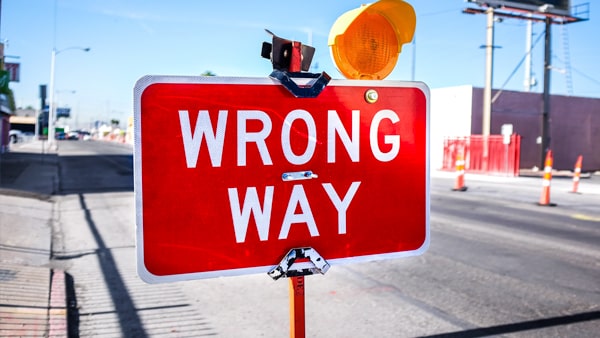
This sign warns drivers that  _________________.
  1. A The driver is entering an expressway
  2. B Heavy traffic is expected ahead
  3. C The vehicle is traveling against the permitted direction on a one-way roadway
  4. D The roadway is closed farther ahead

Correct answer: C – The vehicle is traveling against the permitted direction on a one-way roadway

In Minnesota, the WRONG WAY sign supplements a DO NOT ENTER sign at locations where drivers might enter a one-way roadway in the prohibited direction. A driver who encounters it while moving must recognize that the vehicle is traveling against the permitted traffic flow and must not continue in that direction.

Source: Minnesota Manual on Uniform Traffic Control Devices, 11th Edition including Revision 1 — § 2B.47, “WRONG WAY Sign (R5-1a)”
Question 2

A driver applies the trailer hand valve before the foot brake during normal driving to prevent a jackknife. Which statement is correct?

  1. A The driver should not use this technique
  2. B The technique reduces the chance of a trailer skid
  3. C The technique applies all vehicle brakes evenly
  4. D The technique is the best way to brake in a straight line

Correct answer: A – The driver should not use this technique

Do not use the trailer hand valve during normal driving because applying only the trailer brakes can cause the trailer wheels to skid. The foot brake sends air to the brakes on both the power unit and trailer. Using the foot brake presents less danger of a skid or jackknife.

Source: Minnesota Commercial Driver’s License Manual — § 6.2.1, “Trailer Hand Valve”

Question 3

Which statement correctly defines perception distance?

  1. A The distance traveled while your foot moves from the accelerator to the brake pedal
  2. B The distance traveled from first seeing a hazard until your brain recognizes it
  3. C The distance traveled after the brakes begin slowing the vehicle
  4. D The distance needed to steer around a recognized hazard

Correct answer: B – The distance traveled from first seeing a hazard until your brain recognizes it

Minnesota’s CDL manual defines perception distance as the distance traveled from the moment your eyes see a hazard until your brain recognizes it. Visibility, the type of hazard, and the driver’s mental or physical condition can affect this distance. It is separate from reaction distance and braking distance.

Source: Minnesota Commercial Driver’s License Manual (March 2025) — § 2.6.1, “Stopping Distance”

Question 4

When should you select a lower range in an automatic transmission for a downgrade?

  1. A Before beginning the descent
  2. B After the vehicle has gained speed
  3. C Halfway down the grade
  4. D After reaching the bottom

Correct answer: A – Before beginning the descent

Select the lower range before starting down the grade so the engine can help control the vehicle’s speed. Lower ranges limit automatic upshifting beyond the selected gear. Attempting to force an automatic transmission into a lower gear after speed has built up can damage the transmission or eliminate the engine-braking effect.

Source: Minnesota Commercial Driver’s License Manual (March 2025) — § 2.3.3, “Automatic Transmissions”, Minnesota Commercial Driver’s License Manual (March 2025) — § 2.16.2, “Select the Right Gear Before Starting Down the Grade”

Question 5

About how far ahead can properly adjusted low-beam headlights illuminate the road?

  1. A 250 feet
  2. B 200 feet
  3. C 150 feet
  4. D 350 feet

Correct answer: A – 250 feet

Low-beam headlights let you see approximately 250 feet ahead, while high beams illuminate about 350 to 500 feet. At night, adjust your speed so your stopping distance remains within the area you can see. Dirty or incorrectly aimed headlights can reduce effective visibility.

Source: Minnesota Commercial Driver’s License Manual (March 2025) — § 2.11.4, “Vehicle Factors—Headlights”

Question 6

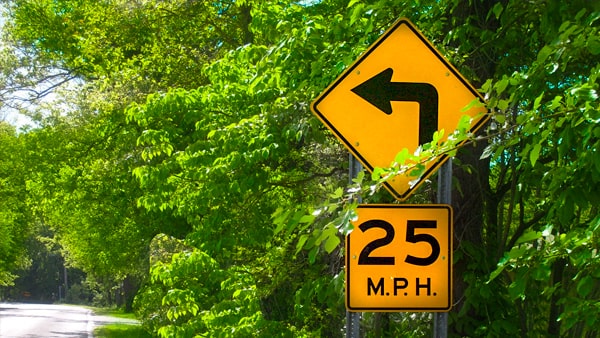
A yellow warning sign shows a black curve symbol bending left, with an advisory-speed plaque below. What should you do?

This sign warns drivers to ____________.
  1. A Prepare for a right-hand curve
  2. B Prepare to slow for a left-hand curve
  3. C Accelerate before making a left turn
  4. D Continue straight at the posted highway speed

Correct answer: B – Prepare to slow for a left-hand curve

The curve symbol indicates that the road ahead changes alignment to the left. In Minnesota, an advisory-speed plaque may supplement the warning sign to show the recommended speed for that condition. Approach at a speed that allows the commercial vehicle to negotiate the curve safely.

Source: Minnesota Manual on Uniform Traffic Control Devices, 11th ed., rev. 1 — § 2C.07, “Horizontal Alignment Signs (W1-1 through W1-5, W1-11, and W1-15)”, Minnesota Manual on Uniform Traffic Control Devices, 11th ed., rev. 1 — § 2C.59, “Advisory Speed Plaque (W13-1P) and Confirmation Advisory Speed Plaque (W13-1aP)”