


Minnesota Permit Test Simulator

4.4 out of 5 (2535 votes)
80% Passing score
40 Questions
8 Mistakes allowed
Minnesota’s Class D permit test deserves more attention than a quick skim of the driver’s manual the night before. Not panic, just attention. The real MN knowledge test covers a pretty wide stretch of material: traffic laws, road signs, signals, pavement markings, right-of-way, defensive driving, sharing the road, winter driving, DWI rules, and the sort of safety details that seem obvious until they show up in a multiple-choice question with two answers that both look annoyingly reasonable. Our Minnesota DMV permit practice test is built around that same structure. You get 40 multiple-choice questions, just like the real Minnesota permit test, and the passing mark is 32 correct answers, or 80%. That means you can miss up to 8, but that is not really the number to aim for unless you enjoy leaving yourself no cushion at all. The smarter move is to practice until 32 feels comfortably behind you, not barely within reach. The questions rotate each time, which matters more than people think. A fixed quiz can make you feel prepared when you have mostly memorized the order, the phrasing, and the one answer that looks familiar. This MN practice permit test makes you work a little harder than that. One round may lean into road signs and lane markings; the next may push right-of-way, school buses, emergency vehicles, rural roads, or Minnesota winter driving. And, yes, those local driving situations count. Snow, slick pavement, limited visibility, country highways, Twin Cities traffic — the manual does not exist in a vacuum, and neither should your studying. There is also the licensing-process piece, which is where people sometimes get their wires crossed. Before Minnesota DVS issues an instruction permit, you need to pass the Class D knowledge test and a vision screening. Teens can start the permit path at 15 after meeting driver education requirements, while adult first-time drivers still need the permit before moving toward the road test. An 18-year-old generally holds that permit for 6 months; applicants 19 and older generally hold it for 3 months. Different timelines, same basic doorway: pass the knowledge test first. Take this free Minnesota permit practice test as many times as you need. Use it to catch the rules you half-know, the signs you recognize but cannot quite explain, and the judgment calls that deserve a second look before test day.
FREE DMV Practice Test App
Study for your Minnesota permit test or driver’s license with the NextDoorDriving app. 700+ DMV questions and answers, 100% free!
Download on the App Store

Sample Minnesota Permit Test Questions

Question 1

If lifting a stuck gas pedal with your toe does not release it, what should you do next?

  1. A. Apply the brakes and shift into neutral
  2. B. Apply the parking brake abruptly
  3. C. Continue pressing and releasing the accelerator
  4. D. Pump the brake pedal rapidly

Correct answer: A. – Apply the brakes and shift into neutral

The driver’s manual first suggests trying to lift a stuck pedal with a toe. If that does not work, apply the brakes and shift into neutral to disengage the engine. Choose a safe path, activate the hazard lights when appropriate, and steer to the shoulder without switching off the ignition while the vehicle is still moving.

Source: Minnesota Driver’s Manual — Ch. 6, “Stuck gas pedal”
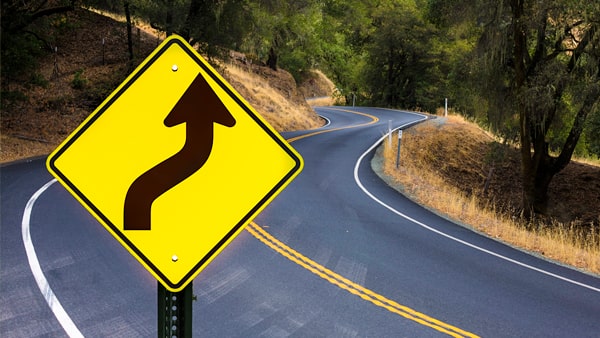
Question 2

The pictured reverse-curve sign shows that the road ahead will:

This sign means:
  1. A. Make one sharp turn to the right
  2. B. Curve first to the right and then to the left
  3. C. Curve first to the left and then to the right
  4. D. Change from pavement to an unpaved surface

Correct answer: B. – Curve first to the right and then to the left

A reverse-curve sign warns of two changes in roadway alignment in opposite directions. The symbol must be read from the bottom upward, in the direction of travel. On the pictured sign, the first curve is to the right and the following curve is to the left.

Source: Minnesota Manual on Uniform Traffic Control Devices, 11th ed., Rev. 1 — Part 2, Ch. 2C, “Horizontal Alignment Warning Signs and Plaques”

Question 3

How should you complete a lawful pass of a large truck?

  1. A. Avoid lingering beside it and return only when its front is visible in your mirror
  2. B. Remain beside the truck until its driver acknowledges you
  3. C. Move back immediately after clearing the truck’s rear bumper
  4. D. Slow down while traveling next to the truck

Correct answer: A. – Avoid lingering beside it and return only when its front is visible in your mirror

Do not remain alongside a commercial vehicle longer than needed to complete a lawful pass. Return to your lane only after you can see the front of the truck in your rearview mirror, and maintain your speed afterward. Complete the maneuver without exceeding the applicable speed limit or cutting closely in front of the truck.

Source: Minnesota Driver’s Manual — Ch. 4, “Passing a commercial vehicle”, Minnesota Driver’s Manual — Ch. 3, “Passing”

Question 4

Which sign directs traffic to pass to the right of an island, median, or obstruction?

  1. A. The divided-highway-ends warning sign
  2. B. The rectangular sign showing an arrow curving right around an obstruction
  3. C. The sharp-left-turn warning sign
  4. D. The lane-ends warning sign

Correct answer: B. – The rectangular sign showing an arrow curving right around an obstruction

The Keep Right sign is a regulatory sign directing drivers to stay to the right of a traffic island, median, or other obstruction. Its black arrow curves around the right side of the obstruction symbol. Warning signs for turns, divided highways, and ending lanes communicate different roadway conditions.

Source: Minnesota Driver’s Manual — Ch. 5, “Keep Right”

Question 5

Except when necessary to avoid a traffic conflict or obey an officer or traffic-control device, may you double park?

  1. A. Yes, while someone remains in the vehicle
  2. B. Yes, while making a delivery
  3. C. No, parking beside a curbside vehicle is prohibited
  4. D. Yes, with a disability parking permit

Correct answer: C. – No, parking beside a curbside vehicle is prohibited

Minnesota prohibits stopping, standing, or parking on the roadway side of a vehicle stopped or parked at the curb or roadway edge. This is commonly called double parking. The statute’s general exceptions apply when stopping is necessary to avoid conflict with traffic or to comply with an officer or traffic-control device; deliveries and parking permits do not create a general exception.

Source: Minn. Stat. § 169.34, subd. 1(a)(11) – Prohibitions; Stopping, Parking, Minnesota Driver’s Manual — Ch. 3, “Parking”

Question 6

Why should you actively scan the road ahead, to the sides, and behind?

  1. A. To eliminate the need to check mirrors
  2. B. Because scanning at a fixed interval is required by statute
  3. C. To identify possible hazards before they develop

Correct answer: C. – To identify possible hazards before they develop

The SIPDE driving system begins with scanning ahead, to the sides, and behind the vehicle. This search helps identify traffic, pedestrians, road conditions, and possible escape paths before a conflict develops. Early recognition gives a driver more time to predict what may happen and select an appropriate response.

Source: Minnesota Driver’s Manual — Ch. 6, “Using the Scan, Identify, Predict, Decide and Execute (SIPDE) System”