


Minnesota DMV Test Evaluation

4.5 out of 5 (2140 votes)
80% Passing score
10 Questions
2 Mistakes allowed
This Minnesota permit practice test is best treated as an early gut-check, not the final rehearsal with the lights fully on. It gives you 10 randomly selected questions pulled from the same general territory Minnesota expects new drivers to know: traffic laws, road signs, lane markings, right-of-way, safe driving, sharing the road, winter driving, DWI rules, and the little rulebook details that feel minor until they are sitting in the answer choices, looking strangely similar. You need 8 out of 10 correct to pass this MN DMV permit practice test. That is intentional. It follows the same 80% standard used on the real Minnesota Class D knowledge test, where the numbers get bigger: 40 questions, 32 correct answers required, and up to 8 misses allowed. So if you do well here, good. That means your base knowledge is probably forming. Still, 10 questions cannot cover the full spread of what DVS may throw at you, which is why this works better as a starting point than as proof that you are done studying. There is no time limit, and honestly, that matters more than people think. Rushing through practice questions teaches you how to rush through practice questions. Slowing down teaches you how Minnesota words things, where the traps are, and which topics you only sort of know. Road signs are a good example. Minnesota does not make most Class D applicants take a separate road-sign-only test; sign questions are folded into the main knowledge test along with signals, pavement markings, and regular traffic-law questions. Missed sign questions count the same as the rest. The licensing process comes after that, and it changes a bit depending on age. Everyone starts with the knowledge test and vision screening before getting an instruction permit. Teens can apply at 15 after meeting driver education requirements and getting the required adult approval. Adults skip the teen driver education path, but first-time drivers still need aa permit before the road test. At 18, that permit period is generally 6 months; at 19 or older, it is generally 3 months. So, yes, this Minnesota practice permit test is only one step, but it tells you whether the rest of the process is going to feel manageable or whether the manual deserves another pass.
FREE DMV Practice Test App
Study for your Minnesota permit test or driver’s license with the NextDoorDriving app. 700+ DMV questions and answers, 100% free!
Download on the App Store

Sample Minnesota Permit Test Questions

Question 1

After receiving notice that your Minnesota driving privilege is revoked, and without a valid limited privilege, you may:

  1. A Drive only during an emergency
  2. B Drive directly to work or school
  3. C Not operate a vehicle that requires a driver’s license
  4. D Drive when accompanied by a licensed adult

Correct answer: C – Not operate a vehicle that requires a driver’s license

A person who has received notice of a revocation, or reasonably should know about it, may not operate a motor vehicle that requires a license. Violating this rule is generally a misdemeanor. It becomes a gross misdemeanor when the person is prohibited from driving unless participating in the ignition interlock device program.

Source: Minn. Stat. § 171.24, subd. 2(a)–(b) – Violations; Driving Without Valid License
Question 2

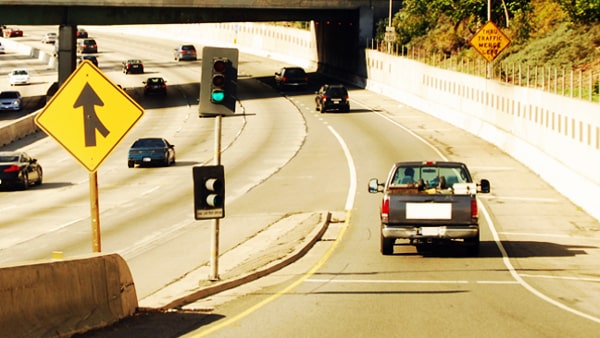
When an acceleration lane is available for entering a freeway, you should adjust your speed to:

When entering a freeway entrance that allows you to accelerate to merge, you should drive at:
  1. A About 10 mph below freeway traffic
  2. B Approximately match freeway traffic without exceeding the speed limit
  3. C The maximum posted speed regardless of traffic conditions
  4. D A speed higher than the vehicles already on the freeway

Correct answer: B – Approximately match freeway traffic without exceeding the speed limit

The acceleration lane provides space to increase speed before merging. Minnesota’s manual directs drivers to adjust their speed to match vehicles already on the freeway, while remaining within the posted limit. Signal, find a safe opening, yield to freeway traffic, and merge without stopping on the ramp unless stopping is absolutely necessary.

Source: Minnesota Driver’s Manual — Ch. 6, “Entering the freeway”

Question 3

Which statement best reflects defensive driving around other road users?

  1. A Traffic signs guarantee that every driver will obey
  2. B A turn signal guarantees that the vehicle will turn
  3. C You must use your own observation because others may not see you
  4. D Drivers of larger vehicles are always more dependable

Correct answer: C – You must use your own observation because others may not see you

Nothing a driver does can guarantee that another road user has seen the vehicle. Defensive drivers remain aware of surrounding traffic and use the SIPDE process to scan, identify, and predict possible conflicts. A signal or right-of-way rule does not replace the need to observe conditions and respond to developing hazards.

Source: Minnesota Driver’s Manual — Ch. 6, “Using the Scan, Identify, Predict, Decide and Execute (SIPDE) System”

Question 4

Before moving left to pass another vehicle, what must you verify?

  1. A The other vehicle will maintain a constant speed
  2. B Your signal will cause the other driver to make room
  3. C There is enough clear roadway to complete the pass and return safely
  4. D The other driver will brake as soon as you begin passing

Correct answer: C – There is enough clear roadway to complete the pass and return safely

Minnesota requires the passing driver to have sufficient clear roadway to complete the pass without interfering with approaching or overtaken traffic. The driver must remain left until safely clear before returning right. Although an overtaken driver must give way after an audible warning and must not increase speed, that duty does not remove the passing driver’s safety obligations.

Source: Minn. Stat. § 169.18, subds. 3(1)–(2), 5(a) – Driving Rules, Minnesota Driver’s Manual — Ch. 3, “When preparing to pass”

Question 5

Traffic is backed up beyond a signal-controlled intersection. What should you do if your vehicle cannot clear the intersection?

  1. A Enter if your light is green
  2. B Wait before entering until you can pass completely through without blocking cross traffic
  3. C Enter if cross traffic can drive around you
  4. D Enter if no vehicle is directly behind you

Correct answer: B – Wait before entering until you can pass completely through without blocking cross traffic

Minnesota law generally prohibits entering a signal-controlled intersection unless you can move immediately, continuously and completely through it without blocking subsequent cross traffic. Limited exceptions apply when directed by an authorized traffic agent or peace officer, when facilitating an emergency vehicle’s passage, or when making a permitted turn that allows you to leave the intersection safely.

Source: Minn. Stat. § 169.15, subd. 2 – IMPEDING TRAFFIC; INTERSECTION GRIDLOCK.

Question 6

How should you direct your vision while driving?

  1. A Keep your eyes fixed straight ahead
  2. B Watch only the vehicle directly ahead
  3. C Look forward unless another vehicle is behind you
  4. D Continuously scan ahead, to the sides and behind you

Correct answer: D – Continuously scan ahead, to the sides and behind you

The SIPDE system begins with actively searching ahead, to both sides and behind your vehicle. This helps you identify traffic, pedestrians, bicycles and road conditions before they become immediate hazards. Fixing your vision on one point, including the vehicle directly ahead, can cause you to miss important changes elsewhere in the driving environment.

Source: Minnesota Driver’s Manual — Ch. 6, “Using the Scan, Identify, Predict, Decide and Execute (SIPDE) System”