Minnesota Permit Test Practice 2

4.7 out of 5 (964 votes)
80% Passing score
20 Questions
4 Mistakes allowed
This Minnesota permit test practice is built for the part of studying where the details start to blur together a little — seat belts, right-of-way rules, safe following distance, road signs, winter driving, all of it. This is the second practice permit test in the series, and it gives you 20 questions that stay close to the material Minnesota actually uses for the Class D knowledge test. Not random driving trivia. Not a guessing game dressed up as prep. Just a practical run-through of the rules and habits you are expected to know before DVS hands over an instruction permit. The questions are based on the Minnesota Driver’s Manual, which matters more than people sometimes want to admit. The official MN permit test is built from that same source, so a good DMV practice test should feel familiar in both subject matter and wording. This one also gives instant feedback after each answer, with explanations that slow things down just enough to be useful. You see what you missed, why the correct answer works, and where your understanding is still a little thin. That part is not flashy, admittedly, but it is where the studying actually happens. The licensing process itself is worth understanding before you schedule anything. Minnesota teens can apply for an instruction permit at 15, but they need the required driver education proof — usually the Blue Card or Pink Card — and approval from a parent, guardian, or another legally authorized adult. Adult applicants follow a different track. An 18-year-old first-time applicant still needs an instruction permit and generally must hold it for at least 6 months before moving on to a license. First-time applicants age 19 or older usually need to hold the permit for at least 3 months, assuming no prior licensing exception applies. And then, because driving is apparently not just about knowing what a yellow diamond sign means, there is the vision screening. Minnesota expects at least 20/40 vision, with or without corrective lenses, and at least 105 degrees of peripheral vision. The knowledge test may be taken at a state exam station, online with an eligible proctor, or through an authorized third-party testing site. So use this Minnesota practice permit test for what it is: a controlled, realistic way to tighten up your knowledge before the real test and the rest of the licensing process start asking for paperwork, patience, and actual confidence.
FREE DMV Practice Test App
Study for your Minnesota permit test or driver’s license with the NextDoorDriving app. 700+ DMV questions and answers, 100% free!
Download on the App Store

Sample Minnesota Permit Test Questions

Question 1

How should you handle an intersection when its traffic signal is completely out of operation?
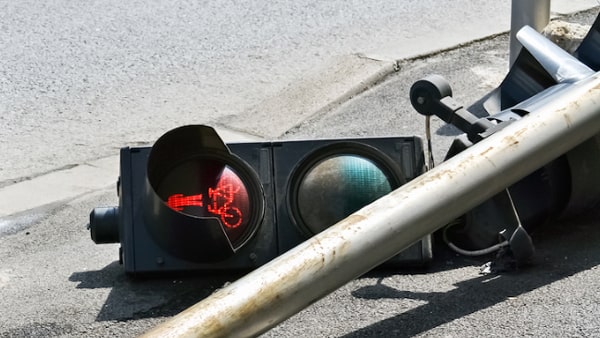
When a traffic signal light is not working, you should:
  1. A Always treat it as an all-way stop
  2. B Proceed at normal speed because no signal is displayed
  3. C Treat it as an uncontrolled intersection and yield as required
  4. D Wait for the signal to begin operating again

Correct answer: C – Treat it as an uncontrolled intersection and yield as required

The Minnesota manual directs drivers to treat a nonfunctioning traffic signal as an uncontrolled intersection, not automatically as an all-way stop. Approach cautiously and yield according to normal intersection rules. When two vehicles arrive at approximately the same time, the driver on the left must yield to the vehicle on the right.

Source: Minn. Stat. § 169.20, subd. 1 — Right-of-Way, Minnesota Driver’s Manual — Ch. 5, “Traffic-control signals”
Question 2

What effect does drinking coffee have on your alcohol concentration?

  1. A It lowers the concentration immediately
  2. B It neutralizes alcohol already in the bloodstream
  3. C It does not increase the rate at which alcohol is eliminated
  4. D It causes the concentration to rise

Correct answer: C – It does not increase the rate at which alcohol is eliminated

Coffee does not make the liver oxidize alcohol more quickly and does not make an impaired person sober. Exercise and cold showers also do not speed alcohol elimination. Waiting for the body to process the alcohol is the only way to reduce alcohol concentration.

Source: Minnesota Driver’s Manual — Ch. 8, “Things to know about alcohol”

Question 3

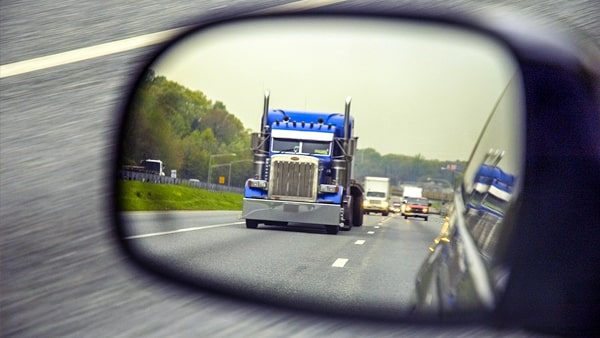
A truck begins passing your vehicle on the left. What should you do?

When a truck driver behind you wants to pass your vehicle, your speed should:
  1. A Stay in your lane and do not increase your speed
  2. B Speed up until the truck falls behind
  3. C Move toward the truck’s lane
  4. D Drive onto the shoulder

Correct answer: A – Stay in your lane and do not increase your speed

Do not accelerate while another vehicle is overtaking you. Minnesota law prohibits an overtaken driver from increasing speed until completely passed and, when passing on the right is not permitted, requires giving way to the right after an audible warning. The driver’s manual also directs you to stay in your lane during the pass.

Source: Minn. Stat. § 169.18, subd. 3(2) — Driving Rules, Minnesota Driver’s Manual — Ch. 3, “Passing”

Question 4

When parking downhill on a road without a curb, where should you point the front wheels?

When parking downhill and the curb is absent, your front wheels must be turned:
  1. A Toward the center of the road
  2. B Straight ahead
  3. C Toward the shoulder
  4. D Toward the left side of the road

Correct answer: C – Toward the shoulder

Turn the front wheels toward the shoulder when parked downhill without a curb. This wheel position directs a rolling vehicle away from the traveled lane rather than into traffic. The driver’s manual gives the same general downhill direction—toward the curb when present or toward the shoulder when no curb exists.

Source: Minnesota Driver’s Manual — Ch. 3, “Parking on a hill”

Question 5

A vehicle ahead has stopped at a crosswalk to let a pedestrian cross. What must you do?

  1. A Remain behind the vehicle and do not pass
  2. B Change lanes and pass carefully
  3. C Pass slowly on the shoulder
  4. D Sound your horn and continue

Correct answer: A – Remain behind the vehicle and do not pass

Minnesota law prohibits overtaking and passing a vehicle stopped at a marked crosswalk or at an intersection without a marked crosswalk to allow a pedestrian to cross. The stopped vehicle may block your view of the person in the crosswalk. Stay behind the vehicle and be prepared to stop until the crossing is clear.

Source: Minn. Stat. § 169.21, subd. 2(b) — Pedestrian, Minnesota Driver’s Manual — Ch. 4, “Watch for pedestrians”

Question 6

When following another vehicle at night, you must use low beams once you are within:

When approaching another vehicle from the rear at night, you must dim your bright headlights within:
  1. A 100 feet
  2. B 200 feet
  3. C 300 feet
  4. D 600 feet

Correct answer: B – 200 feet

When following another vehicle at night, Minnesota law requires low beams once you are within 200 feet, except while overtaking and passing. High beams at close range can create glare in the other driver’s mirrors. Switch to low beams before reaching that distance and keep them low while following.

Source: Minn. Stat. § 169.61(c) — Composite Beam, Minnesota Driver’s Manual — Ch. 6, “Headlights”