Minnesota DMV Practice Test 7

4.8 out of 5 (276 votes)
80% Passing score
20 Questions
4 Mistakes allowed
Getting ready for the Minnesota permit test means dealing with more than a few friendly little road-sign questions and the obvious stuff everyone swears they already know. The Class D knowledge test is the first official checkpoint for most new drivers in Minnesota, whether you are 15 and entering the Graduated Driver Licensing system or an adult finally getting around to the whole license thing. Either way, the test expects you to know the rules, not just have a vague feeling that stop signs are important and icy roads are bad. Bold position, Minnesota. This Minnesota permit test practice gives you 20 questions covering the material that tends to show up when it counts: road signs, right-of-way rules, safe driving habits, insurance requirements, winter driving, cell phone restrictions, and those small legal details that somehow become very important the second they appear in multiple-choice form. To pass this MN permit practice test, aim for at least 16 correct answers. That does not magically replace the Minnesota Driver’s Manual, sadly, but it does give you a decent read on whether the information is actually sticking or just floating around in your head looking official. For teen drivers, the permit comes with a few extra hoops, because of course it does. Minnesota allows teens to apply for an instruction permit at age 15, but only after meeting driver education requirements, passing the knowledge test, passing vision screening, providing documents, and getting the required adult approval. Under 18, driver education starts before the permit, with classroom instruction and behind-the-wheel enrollment folded into the process. After that, the path runs through the instruction permit, provisional license, and full Class D license. Permit holders need a licensed adult beside them while driving, and teen permit drivers cannot use a cell phone behind the wheel, even hands-free. Adults get a cleaner version of the process, though not exactly a free pass. First-time adult drivers still need to pass the Class D knowledge test, clear vision screening, get an instruction permit, practice under supervision, and pass the road test. At 18, the permit must be held for six months before licensing; at 19 or older, it is three months. Use this Minnesota DMV practice test as a study check, a confidence boost, and a quiet warning system for the rules you were maybe skimming too quickly.
FREE DMV Practice Test App
Study for your Minnesota permit test or driver’s license with the NextDoorDriving app. 700+ DMV questions and answers, 100% free!
Download on the App Store

Sample Minnesota Permit Test Questions

Question 1

Four-way warning lights are flashing on a vehicle moving ahead. What do those lights indicate?

If you see warning hazard lights on a moving passenger vehicle, it means:
  1. A. The vehicle has priority over all traffic
  2. B. Every following driver must stop immediately
  3. C. A traffic hazard requires unusual care when approaching or passing
  4. D. The road is closed in both directions

Correct answer: C. – A traffic hazard requires unusual care when approaching or passing

Minnesota permits flashing warning lights to alert other drivers to a vehicular traffic hazard. Their use indicates that unusual care is needed when approaching, overtaking or passing the vehicle. Reduce speed as conditions require and determine what the hazard is before attempting to pass.

Source: Minn. Stat. § 169.59, subd. 4 — Warning Lights

Question 2

A No Stopping restriction is in effect. Which situation allows you to stop?

  1. A. While unloading packages
  2. B. When necessary to avoid a traffic conflict or obey an officer or traffic-control device
  3. C. While waiting briefly for a passenger
  4. D. Whenever the stop lasts less than five minutes

Correct answer: B. – When necessary to avoid a traffic conflict or obey an officer or traffic-control device

Minnesota’s stopping prohibitions include exceptions when stopping is necessary to avoid conflict with other traffic or to comply with a police officer or traffic-control device. Loading, unloading or waiting briefly does not create a general exception. Follow any officer’s direction even when it differs from a posted restriction.

Source: Minn. Stat. § 169.34, subd. 1(a) — Prohibitions; Stopping, Parking

Question 3

What is a primary safety benefit of wearing a properly adjusted seat belt?

  1. A. It prevents a collision from occurring
  2. B. It reduces the chance of being killed or injured in a crash
  3. C. It makes airbags unnecessary
  4. D. It increases the likelihood of being ejected

Correct answer: B. – It reduces the chance of being killed or injured in a crash

A seat belt cannot prevent a collision, but it can reduce the risk of death or injury and help prevent ejection. Minnesota generally requires drivers and passengers to wear properly adjusted and fastened belts, including both lap and shoulder portions when provided. Airbags supplement seat belts rather than replace them.

Source: Minn. Stat. § 169.686, subd. 1 — Seat Belt Use Required; Penalty, Minnesota Driver’s Manual — Ch. 3, “Seat belt laws”

Question 4

When approaching a curve or hill crest with a restricted view in Minnesota, what should you do?

  1. A. Reduce speed appropriately and be prepared for a hazard ahead
  2. B. Maintain speed and use high beams
  3. C. Move across the centerline for a better view
  4. D. Accelerate to spend less time in the restricted area

Correct answer: A. – Reduce speed appropriately and be prepared for a hazard ahead

Drivers must use an appropriate reduced speed when approaching and traveling around a curve or approaching a hill crest. Speed must remain reasonable and prudent for actual and potential hazards. A driver should maintain control and be prepared to avoid a person, vehicle or other obstruction that becomes visible ahead.

Source: Minn. Stat. § 169.14, subds. 1, 3(a) — Speed Limits, Zones; Radar

Question 5

On a standard vertical traffic signal, what is the order of the circular lights from top to bottom?

From top to bottom, the following is the proper order for traffic lights:
  1. A. Red, yellow, green
  2. B. Red, green, yellow
  3. C. Green, red, yellow
  4. D. Green, yellow, red

Correct answer: A. – Red, yellow, green

A standard vertical signal face places the red indication at the top, yellow in the middle and green at the bottom. This consistent arrangement helps drivers recognize signal indications even when visibility or color recognition is limited. Drivers must still respond to the illuminated indication rather than relying only on its position.

Source: Minnesota MUTCD, 11th ed., rev. 1 — Part 4, Ch. 4D, “Traffic Control Signal Features”

Question 6

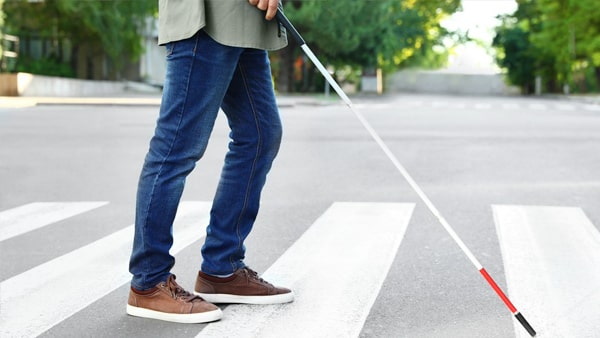
In Minnesota, a pedestrian carrying a predominantly white or metallic cane should be recognized as:

You need to use extra caution when driving near a pedestrian using a white cane because:
  1. A. A person who is deaf
  2. B. A road construction worker
  3. C. A person who is totally or partially blind
  4. D. A person directing traffic

Correct answer: C. – A person who is totally or partially blind

A predominantly white or metallic cane, with or without a red tip, identifies a totally or partially blind pedestrian. When such a pedestrian enters an intersection, a motor vehicle driver must stop and give the pedestrian the right-of-way. The same intersection duty applies when a blind pedestrian is using a guide dog.

Source: Minn. Stat. § 169.202, subds. 1–2 — Blind Person Carrying White Cane