Minnesota DMV Practice Test 9

4.7 out of 5 (245 votes)
80% Passing score
20 Questions
4 Mistakes allowed
School bus safety deserves its own MN permit test practice because Minnesota treats it like a real driving responsibility, not a tiny footnote buried somewhere in the Driver’s Manual. This ninth test in our Minnesota practice permit test series puts all 20 questions on school buses: when you must stop, when traffic coming the other way must stop, what flashing lights actually require, and how to think around children who may be crossing before every driver nearby has fully caught up with the situation. Which happens. More than it should, honestly. The Minnesota Class D knowledge test is the written permit test for a standard passenger-vehicle instruction permit, and it is administered by Minnesota Driver and Vehicle Services, better known as DVS. The official study source is the Minnesota Driver’s Manual, so the real exam can reach into traffic laws, signs, signals, pavement markings, right-of-way, defensive driving, winter driving, impaired driving rules, vehicle safety, and sharing the road with buses, pedestrians, bicyclists, motorcycles, trucks, and emergency vehicles. School buses are not floating off in some separate little category. They are part of the larger test because they are part of the larger job of driving. The real Minnesota permit test has 40 questions, with 32 correct answers needed to pass. That is 80%, or up to 8 missed questions. This MN DMV practice test uses the same basic passing standard: get at least 16 out of 20 correct, and you are showing the kind of working knowledge you want before the official test. Not perfect knowledge, necessarily. Useful knowledge. The kind that keeps you from second-guessing yourself when a bus stops on a two-lane road and the answer choices start sounding just close enough to be irritating. Each attempt draws from a larger pool of questions, so you are not just rehearsing the same handful of lines until they feel familiar. You will see bus rules from different angles, with slightly different setups, because that is usually where people get tripped up. Afterward, the review explains what you missed, which is the part worth slowing down for. Minnesota allows only one knowledge-test attempt per day, the first two Class D attempts come without a DVS retest charge, and the third and later attempts after two failures carry a $10 fee. So, yes, practice first. It is the calmer place to be wrong.
FREE DMV Practice Test App
Study for your Minnesota permit test or driver’s license with the NextDoorDriving app. 700+ DMV questions and answers, 100% free!
Download on the App Store

Sample Minnesota Permit Test Questions

Question 1

Should you shift into neutral and coast while traveling down a steep hill?

  1. A. No, because the vehicle can continue gaining speed
  2. B. Yes, because neutral improves steering control
  3. C. Only when there is little traffic
  4. D. Only if the vehicle has anti-lock brakes

Correct answer: A. – No, because the vehicle can continue gaining speed

The Minnesota Driver’s Manual instructs drivers not to coast down steep hills with the transmission in neutral. A vehicle may continue gaining speed even when the accelerator is not being pressed. Remaining in gear provides better control of the vehicle’s speed while descending.

Source: Minnesota Driver’s Manual — Ch. 6, “Driving on narrow roads and hills”

Question 2

May a Minnesota driver exceed the posted speed merely to keep up with traffic?

  1. A. Yes, whenever surrounding traffic is moving faster
  2. B. No, except for the limited 10-mph allowance when lawfully passing on a qualifying two-lane highway
  3. C. Yes, on rural roads when traffic is light

Correct answer: B. – No, except for the limited 10-mph allowance when lawfully passing on a qualifying two-lane highway

Drivers must use a reasonable and prudent speed and ordinarily may not exceed the applicable limit. Minnesota provides a narrow exception: the limit increases by 10 mph while lawfully passing on a two-lane highway with one lane in each direction and a posted limit of at least 55 mph. All passing requirements must still be satisfied.

Source: Minn. Stat. § 169.14, subds. 1, 2a – SPEED LIMITS, ZONES; RADAR.

Question 3

On a three-lane freeway, when may a driver use the open lane to your right to pass?

  1. A. Never, because every pass must be made on the left
  2. B. Only when the passing vehicle remains in your blind spot
  3. C. Only when the vehicle being passed is preparing to exit
  4. D. When traffic moves in one direction, the lane is unobstructed and the pass can be made safely

Correct answer: D. – When traffic moves in one direction, the lane is unobstructed and the pass can be made safely

Minnesota permits passing on the right on a one-way roadway or another roadway restricted to one direction when there is enough unobstructed width for at least two lines of moving vehicles. The maneuver must be safe. A driver may not use a bicycle lane, shoulder or area outside the main-traveled roadway to complete the pass.

Source: Minn. Stat. § 169.18, subd. 4 – DRIVING RULES., Minnesota Driver’s Manual — Ch. 3, “Passing on the right”

Question 4

At a red signal with no stop line, where must you stop when a crosswalk is present?

  1. A. At the far corner of the intersection
  2. B. Before entering the crosswalk
  3. C. Just beyond the crosswalk
  4. D. At least 15 feet from the corner

Correct answer: B. – Before entering the crosswalk

When facing a steady red signal, first stop at a clearly marked stop line. If there is no stop line, Minnesota law requires you to stop before entering the crosswalk on the near side of the intersection. If neither a stop line nor a crosswalk exists, stop before entering the intersection.

Source: Minn. Stat. § 169.06, subd. 4(3)(i) – SIGNS AND SIGNALS.

Question 5

A two-way road has a solid yellow line and a broken yellow line, with the broken line beside your lane. When may you pass?

When the road is marked with a solid yellow line and a broken yellow line on your side you may pass:
  1. A. Only when responding to an emergency
  2. B. Only when the road is an expressway
  3. C. When passing is otherwise lawful and traffic conditions make it safe
  4. D. Only while traveling through an intersection

Correct answer: C. – When passing is otherwise lawful and traffic conditions make it safe

A broken yellow line beside your lane indicates that passing may be permitted. Before crossing the centerline, verify that the roadway is clear and that the maneuver can be completed safely and lawfully. Do not pass when a solid yellow line is beside your lane, a no-passing sign is posted or another passing restriction applies.

Source: Minn. Stat. § 169.18, subd. 5 – DRIVING RULES., Minnesota Driver’s Manual — Ch. 3, “Passing”

Question 6

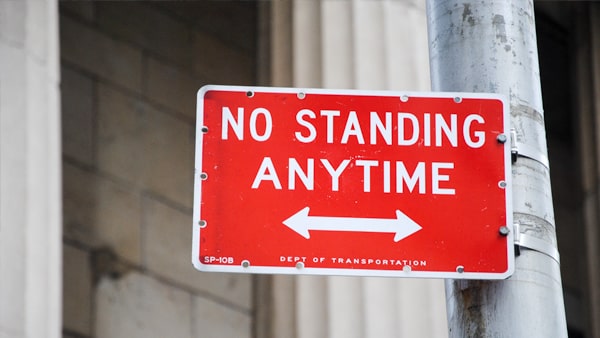
What does a NO STANDING sign ordinarily allow?

A "no standing sign" at a certain location means:
  1. A. No stopping for any reason
  2. B. Parking if the driver stays inside
  3. C. A temporary stop while actively picking up or dropping off passengers
  4. D. Stopping to load or unload merchandise

Correct answer: C. – A temporary stop while actively picking up or dropping off passengers

Under Minnesota’s statutory definition, “standing” does not include a temporary stop made while a vehicle is actually receiving or discharging passengers. A NO STANDING sign therefore permits that limited passenger-loading activity but does not permit parking or waiting. Loading merchandise is not included in the passenger exception.

Source: Minn. Stat. § 169.011, subd. 78 – DEFINITIONS.