Minnesota Road Signs Test 2

4.7 out of 5 (218 votes)
80% Passing score
20 Questions
4 Mistakes allowed
If you are studying for the Minnesota Class D knowledge test, road signs need more than a quick glance through the manual. They are part of the same exam as traffic laws, signals, pavement markings, right-of-way rules, and general safe-driving material, so they are not handled as a separate road-sign-only test for a standard instruction permit. That matters because sign questions still count toward your final score, and they can be the kind of questions people miss simply because they looked familiar and got answered too quickly. This Minnesota road sign practice test gives you 20 multiple-choice questions focused on sign recognition, traffic-control situations, pavement markings, and the sign-related details covered in the Minnesota driver’s manual. It is a focused review, not a replacement for studying the full manual, but it gives you useful practice with the visual material that tends to show up on the official MN DMV knowledge test. Warning signs, regulatory signs, guide signs, construction-zone signs, lane-use markings — all of it is fair game, and some of it is more precise than people expect. That precision matters in Minnesota. A sign on a dry suburban road in May is one thing; the same instruction during a snowy Duluth commute or near a rural deer crossing can feel a little less theoretical. Then there is summer roadwork, which arrives with cones, lane shifts, temporary signs, and enough visual clutter to make even an experienced driver slow down and re-check what is happening. So, yes, this is test preparation, but it is also practical driving preparation, which sounds a little earnest but happens to be true. On the official Minnesota Class D knowledge test, there are 40 questions, and you need 32 correct answers to pass. You can miss up to 8 questions total. Road sign questions are included in that same overall score; there is no separate road-sign score or special missed-question limit for signs. Still, every missed sign question counts, and those misses are usually the ones that feel avoidable once you see the correct answer. Minnesota applicants may take the Class D knowledge test at a state exam station, through online testing, or at an authorized third-party testing location. The online option can be taken from home, but it requires a proctor who is at least 21 and holds a valid Minnesota driver’s license. You generally get two online attempts, with only one attempt allowed per day; after two failed online attempts, the next try must be at an exam station, and the third-test fee may apply. Some third-party testing sites also offer electronic knowledge testing and may charge an administration fee. Use this MN DMV practice test as a focused road sign review before the real knowledge test. Take it once to find the weak spots, then go back through the questions you missed instead of just chasing a better score. The point is not only to recognize the sign. It is to understand what the sign is telling you to do, quickly and correctly, before the official test asks you — or the road does.
FREE DMV Practice Test App
Study for your Minnesota permit test or driver’s license with the NextDoorDriving app. 700+ DMV questions and answers, 100% free!
Download on the App Store

Sample Minnesota Permit Test Questions

Question 1

Which color lines normally separate traffic moving in opposite directions?

  1. A. White
  2. B. Red
  3. C. Black
  4. D. Yellow

Correct answer: D. – Yellow

Yellow lines separate traffic moving in opposite directions. Depending on whether the lines are solid, broken, or mixed, they also indicate where passing is permitted or prohibited. Drivers must obey the marking on their side of the roadway.

Source: Minnesota Driver’s Manual — Ch. 5, “Pavement markings: Yellow lines”
Question 2

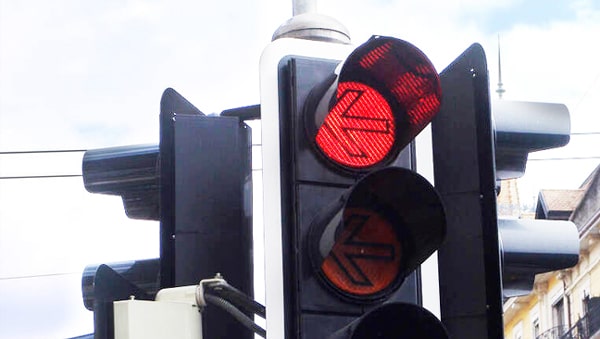
You face a steady red arrow, and no sign permits a turn on the red arrow. What must you do?

What is the difference between traffic lights with red arrows and those with solid red lights?
  1. A. Remain stopped until a permissive signal allows the arrow movement
  2. B. Turn after stopping if no vehicle is approaching
  3. C. Proceed because arrows apply only to pedestrians
  4. D. Turn after slowing and sounding the horn

Correct answer: A. – Remain stopped until a permissive signal allows the arrow movement

Under Minnesota law, traffic facing a steady red arrow must stop and remain stopped until a permissive signal authorizes the movement. A turn on a red arrow is allowed only when an official sign expressly permits it; the driver must first stop and yield. Without that sign, a clear intersection does not authorize the turn.

Source: Minn. Stat. § 169.06, subd. 5(a)(3)(iii) – Signs, Signals, Markings

Question 3

Which color lines normally separate lanes traveling in the same direction?

  1. A. Yellow
  2. B. White
  3. C. Red
  4. D. Black

Correct answer: B. – White

White lines separate lanes of traffic traveling in the same direction. Broken white lines generally allow lane changes, while solid white lines indicate that drivers should not change lanes. Double solid white lines must not be crossed to change lanes.

Source: Minnesota Driver’s Manual — Ch. 5, “Pavement markings: White lines”

Question 4

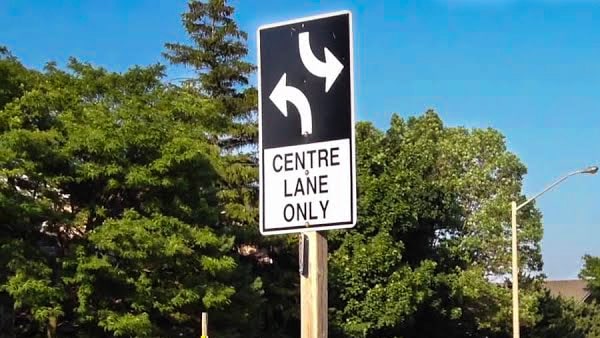
A center lane marked for left turns from both directions may be used to:

From the center lane, what maneuvers can you perform?
  1. A. Make a left turn onto another road or driveway
  2. B. Make any U-turn without checking traffic
  3. C. Pass slower vehicles
  4. D. Travel continuously between intersections

Correct answer: A. – Make a left turn onto another road or driveway

On a Minnesota roadway, a center turn lane marked by parallel solid and broken yellow lines is reserved for left turns from either direction. Drivers may use it to turn left onto another roadway or driveway. It is not a passing lane or a lane for continuous travel.

Source: Minnesota Driver’s Manual — Ch. 5, “Center turn lanes”

Question 5

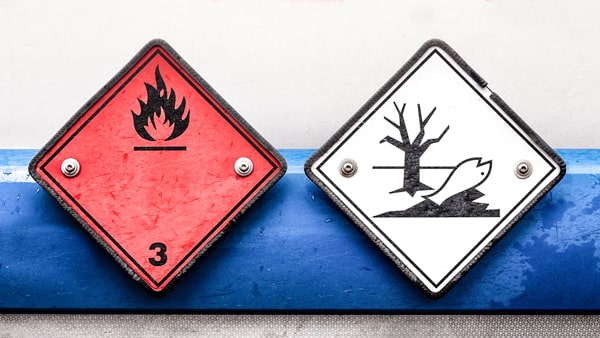
A truck displaying diamond-shaped hazardous-material placards approaches a railroad crossing that is not marked exempt. What must its driver do?

Which of the following is true about vehicles displaying a diamond-shaped sign (indicating a hazardous load)?
  1. A. Leave the freeway before reaching the crossing
  2. B. Reduce speed to 35 mph
  3. C. Stop before crossing the tracks
  4. D. Proceed first because placarded vehicles have priority

Correct answer: C. – Stop before crossing the tracks

In Minnesota, a placarded hazardous-material vehicle must stop between 15 and 50 feet from the nearest rail. The driver must look and listen for trains and proceed only when the crossing can be cleared without stopping. A vehicle otherwise required to stop need not do so at a crossing officially marked “Exempt,” unless directed otherwise.

Source: Minn. Stat. § 169.28, subds. 1(a), 2(d) – Certain Vehicles to Stop at Railroad Crossing, Minnesota Commercial Driver’s License (CDL) Manual — § 9.6.12, “Stop before Railroad Crossings”

Question 6

A traffic signal displays a green arrow together with a red circular light. What movement is permitted?

  1. A. Only travel straight ahead
  2. B. Only the movement indicated by the green arrow
  3. C. No movement until the circular light turns green
  4. D. Movement in every direction

Correct answer: B. – Only the movement indicated by the green arrow

Under Minnesota law, a driver facing a green arrow may cautiously enter the intersection to make the movement indicated by that arrow. The driver must still yield to pedestrians lawfully within an adjacent crosswalk and to other traffic lawfully using the intersection. The red circular signal continues to prohibit movements not authorized by another displayed indication.

Source: Minn. Stat. § 169.06, subd. 5(a)(1)(ii) – Signs, Signals, Markings