Minnesota DMV Sign Test 3

4.7 out of 5 (219 votes)
80% Passing score
20 Questions
4 Mistakes allowed
Minnesota road signs are not background decoration. They are the little commands, warnings, and course corrections that keep a normal drive from turning into guesswork, especially when the lane markings are half-buried in slush or the roadwork signs seem to appear out of nowhere on a summer highway. This MN road sign practice test is built around that practical kind of recognition: knowing the shape, color, and meaning of a sign quickly enough that you are not sitting there mentally flipping through the driver’s manual while traffic keeps moving. This is the third MN road sign practice test in the series, and it puts extra attention on sign shapes. That matters more than it sounds like it should. An octagon tells you something before the word “STOP” even registers. A triangle has its own job. Rectangular signs, diamond-shaped warnings, route markers, school-zone signs — they all give you clues before you read a single line of text. And in Minnesota, where winter weather can make signs harder to see and react to, that quick recognition is not just test prep theater. It is part of driving competently. For the official Minnesota Class D knowledge test, road signs are folded into the main permit exam rather than treated as a separate road-sign-only test. The real knowledge test includes Minnesota traffic laws, signals, pavement markings, right-of-way, defensive driving, winter driving, and the usual mix of shared-road responsibilities. The full exam has 40 questions, and you need 32 correct to pass, which means 80%. So, yes, signs matter — but they count inside the larger score, not in their own private little category. This free MN DMV road sign practice test gives you 20 multiple-choice questions, with 16 correct answers needed to pass. It is short enough to repeat without making a whole afternoon of it, but focused enough to show whether you actually know the signs or just recognize the easy ones. Use it alongside the Minnesota Driver’s Manual, as a drivers ed refresher, or as a final tune-up before the real permit test. Better to find the weak spots here, quietly, than discover them later when the official test clock is running and the answer choices all look a little too friendly.
FREE DMV Practice Test App
Study for your Minnesota permit test or driver’s license with the NextDoorDriving app. 700+ DMV questions and answers, 100% free!
Download on the App Store

Sample Minnesota Permit Test Questions

Question 1

Which pavement marking identifies the movements permitted from a turn lane?

  1. A. Flashing red signals
  2. B. Flashing yellow signals
  3. C. White edge lines beside the shoulder
  4. D. White directional arrows within the lane

Correct answer: D. – White directional arrows within the lane

White arrows painted within turn lanes show the movement or movements permitted from those lanes. Some arrows are accompanied by the word “ONLY,” requiring the driver to turn as indicated. A lane with multiple arrows may permit a turn, straight travel, or a combination of movements.

Source: Minnesota Driver’s Manual — Ch. 5, “Turn lanes”

Question 2

A black chevron on a yellow rectangular sign indicates that:

When you see this black and yellow sign, it means:
  1. A. The road to the right carries one-way traffic
  2. B. A construction detour turns right
  3. C. The roadway changes direction sharply
  4. D. A side road enters from the right

Correct answer: C. – The roadway changes direction sharply

A chevron alignment sign provides additional warning and guidance where the roadway changes direction. It is positioned on the outside of a turn or curve and points in the direction drivers must follow. Reduce to a safe speed before following the change in alignment.

Source: Minnesota MUTCD, 11th Edition including Revision 1 — § 2C.08, “Chevron Alignment Sign (W1-8)”, Minnesota Driver’s Manual — Ch. 5, “Road Turns Ahead”

Question 3

When a traffic signal changes to steady yellow as you approach, you should:

  1. A. Accelerate before the light turns red
  2. B. Yield only to vehicles entering from the right
  3. C. Stop before the intersection if you can do so safely
  4. D. Stop immediately, even if a safe stop is impossible

Correct answer: C. – Stop before the intersection if you can do so safely

In Minnesota, a steady yellow signal warns that the related green movement is ending or a red indication will appear immediately. Do not enter the intersection if you can stop safely before it. If a safe stop is not possible, proceed through cautiously rather than braking abruptly.

Source: Minn. Stat. § 169.06, subd. 5(a)(2)(i) – Signs, Signals, Markings, Minnesota Driver’s Manual — Ch. 5, “Traffic-control signals”

Question 4

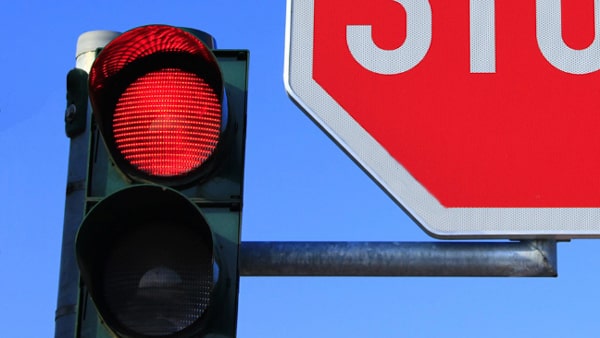
What is required when you approach a flashing red traffic signal?

If you are approaching an intersection with a red flashing light, what should you do?
  1. A. Continue without reducing speed
  2. B. Slow down and yield without stopping
  3. C. Wait until the signal displays steady green
  4. D. Stop, then proceed when right-of-way rules allow

Correct answer: D. – Stop, then proceed when right-of-way rules allow

Minnesota law requires a complete stop at the stop line, before the crosswalk, or at the nearest point with a view of approaching traffic. After stopping, follow the same right-of-way rules that apply at a stop sign. Enter only when it is safe and lawful to proceed.

Source: Minn. Stat. § 169.06, subd. 7(a) – Signs, Signals, Markings, Minnesota Driver’s Manual — Ch. 5, “Traffic-control signals”

Question 5

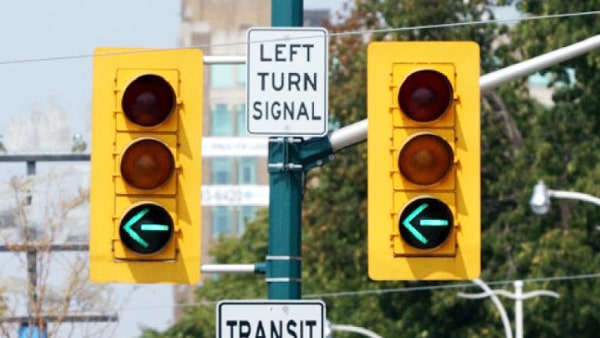
What does a green left-turn arrow authorize you to do?

A green arrow pointing to the left on a traffic light means you may:
  1. A. Turn left or continue straight regardless of other indications
  2. B. Stop before making the indicated turn
  3. C. Turn left cautiously after yielding to lawful traffic and pedestrians
  4. D. Turn without checking whether the intersection is occupied

Correct answer: C. – Turn left cautiously after yielding to lawful traffic and pedestrians

A green arrow permits movement in the arrow’s direction and normally provides a protected turn. Minnesota law still requires the driver to enter cautiously and yield to pedestrians in an adjacent crosswalk and to traffic lawfully using the intersection. The arrow does not authorize an unsafe turn through an occupied intersection.

Source: Minn. Stat. § 169.06, subd. 5(a)(1)(ii) – Signs, Signals, Markings, Minnesota Driver’s Manual — Ch. 5, “Traffic-control signals”

Question 6

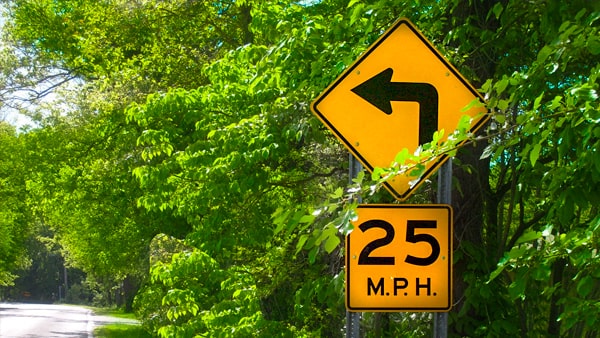
The pictured left-curve sign with a 25 mph plaque advises you to:

This sign means:
  1. A. Curve left while traveling at least 25 mph
  2. B. Curve right while traveling at least 25 mph
  3. C. Expect a right curve and slow to 25 mph
  4. D. Expect a left curve and slow to 25 mph

Correct answer: D. – Expect a left curve and slow to 25 mph

The warning sign shows that the roadway curves to the left. The accompanying plaque tells drivers to slow to the indicated 25 mph for the curve. A yellow advisory-speed plaque is different from a regulatory speed-limit sign, but drivers should use the advised speed to prepare for the roadway alignment.

Source: Minnesota Driver’s Manual — Ch. 5, “Curve”