


Minnesota DMV Sign Test 4

4.7 out of 5 (194 votes)
80% Passing score
20 Questions
4 Mistakes allowed
Minnesota road signs are a big part of the Class D knowledge test, mixed in with traffic signals, pavement markings, lane rules, and the other material drivers are expected to understand before they get behind the wheel. That matters, because road signs are easy to brush off as “common sense” until you run into a question about shape, color, or right-of-way language and realize the test is asking for more than a vague memory from the passenger seat. This MN DMV practice test gives you a focused way to work on that sign knowledge without turning every study session into a full manual review. It includes 20 multiple-choice questions centered on Minnesota road signs, sign colors, shapes, symbols, warnings, restrictions, and the kinds of traffic-control details that can appear on the real knowledge test. Red signs, yellow warning signs, regulatory signs, pavement markings — they all have a job, and the faster you recognize what they are telling you, the less guessing you do. For the actual Minnesota Class D knowledge test, there are 40 questions, and you need 32 correct answers to pass. You can miss up to 8 total. There is no separate road-sign-only test for the standard instruction permit, and there is no special road-sign missed-question limit, which is a detail people sometimes get wrong. Road sign questions simply count as part of the overall score. Fine. Slightly less dramatic. Still important. The real test may be taken at a state exam station, online with an eligible proctor, or through an authorized third-party testing location. Online testing has limits, including one test per day and a cap on online attempts before an in-person exam-station attempt may be required. And then, yes, there are the practical pieces: vision screening, documents, fees, language options, and retake rules. None of that is the fun part, but it is part of getting through the process cleanly. Use this Minnesota permit test practice as a sharper, more concentrated review of the signs section. Take it once to see where you stand, then take it again after the weak spots have had a little time to embarrass you into remembering them.
FREE DMV Practice Test App
Study for your Minnesota permit test or driver’s license with the NextDoorDriving app. 700+ DMV questions and answers, 100% free!
Download on the App Store

Sample Minnesota Permit Test Questions

Question 1

A protected left-turn arrow changes to a circular green light. What may you do?

  1. A. Turn left after yielding to oncoming traffic and pedestrians
  2. B. Proceed straight because left turns are no longer permitted
  3. C. Turn left with the same protection provided by the arrow
  4. D. Turn left only after coming to a complete stop

Correct answer: A. – Turn left after yielding to oncoming traffic and pedestrians

Under Minnesota law, a circular green signal permits a left turn unless a sign prohibits it. Unlike a green arrow, the circular green does not provide a protected left-turn movement. Yield to approaching vehicles that present an immediate hazard and to pedestrians crossing in front of the vehicle.

Source: Minn. Stat. § 169.06, subd. 5(a)(1)(i) – Signs, Signals, Markings, Minnesota Driver’s Manual — Ch. 5, “Traffic-control signals”
Question 2

When a signal turns green, what must you do before entering the intersection?

  1. A. Wait five seconds before moving
  2. B. Enter immediately to avoid delaying traffic
  3. C. Yield to vehicles and pedestrians lawfully still in the intersection
  4. D. Proceed because green gives an unconditional right-of-way

Correct answer: C. – Yield to vehicles and pedestrians lawfully still in the intersection

A green light permits you to proceed, but it does not give an unconditional right-of-way. Minnesota requires drivers to yield to vehicles and pedestrians lawfully within the intersection or adjacent crosswalk when green first appears. Check that your path is clear before moving.

Source: Minn. Stat. § 169.06, subd. 5(a)(1)(i) – Signs, Signals, Markings, Minnesota Driver’s Manual — Ch. 5, “Traffic-control signals”
Question 3

You may cross a broken white or yellow line only when:

  1. A. You have verified that the movement can be completed safely
  2. B. You are turning into any driveway
  3. C. The vehicle ahead is moving below the speed limit
  4. D. You are passing on the right side of a one-way street

Correct answer: A. – You have verified that the movement can be completed safely

Broken white lines allow lane changes, while broken yellow lines may permit passing into a lane used by opposing traffic. Minnesota requires a driver to verify that a lane movement is safe. A pass across the center line also requires enough clear roadway to complete the maneuver without interfering with approaching or overtaken traffic.

Source: Minn. Stat. § 169.18, subds. 5(a), 7(1) – Driving Rules, Minnesota Driver’s Manual — Ch. 5, “Pavement markings”

Question 4

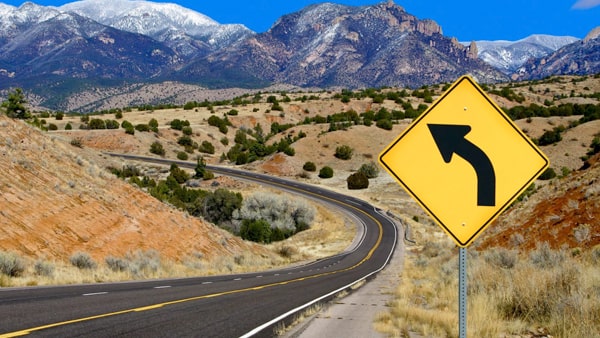
The pictured yellow sign with a left-curving arrow warns of:

This sign is used to warn drivers about:
  1. A. An intersection ahead
  2. B. A construction area
  3. C. A left curve in the roadway
  4. D. A reduction in the number of lanes

Correct answer: C. – A left curve in the roadway

A curve warning sign indicates that the roadway bends in the direction shown by its arrow. In this case, the road curves to the left. Reduce speed as needed before entering the curve and follow any advisory-speed plaque displayed below the warning sign.

Source: Minnesota Driver’s Manual — Ch. 5, “Curve”

Question 5

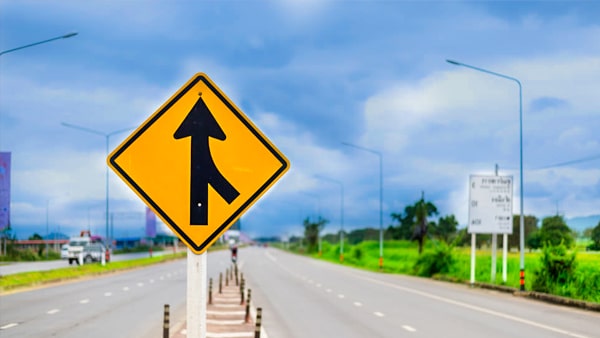
What condition does the pictured merge warning sign indicate?

This sign means:
  1. A. The road becomes two-way ahead
  2. B. Your lane ends and must merge right
  3. C. Traffic may enter the roadway on which you are traveling
  4. D. A divided highway begins

Correct answer: C. – Traffic may enter the roadway on which you are traveling

The merge warning sign tells drivers on the main roadway that vehicles may enter their traffic stream from another roadway. Watch the entering traffic and be prepared to make safe adjustments. The sign is different from a lane-ends warning, which indicates that two lanes on the same roadway will become one.

Source: Minnesota Driver’s Manual — Ch. 5, “Merging Traffic”

Question 6

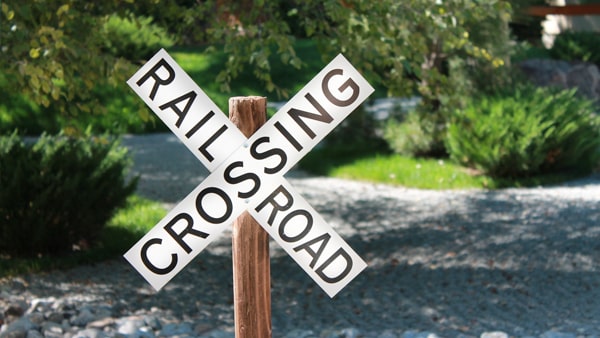
An X-shaped crossbuck sign identifies:

This road sign means:
  1. A. A place to stop only when cross traffic approaches
  2. B. A three-way highway intersection
  3. C. A standard crossroad intersection
  4. D. A railroad grade crossing

Correct answer: D. – A railroad grade crossing

In Minnesota, an X-shaped crossbuck marks a railroad grade crossing. A plaque below it may show the number of tracks. The crossbuck identifies the crossing; drivers must stop when a train or warning signal presents the conditions specified by law, or when directed by a flagger or lowered gate.

Source: Minn. R. 8830.0500 – Crossbuck Sign, Minn. Stat. § 169.26, subd. 1 – Special Stops at Railroad Crossing, Minnesota Driver’s Manual — Ch. 5, “Railroad Crossings”