Minnesota Road Signs Test Simulator

4.7 out of 5 (242 votes)
80% Passing score
25 Questions
5 Mistakes allowed
Minnesota road sign questions sit inside the regular Class D knowledge test, not off in a separate road-sign-only exam. That matters, because a lot of people study as if signs are their own little appointment with destiny, when really they are mixed in with traffic laws, right-of-way rules, pavement markings, safe-driving habits, winter driving, DWI rules, and the rest of the material from the Minnesota Driver’s Manual. The full MN permit test has 40 questions, and you need 32 correct answers to pass. So, yes, road signs count. They just count as part of the whole score. This Minnesota road signs practice test gives you a focused way to work on that one area without dragging yourself through every licensing topic at the same time. Each session includes 20 multiple-choice questions, and you will need 16 correct answers to pass, which keeps the same 80% standard used on the real knowledge exam. The questions come from a larger, updated database, so a new attempt is not just the same quiz wearing a different hat. You will see signs by shape, color, symbol, wording, and meaning, with visual prompts included where they actually help instead of just decorating the page. It is a useful tool for first-time teen drivers getting ready for an instruction permit, adults applying for a Minnesota license for the first time, new residents who want to get comfortable with state-specific expectations, and licensed drivers who are brushing up before renewal or retesting. Minnesota applicants must pass the Class D knowledge test and a vision screening before receiving an instruction permit. After that, the path depends on the driver. Teens deal with driver education, supervised driving hours, permit holding periods, and graduated licensing rules. Adults still need the permit, the practice, and the road test, just without the teen driver education requirements. Different lane, same licensing system—more or less. And that is the point of this MN DMV practice test. It does not pretend the real exam is only about signs. It narrows the focus on purpose, because sign recognition is one of those skills that seems settled until you have to separate a warning sign from a regulatory sign, read a lane marking correctly, or remember what a shape is telling you before the words even register. On Minnesota roads—snow, construction, rural highways, Twin Cities traffic and all—that kind of recognition is not trivia. It is part of driving well. Use this practice test to tighten that piece first, then carry the confidence into your full Minnesota permit test practice.

FREE DMV Practice Test App
Study for your Minnesota permit test or driver’s license with the NextDoorDriving app. 700+ DMV questions and answers, 100% free!
Download on the App Store

Sample Minnesota Permit Test Questions

Question 1

A steady yellow traffic signal warns that the signal will soon display:

  1. A. A flashing yellow indication
  2. B. A steady green indication
  3. C. A steady red indication
  4. D. A flashing red indication

Correct answer: C. – A steady red indication

Minnesota law states that a steady yellow signal warns that the related green or flashing-yellow movement is ending and a red indication will immediately follow. Do not enter if you can stop safely before the intersection. If you cannot stop safely, proceed through with caution.

Source: Minn. Stat. § 169.06, subd. 5(a)(2)(i) – Signs, Signals, Markings, Minnesota Driver’s Manual — Ch. 5, “Traffic-control signals”

Question 2

According to the Minnesota Driver’s Manual, a curb painted yellow marks a place where:

  1. A. Parking is not allowed
  2. B. Only buses may park
  3. C. Only emergency vehicles may stop
  4. D. Disability parking is permitted

Correct answer: A. – Parking is not allowed

The Minnesota Driver’s Manual identifies a yellow-painted curb as a place where parking is prohibited. Do not confuse yellow curb paint with designated disability parking, which is identified by blue signs. Drivers must also obey any official parking signs posted at the location.

Source: Minnesota Driver’s Manual — Ch. 3, “Parking”

Question 3

You have a green light and are waiting to turn left across heavy oncoming traffic. Where should you wait?

  1. A. At the next intersection
  2. B. Behind the crosswalk until all traffic disappears
  3. C. In the intersection while yielding to oncoming traffic
  4. D. In the oncoming lane because the light is green

Correct answer: C. – In the intersection while yielding to oncoming traffic

In Minnesota, a driver waiting to turn left at a green light may position the vehicle in the intersection, approximately even with the curb line. The driver must continue yielding to oncoming vehicles that are in the intersection or close enough to be an immediate hazard. Complete the turn when it is safe.

Source: Minn. Stat. § 169.20, subd. 2 – Right-of-Way, Minnesota Driver’s Manual — Ch. 3, “Turning”

Question 4

When may you make a right turn at a steady circular red signal?

  1. A. After stopping and yielding to pedestrians and lawful traffic
  2. B. Whenever a red arrow points right
  3. C. Only when approaching from the left lane
  4. D. After slowing without stopping

Correct answer: A. – After stopping and yielding to pedestrians and lawful traffic

Minnesota permits a right turn at a circular red signal after a complete stop unless an official sign prohibits the turn. Before turning, yield to pedestrians and other traffic lawfully proceeding through the intersection. Merely slowing down does not satisfy the stop requirement.

Source: Minn. Stat. § 169.06, subd. 5(a)(3)(i)(A) – Signs, Signals, Markings, Minnesota Driver’s Manual — Ch. 3, “Turning on a red light”

Question 5

When the centerline has one solid yellow line and one broken yellow line, you may pass if the line on your side is:

You may cross a double line to pass another vehicle if the line on your side is:
  1. A. Solid yellow
  2. B. Double solid yellow
  3. C. Broken yellow
  4. D. Solid white

Correct answer: C. – Broken yellow

The Minnesota Driver’s Manual states that you must obey the centerline marking on your side. A broken yellow line permits passing, while a solid yellow line prohibits it. Passing is still allowed only when the roadway is clearly visible, sufficient distance is available, and no other passing restriction applies.

Source: Minn. Stat. § 169.18, subd. 5(a), (b)(3) – Driving Rules, Minnesota Driver’s Manual — Ch. 5, “Pavement markings: Yellow lines”

Question 6

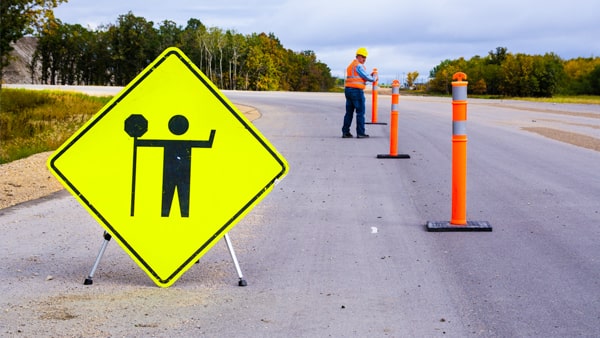
An orange diamond sign showing a person holding a flag warns that:

This sign means:
  1. A. A pedestrian crossing is ahead
  2. B. The work zone has ended
  3. C. A school crossing is ahead
  4. D. A flagger is directing traffic ahead

Correct answer: D. – A flagger is directing traffic ahead

This construction-zone sign indicates that a person with a flag is ahead. Approach cautiously and be ready to slow or stop. Drivers must follow directions given by people using flags, orange signs, or stop signs to control traffic through a work zone.

Source: Minnesota Driver’s Manual — Ch. 5, “Construction signs”