Missouri DMV Practice Test 9

4.9 out of 5 (128 votes)
80% Passing score
20 Questions
4 Mistakes allowed
Missouri’s ninth DMV practice test gets into one of those topics that feels simple in theory and then suddenly asks you to remember exactly what drivers are supposed to do around a stopped school bus. That matters, obviously, because this is not just permit-test trivia. School bus rules are tied to real safety, and Missouri expects new drivers to know how to handle them without guessing their way through the answer choices. This Missouri DMV permit practice test includes 20 questions focused on school bus safety and the rules drivers need to recognize before taking the real Class F written test. The official Missouri knowledge test is a 25-question, multiple-choice exam based on the Missouri Driver Guide, and you need 20 correct answers to pass. So, yes, the real thing is not endless, but there is not much room for casual “I’m pretty sure” answers either. The practice test is built to help you slow down and actually learn the rule behind the question. A hint is available when the wording starts to feel too close for comfort, and if you miss a question, the explanation tells you why the correct answer works instead of just waving you along to the next one. That is the useful part, really. You are not only checking whether you remembered something; you are tightening up the little weak spots before they cost you points at the testing station. It also fits neatly beside the rest of your Missouri permit prep. The real driver examination includes the written test, vision screening, road sign test, and driving skills test, with testing handled by the Missouri State Highway Patrol before you take your Driver Examination Record to a license office. For teen applicants, the instruction permit starts at age 15, and the licensing process eventually includes supervised driving requirements, so the written test is only one piece of the bigger licensing picture. Use this school bus practice test as targeted preparation, not a substitute for the Driver Guide, and take it more than once if you need to. Repetition is not glamorous here, but it works — especially when the goal is walking into the Missouri permit test with fewer surprises and a much better sense of what the state actually expects you to know.
FREE DMV Practice Test App
Study for your Missouri permit test or driver’s license with the NextDoorDriving app. 700+ DMV questions and answers, 100% free!
Download on the App Store

Sample Missouri Permit Test Questions

Question 1

If signs and lane markings do not direct otherwise, begin a left turn from a one-way street in:

  1. A. The far-left lane available for your direction
  2. B. Any lane that appears open
  3. C. The lane nearest the right curb
  4. D. The center lane

Correct answer: A. – The far-left lane available for your direction

A driver intending to turn left at an intersection must approach from the extreme left-hand lane lawfully available in the direction of travel. After entering the intersection, complete the turn into a lane lawfully available on the roadway being entered. Follow any traffic-control signs or pavement markings that direct a different turning path.

Source: RSMo § 304.341.1(2)–(3) – Turns at intersection — violation, penalty
Question 2

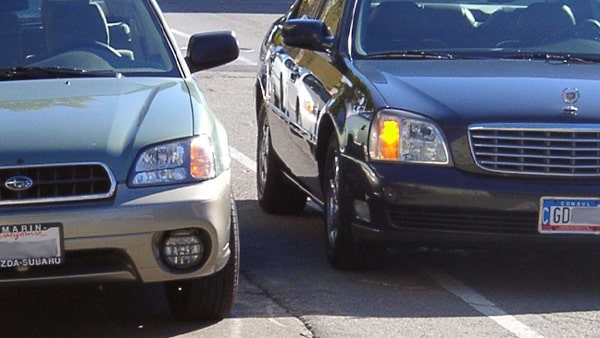
Under normal conditions, which action describes prohibited double parking?

Which of the following is true about double parking?
  1. A. Stopping on the roadway side of a vehicle parked at the curb
  2. B. Parking parallel within a legal marked space
  3. C. Using a designated loading area as posted
  4. D. Parking in a lawful space on a one-way street

Correct answer: A. – Stopping on the roadway side of a vehicle parked at the curb

Missouri’s model traffic ordinance prohibits stopping, standing, or parking on the roadway side of a vehicle already stopped or parked at the curb. Limited exceptions apply when necessary to avoid a traffic conflict or to comply with law, a police officer, or an official traffic-control device. Drivers should not park where they block the normal flow of traffic.

Source: RSMo § 300.440.1(1)(a) – Stopping, standing or parking prohibited, Missouri Driver Guide — Ch. 5, “No-Parking Zones”

Question 3

Which traffic signal requires a complete stop?

  1. A. A flashing red light
  2. B. A steady yellow light
  3. C. A steady yellow arrow
  4. D. A flashing yellow light

Correct answer: A. – A flashing red light

A flashing red signal requires a complete stop at the marked stop line. If there is no line, stop before the crosswalk or at the nearest point where you can see approaching traffic before entering the intersection. After stopping, proceed according to the same right-of-way rules that apply at a stop sign.

Source: RSMo § 304.301.1(1) – Rules for vehicular traffic controlled by flashing signals — violation, penalty

Question 4

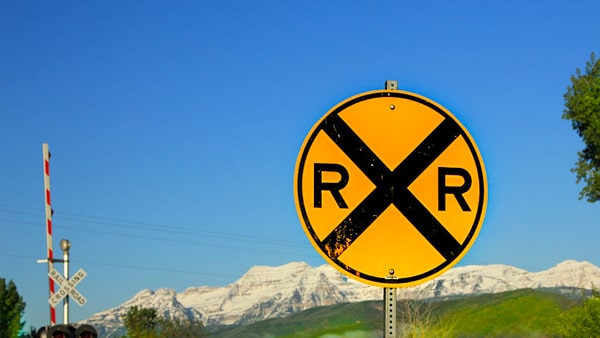
A round yellow sign displaying a black “X” and the letters “RR” warns of:

This sign is a warning that you are approaching:
  1. A. An ordinary road intersection
  2. B. A pedestrian crosswalk
  3. C. A railroad crossing ahead
  4. D. A blasting zone

Correct answer: C. – A railroad crossing ahead

The round advance-warning sign tells drivers they are nearing a railroad crossing. Be alert for tracks, crossing signals, gates, and trains. Do not begin crossing the tracks unless there is enough space for your entire vehicle on the other side.

Source: Missouri Driver Guide — Ch. 7, “Railroad Crossing”

Question 5

Under Missouri law, when must a vehicle’s headlights be on?

When should you use your headlights while driving?
  1. A. Only from sunset until sunrise
  2. B. From one-half hour after sunset to one-half hour before sunrise and when weather or visibility requires them
  3. C. Only when windshield wipers are operating in rain
  4. D. Only on unlighted rural roads

Correct answer: B. – From one-half hour after sunset to one-half hour before sunrise and when weather or visibility requires them

Lighted lamps are required from one-half hour after sunset until one-half hour before sunrise and whenever people or vehicles cannot be clearly seen 500 feet ahead. They are also required when weather makes windshield-wiper use necessary for prudent driving and during fog. A weather- or fog-related headlight violation carries a $10 fine without court costs.

Source: RSMo § 307.020(9) – Definitions, RSMo § 307.040.1–.2 – When lights required — violation, penalty

Question 6

What should you understand about combining alcohol with prescription or over-the-counter medication?

  1. A. Medication cancels alcohol’s effects
  2. B. Alcohol makes cold medicine work more quickly
  3. C. The combination can be dangerous and cause unexpected side effects
  4. D. The substances cannot affect each other

Correct answer: C. – The combination can be dangerous and cause unexpected side effects

Prescription and over-the-counter medications can impair driving even when taken as directed. Using medication with alcohol can be dangerous and may cause unexpected side effects affecting judgment, vision, reflexes, or alertness. Read medication warnings and ask a physician or pharmacist if you are unsure how a medicine may affect your ability to drive.

Source: Missouri Driver Guide — Ch. 10, “Prescription and Over-the-Counter Medications”, Missouri Driver Guide — Ch. 10, “Physical and Mental Effects of Alcohol and Drugs”