Missouri DMV Sign Test 3

4.9 out of 5 (147 votes)
80% Passing score
20 Questions
4 Mistakes allowed
Missouri puts road signs in their own lane on the driver exam, and that tells you something. They are not filler material tucked into the back of the Missouri Driver Guide so someone can ask a few easy questions later. The state’s driver examination includes the written knowledge test, vision test, road sign test, and driving skills test, and you have to clear the written, vision, and sign tests before you get to the road test. So the shape of a sign, the color, the category it belongs to — all of that matters more than people sometimes want it to matter. This MO permit practice test gives you 20 focused questions on the road sign knowledge Missouri expects new drivers to have. A passing score is 16 out of 20, which is a practical 80% benchmark, not a vague “you seem ready” kind of measure. The questions lean into the things that actually show up in sign study: octagons that mean stop, triangles that tell you to yield, rectangular regulatory and guide signs, warning signs, traffic signals, pavement markings, and those little visual cues that are easy to skim over when you are only half-studying. And, well, half-studying signs is usually where the mistakes start. Missouri’s separate Class F written knowledge test is its own deal: 25 multiple-choice questions, not open book, based on traffic laws, safe driving practices, rules of the road, signs and signals, markings, sharing the road, distracted driving rules, alcohol and drug laws, and safe vehicle operation topics from the Driver Guide. You need 20 correct answers to pass that exam. The road sign test is separate, but the overlap is obvious enough. Signs are part of the written material, part of the sign test, and part of real driving once the testing center is behind you. Use this Missouri sign test DMV practice as a quieter place to get the details wrong before they count. That sounds a little dramatic, maybe, but it is true. Practicing online lets you slow down, notice why a sign means what it means, and build recognition instead of just guessing from memory. Pair it with the Missouri Driver Guide, road sign charts, flashcards, or a drivers education course, and you will be studying in a way that actually fits the Missouri exam instead of just hoping the signs look familiar on test day.
FREE DMV Practice Test App
Study for your Missouri permit test or driver’s license with the NextDoorDriving app. 700+ DMV questions and answers, 100% free!
Download on the App Store

Sample Missouri Permit Test Questions

Question 1

A centerline has one solid and one broken yellow line, with the broken line next to your lane. When may you cross it to pass?

When the road is marked with a solid yellow line and a broken yellow line on your side you may pass:
  1. A. Only during an emergency
  2. B. Only when driving on an expressway
  3. C. When the road ahead is clear and the pass can be completed safely
  4. D. Only while traveling through an intersection

Correct answer: C. – When the road ahead is clear and the pass can be completed safely

Missouri’s Driver Guide permits crossing a broken line for a passing maneuver, while a solid line on your side should not be crossed to pass. The law also requires the left side to be visible and clear of oncoming traffic for enough distance to complete the pass safely. The broken line does not guarantee that conditions are safe.

Source: Mo. Rev. Stat. § 304.016.3 — Passing regulations — violations, penalties, Missouri Driver Guide — Ch. 7, “Meanings of Pavement Markings”, Missouri Driver Guide — Ch. 7, “No Passing Zones”
Question 2

When red inlaid pavement markers face you on a one-way roadway or ramp, what do they indicate?

  1. A. A busy intersection is ahead
  2. B. A stop sign is ahead
  3. C. The roadway must not be entered or used in your direction
  4. D. You are entering a no-passing zone

Correct answer: C. – The roadway must not be entered or used in your direction

Missouri traffic-engineering standards use red inlaid pavement markers to delineate one-way roadways, ramps, or travel lanes that must not be entered or used from the direction in which the markers are visible. Seeing the red faces indicates that you are traveling or attempting to enter in the wrong direction. They do not identify an ordinary no-passing zone.

Source: Missouri Engineering Policy Guide — § 620.1.3, “Colors”

Question 3

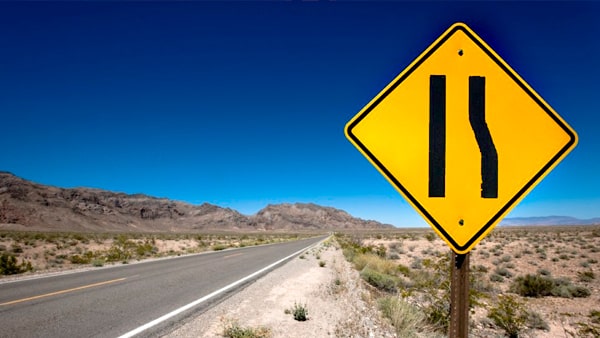
A yellow Lane Ends/Merge Left sign means:

This sign means:
  1. A. The right lane ends and its traffic must merge left
  2. B. A divided highway begins ahead
  3. C. A steep downhill grade begins ahead
  4. D. Trucks enter the roadway ahead

Correct answer: A. – The right lane ends and its traffic must merge left

This sign warns that two lanes will soon become one. If you are traveling in the right lane, you must merge left and yield to traffic already traveling in the left lane. Check surrounding traffic and prepare for the lane reduction before reaching the end of your lane.

Source: Missouri Driver Guide — Ch. 7, “Traffic Flow—Lane Ends/Merge Left”

Question 4

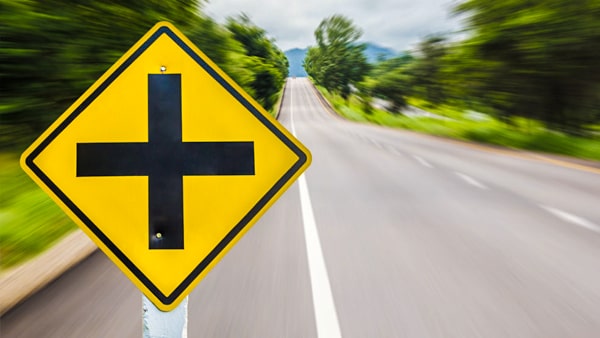
A yellow diamond sign displaying a black cross symbol warns that:

This sign means:
  1. A. A church is ahead
  2. B. A first-aid station is ahead
  3. C. Another road crosses your road ahead
  4. D. A railroad crossing is ahead

Correct answer: C. – Another road crosses your road ahead

The cross symbol is the Intersection warning sign. It tells you that another road crosses the roadway ahead. Watch carefully for vehicles that may cross your path as you approach the intersection.

Source: Missouri Driver Guide — Ch. 7, “Road Intersections—Intersection”

Question 5

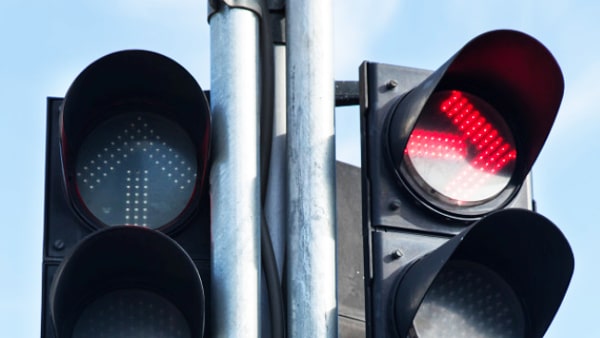
A steady red arrow pointing right means you must:

A red arrow pointing to the right on a traffic light means you may:
  1. A. Turn right after making a complete stop
  2. B. Remain stopped until a signal permits the movement
  3. C. Turn right after slowing and checking traffic
  4. D. Turn if no pedestrians are present

Correct answer: B. – Remain stopped until a signal permits the movement

The Missouri Driver Guide directs a driver facing a steady red arrow to stop at the stop line, crosswalk, or before the intersection. Remain stopped until a permitted indication appears, such as a green signal or a flashing yellow arrow. A right turn is not permitted merely because you stopped and found the roadway clear.

Source: Missouri Driver Guide — Ch. 7, “Left Turn Signals”

Question 6

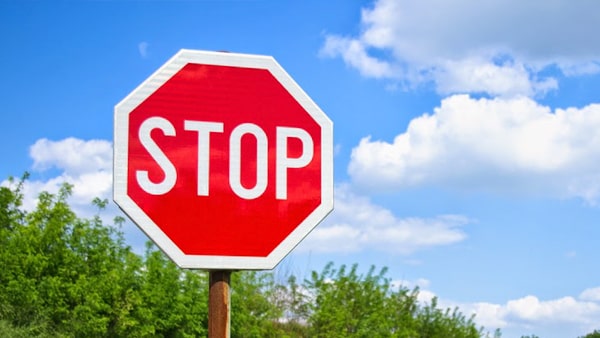
What must you do at a red, octagonal STOP sign?

When you see this sign, you must:
  1. A. Stop completely and yield until crossing vehicles and pedestrians have cleared
  2. B. Slow down but continue if the roadway appears clear
  3. C. Stop and wait for a green traffic signal
  4. D. Continue at low speed after checking for vehicles

Correct answer: A. – Stop completely and yield until crossing vehicles and pedestrians have cleared

A stop sign requires a complete stop at the marked stop line, before the near crosswalk if there is no line, or before entering the intersection if neither exists. After stopping, yield to vehicles that present an immediate hazard. The Driver Guide also directs drivers to wait until crossing vehicles and pedestrians have cleared the intersection.

Source: Mo. Rev. Stat. § 304.351.4(2)(a) — Right-of-way at intersection — signs at intersections — violation, penalty — additional penalties — definitions — order of suspension, contents, appeal, Missouri Driver Guide — Ch. 7, “Stop”