


Montana CDL Permit Test (MT) Online Simulator

5 out of 5 (40 votes)
80% Passing score
50 Questions
10 Mistakes allowed
Attention all aspiring commercial drivers in Montana! We are excited to introduce our innovative Montana CDL Permit Test Online Simulator, a unique and dynamic tool tailored to enhance your test preparation experience. Unlike standard CDL practice tests, this simulator elevates your study game, ensuring you're not just practicing, but mastering the material. Imagine a resource that adapts each time you use it. That's our simulator. Boasting over 700 Montana CDL test questions, it generates a fresh set of 50 multiple-choice and true/false questions every time you engage with it. This variety is crucial, as it mirrors the unpredictability of the actual Montana CDL test. Whether you're aiming for Class A or B licenses, our simulator has got you covered. One of the standout features of our simulator is its free access. We believe in equal opportunities for all, and by offering this top-notch resource at no cost, we level the playing field. It's a testament to our commitment to your success, providing the same caliber of preparation as paid alternatives. Our online DMV test simulator is designed to closely resemble the real Montana CDL test. The questions you'll tackle are not just similar in style but also in content, ensuring you're not caught off guard on test day. It's about building familiarity and confidence, two key ingredients for success. Remember, you need to answer at least 40 out of 50 permit test questions correctly to pass, but we encourage aiming higher. Our DMV permit test simulator allows unlimited attempts, giving you the freedom to practice until you feel fully prepared. This isn't just about passing; it's about excelling in 2026! So, gear up and use this CDL permit test simulator as your reliable study companion. It's your secret weapon to conquer the Montana CDL test with confidence and ease in 2026!
FREE CDL Practice Test App
Pass your Montana CDL General Knowledge test with the NextDoorDriving app. Real questions and answers—100% free and ad-free.
Download on the App Store

Sample Montana CDL Test Questions - General Knowledge

Question 1

When choosing a safe speed for a long mountain downgrade, which factors must be considered?

  1. A The combined weight of the vehicle and cargo
  2. B The grade’s length and steepness
  3. C Weather and roadway conditions
  4. D All of the above

Correct answer: D – All of the above

Montana’s CDL guidance lists vehicle and cargo weight, grade length, grade steepness, road conditions, and weather as factors in selecting a safe downhill speed. A heavier vehicle or steeper, longer grade places greater demands on the braking system. Slippery or poor road conditions require additional speed reduction.

Source: Montana Commercial Driver License Manual 2026 — § 2.16.1, “Select a ‘Safe’ Speed”
Question 2

Coffee and fresh air can quickly remove alcohol’s effects and make a person sober enough to drive.

  1. A True
  2. B False

Correct answer: B – False

Coffee, cold air, exercise, and cold showers do not speed the body’s removal of alcohol. The liver processes alcohol at a limited rate, and only time lowers the amount remaining in the body. Drinking faster than the body can process alcohol increases impairment and makes driving more dangerous.

Source: Montana Commercial Driver License Manual 2026 — § 2.22.1, “Alcohol and Driving”

Question 3

Which condition is a suspension-system defect?

  1. A A leaking shock absorber
  2. B An underinflated tire
  3. C A loose wheel lug nut
  4. D A cracked brake cylinder

Correct answer: A – A leaking shock absorber

A leaking shock absorber is listed as a suspension-system defect. Shock absorbers help control suspension movement and maintain vehicle stability. Underinflated tires and loose lug nuts are wheel or tire concerns, while a damaged brake component belongs to the braking system.

Source: Montana Commercial Driver License Manual 2026 — § 2.1, “Vehicle Inspection—Suspension System Defects”

Question 4

Which statement describes stab braking?

  1. A It must never be used under any circumstances
  2. B The brakes are fully applied, released when the wheels lock, and reapplied when they roll
  3. C Steady brake-pedal pressure is maintained without release
  4. D The brakes are released before any wheel begins to lock

Correct answer: B – The brakes are fully applied, released when the wheels lock, and reapplied when they roll

With stab braking, apply the brakes fully and release them when the wheels lock. Wait until the wheels begin rolling again, then apply the brakes fully once more. Reapplying too early prevents the vehicle from straightening because the wheels are still locked.

Source: Montana Commercial Driver License Manual 2026 — § 2.17.2, “How to Stop Quickly and Safely”

Question 5

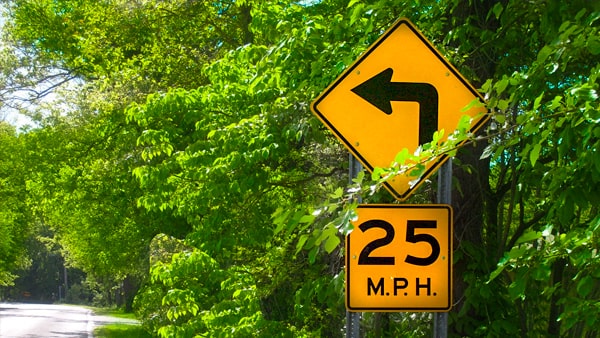
A yellow diamond sign displays a black arrow that curves to the left, with an advisory-speed plaque below it. What does the sign warn about?

This sign warns drivers to ____________.
  1. A A curve to the right
  2. B A curve to the left
  3. C A sharp left turn
  4. D A sharp right turn

Correct answer: B – A curve to the left

The sign warns that the road curves to the left ahead. The plaque below it shows a suggested safe speed for traveling through the curve. Montana’s driver guidance advises slowing before entering a curve because braking after entering can reduce traction and cause a skid.

Source: Montana Driver Manual — Ch. 3, “Signs”, Manual on Uniform Traffic Control Devices, 11th ed. — § 2C.07, “Horizontal Alignment Signs (W1-1 through W1-5, W1-11, and W1-15)”

Question 6

Your commercial vehicle is disabled on a straight, level, undivided Montana highway. Where should the three warning triangles be placed?

  1. A About 100 feet ahead, within 10 feet of the vehicle on the traffic side, and about 100 feet behind
  2. B At 10, 100, and 200 feet behind the vehicle
  3. C About 100 feet ahead and at 100 and 200 feet behind
  4. D At 100, 200, and 500 feet behind the vehicle

Correct answer: A – About 100 feet ahead, within 10 feet of the vehicle on the traffic side, and about 100 feet behind

On a two-way or undivided highway, place one warning device within approximately 10 feet of the vehicle to mark its location. Place the other two about 100 feet ahead of and 100 feet behind the vehicle, in the shoulder or occupied lane. Different placement is required when a hill, curve, or obstruction limits visibility.

Source: Montana Commercial Driver License Manual 2026 — § 2.5.2, “Communicating Your Presence”, 49 CFR § 392.22(b) – Emergency Signals; Stopped Commercial Motor Vehicles