


Montana Permit Test Simulator

4.8 out of 5 (35 votes)
82% Passing score
33 Questions
6 Mistakes allowed
A good Montana DMV practice test should do more than toss a few signs at you and call it preparation. Montana’s Class D knowledge test pulls from the official Driver Manual, and the exam expects you to understand traffic laws, road signs, signals, pavement markings, right-of-way rules, safe driving practices, impaired-driving laws, and the everyday judgment that matters on Montana roads. That last part sounds broad because it is. Rural highways, winter conditions, wildlife, long stretches between towns—Montana driving has its own texture, and the written test reflects enough of that to make casual studying a little risky. The real Montana permit test has 33 multiple-choice questions, and you need 27 correct answers to pass. That gives you room to miss 6, which is not a huge cushion once the questions start mixing legal wording with common-sense driving situations. This simulator follows that structure with 33 randomly selected questions each time you take it, so the practice does not become a memorized loop. One attempt may press harder on regulatory signs and traffic signals; another may drift into right-of-way, alcohol rules, pavement markings, or sharing the road. Slightly inconvenient, yes, but that is also what makes the practice useful. The test format stays close to what you will see at an MVD exam station: multiple-choice questions, straightforward answer choices, and feedback that explains what you missed instead of just leaving you with a red X and a vague feeling of betrayal. You can use the Montana permit practice test whenever you have time, whether that means a careful study session or a not-very-glamorous ten-minute run-through before the day gets away from you. And, because the written test is only one part of the licensing process, it helps to know where it fits. Teen drivers under 18 move through Montana’s Graduated Driver Licensing program, including learner-permit rules, supervised driving hours, and first-year restrictions. Adults 18 and older still need the written test, vision screening, required documents, and road test. New residents may have different transfer rules, depending on their current license. But for a first-time Montana permit applicant, the order is plain enough: learn the manual, practice the test format, pass the knowledge exam, and then move on to the next step without dragging the same uncertainty along with you.
FREE DMV Practice Test App
Study for your Montana permit test or driver’s license with the NextDoorDriving app. 700+ DMV questions and answers, 100% free!
Download on the App Store

Sample Montana Permit Test Questions

Question 1

Before passing in the opposing lane of a two-lane road, what must you evaluate?
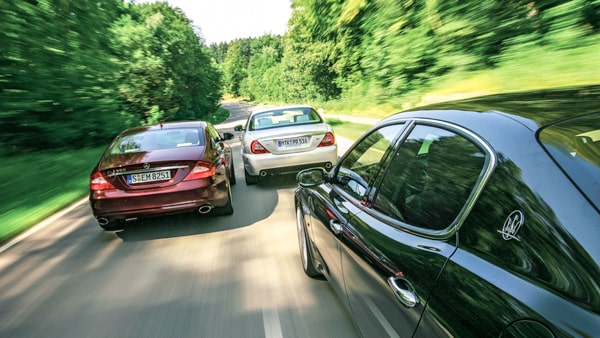
When passing in the oncoming traffic lane of a two-lane road, you should consider:
  1. A How quickly your vehicle can complete the pass
  2. B Whether enough clear space exists to pass and return
  3. C The speed of oncoming traffic and possible roadway hazards
  4. D All of these factors

Correct answer: D – All of these factors

Montana law permits passing left of the centerline only when that side is clearly visible and free of oncoming traffic for enough distance to complete the maneuver safely. You must account for the time and distance needed to pass, return safely, and avoid hazards. Do not begin if a hill, curve, intersection, railroad crossing, or other condition limits the required view or space.

Source: MCA § 61-8-325 – Limitations on Overtaking on the Left, Montana Driver Manual — Ch. 5, “Space for Passing”

Question 2

An approaching train is plainly visible and close enough to create a hazard. What must you do?

  1. A Slow down and cross before it reaches the roadway
  2. B Stop and remain off the crossing until you can proceed safely
  3. C Cross if the crossing has no working signals
  4. D Continue unless a flagger is present

Correct answer: B – Stop and remain off the crossing until you can proceed safely

In Montana, a driver must slow in preparation to stop and then stop as close as practicable, but not less than 15 feet from the nearest rail, when a train is plainly visible and in hazardous proximity. The driver may not proceed until the crossing can be made safely. This duty does not depend solely on gates or flashing signals.

Source: MCA § 61-8-347(1)(d) – Obedience to Signal Indicating Approach of Train or Other On-Track Equipment

Question 3

What condition is indicated by the pictured warning sign?

This sign means:
  1. A A sharp depression or dip in the roadway
  2. B A soft roadway shoulder
  3. C A pedestrian crossing
  4. D A required stop

Correct answer: A – A sharp depression or dip in the roadway

The DIP sign warns drivers of a sharp depression in the roadway profile. It identifies a vertical change in the road rather than a shoulder condition, pedestrian area, or stop requirement. Approach the dip at a speed appropriate for the roadway condition.

Source: MCA § 61-8-202 – Department of Transportation to Adopt Manual, Manual on Uniform Traffic Control Devices, 11th ed. — Ch. 2C, “BUMP and DIP Signs (W8-1 and W8-2)”

Question 4

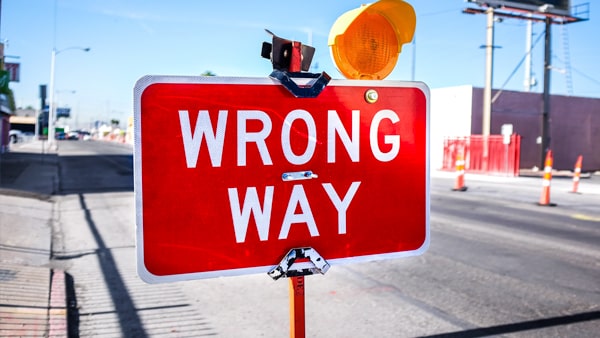
What does the pictured red-and-white WRONG WAY sign tell you?

This red and white sign means:
  1. A You may enter after yielding to other traffic
  2. B The roadway is closed to traffic in every direction
  3. C U-turns are prohibited at this location
  4. D You are traveling or entering against the permitted traffic direction

Correct answer: D – You are traveling or entering against the permitted traffic direction

A WRONG WAY sign is positioned to face drivers traveling opposite the permitted direction on a one-way roadway or ramp. It is commonly used as a supplement to a Do Not Enter sign. If this sign faces you, do not continue in that direction.

Source: MCA § 61-8-202 – Department of Transportation to Adopt Manual, Manual on Uniform Traffic Control Devices, 11th ed. — § 2B.47, “WRONG WAY Sign (R5-1a)”

Question 5

Before pulling out of a parallel parking space, which check should you make?

  1. A Sound the horn before moving
  2. B Switch on the emergency flashers
  3. C Turn and look over your left shoulder
  4. D Check only the inside rearview mirror

Correct answer: C – Turn and look over your left shoulder

Montana law allows a parked vehicle to move only when the movement can be made with reasonable safety. The driver manual instructs you to signal and look over your left shoulder before pulling away from the curb. This direct check helps reveal road users that may not appear in your mirrors.

Source: MCA § 61-8-335 – Starting parked vehicle, Montana Driver Manual — Ch. 5, “When Pulling Away From the Curb”

Question 6

After safely positioning your vehicle while passing a roadside incident, what helps prevent unnecessary congestion?

  1. A Accelerating abruptly past the scene
  2. B Keeping your eyes ahead instead of slowing merely to stare
  3. C Stopping beside the scene to observe
  4. D Using a phone to record the activity

Correct answer: B – Keeping your eyes ahead instead of slowing merely to stare

Do not slow merely to stare at a crash, traffic stop, or other roadside activity. This behavior, commonly called rubbernecking, takes your attention away from vehicles that may be slowing or stopping ahead. It can also add to traffic congestion. Always obey emergency personnel and any required lane or speed restrictions.

Source: Montana Driver Manual — Ch. 5, “Don’t Be a Distracted Driver”