Nebraska CDL Practice Test: General Knowledge (NE) 6

5 out of 5 (35 votes)
80% Passing score
50 Questions
10 Mistakes allowed
Welcome to Nebraska's CDL General Knowledge Practice Test =6 - your stepping stone to mastering the essentials of commercial driving in the Cornhusker State! This DMV practice test, updated for 2026, offers an invaluable opportunity for aspiring commercial drivers to sharpen their skills and knowledge. Featuring 50 comprehensive questions, this Nebraska CDL practice test provides a thorough assessment of your understanding of critical topics. You'll encounter DMV test questions on a variety of subjects, ranging from vehicle equipment management, effective responses to road emergencies, accident procedures, to pre-trip inspections. The DMV practice test even touches on crucial aspects of handling hazardous materials - an essential skill set for every commercial driver, regardless of your HazMat endorsement plans. One of the standout features of this Nebraska CDL practice test is its commitment to current content. We ensure that each question reflects the latest driving laws and regulations, offering you the most up-to-date study material. This constant updating process makes our Nebraska CDL practice test a reliable resource for both newcomers and seasoned drivers seeking to refresh their knowledge. Upon completing the DMV permit practice test, you'll receive a detailed summary of your performance. This feedback is invaluable, highlighting the areas you excel in and the topics where you might need more study. By providing correct answers to the questions you missed, the summary is a powerful tool in reinforcing your learning and preparing you for the actual CDL test in 2026. Our Nebraska CDL practice test is designed not just to evaluate your knowledge but to build it. As you engage with our meticulously crafted 2026 permit test questions, you're not only preparing to pass the CDL test but also to become a safer, more informed driver. Embrace this opportunity to excel in your commercial driving career in Nebraska!
FREE CDL Practice Test App
Pass your Nebraska CDL General Knowledge test with the NextDoorDriving app. Real questions and answers—100% free and ad-free.
Download on the App Store

Sample Nebraska CDL Test Questions - General Knowledge

Question 1

If you are involved in a crash and are not seriously injured, which basic actions should you take?

  1. A Protect the scene from further crashes
  2. B Notify the proper authorities
  3. C Provide appropriate assistance to injured people
  4. D All of these actions

Correct answer: D – All of these actions

The basic crash-response steps are to protect the area, notify authorities, and care for injured people. Protecting the scene can include moving the vehicle when appropriate, activating flashers, and placing warning devices. Do not move a severely injured person unless fire or passing traffic creates an immediate danger.

Source: Nebraska Commercial Driver’s License Manual — § 2.20, “Accident Procedures”
Question 2

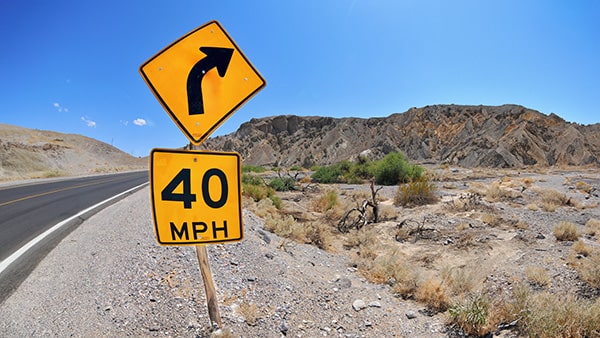
A curve warning sign is accompanied by a yellow 40 MPH plaque. What does the plaque indicate?

This sign warns drivers to _______________.
  1. A Vehicles traveling below 40 mph must remain in the right lane
  2. B The minimum permitted speed is 40 mph
  3. C The advisory speed for the curve is 40 mph
  4. D Drivers must travel exactly 40 mph through the curve

Correct answer: C – The advisory speed for the curve is 40 mph

The 40 MPH plaque gives the advisory speed for the curve or other condition identified by the warning sign. It is not a minimum-speed requirement or a direction to maintain exactly 40 mph. Weather, surface conditions, vehicle characteristics, or cargo may require a lower speed.

Source: Manual on Uniform Traffic Control Devices for Streets and Highways, 11th ed. — § 2C.59, “Advisory Speed Plaque (W13-1P) and Confirmation Advisory Speed Plaque (W13-1aP)”

Question 3

When should a driver switch off a vehicle retarder?

  1. A When the roadway is wet, icy, or covered with snow
  2. B Whenever the driver slept fewer than six hours
  3. C Whenever any hazardous material is being transported
  4. D Only when driving after dark

Correct answer: A – When the roadway is wet, icy, or covered with snow

The Nebraska CDL manual warns that a retarder can make the drive wheels skid when traction is poor. Switch it off on wet, icy, or snow-covered roads. Use particular care with an empty or lightly loaded vehicle because reduced drive-wheel traction can make a skid more likely.

Source: Nebraska Commercial Driver’s License Manual — § 2.3.4, “Retarders”

Question 4

Battery fluid is listed under which hazardous-material class?

  1. A Class 6 poison
  2. B Class 3 flammable liquid
  3. C Class 9 miscellaneous hazardous material
  4. D Class 8 corrosive material

Correct answer: D – Class 8 corrosive material

Federal hazardous-materials rules define Class 8 as corrosive material. The CDL manual lists battery fluid as an example within that class. Its relevant transportation classification is corrosive rather than flammable, poisonous, or miscellaneous hazardous material.

Source: Nebraska Commercial Driver’s License Manual — § 2.23.3, “Lists of Regulated Products”, 49 CFR § 173.136 — Class 8—Definitions

Question 5

A yellow diamond sign displaying one upward arrow and one downward arrow warns that:

This sign warns drivers to _____________.
  1. A A two-way cross street is immediately ahead
  2. B Opposing traffic will use the roadway ahead
  3. C The road ahead changes to one-way traffic
  4. D Traffic must turn at the next intersection

Correct answer: B – Opposing traffic will use the roadway ahead

The Two-Way Traffic sign warns that vehicles traveling in opposite directions will use the roadway ahead. It commonly marks a transition from a divided roadway to a two-lane, two-way section. With an AHEAD plaque, it can also warn of a transition from a one-way street to two-way traffic.

Source: Manual on Uniform Traffic Control Devices for Streets and Highways, 11th ed. — § 2C.51, “Two-Way Traffic Sign (W6-3)”

Question 6

Which preparation is appropriate for operating a commercial vehicle in freezing weather?

  1. A Use windshield-washer antifreeze in the washer reservoir
  2. B Use plain water only in the washer reservoir
  3. C Reduce the amount of antifreeze in the cooling system
  4. D Ignore wiper condition if the washer pump operates

Correct answer: A – Use windshield-washer antifreeze in the washer reservoir

The Nebraska CDL manual recommends windshield-washer antifreeze to prevent the washer liquid from freezing. Drivers should also confirm that the washer operates and the wiper blades are in good condition. If visibility becomes inadequate, stop safely and correct the problem before continuing.

Source: Nebraska Commercial Driver’s License Manual — § 2.13.1, “Wipers and Washers”