


Nebraska DMV Practice Test

4.6 out of 5 (59 votes)
80% Passing score
20 Questions
4 Mistakes allowed
A Nebraska DMV practice test works best when it does one thing clearly: helps you get ready for the written knowledge test without making the whole licensing process feel more tangled than it already is. This free Nebraska permit practice test gives you 20 multiple-choice questions covering the material Nebraska drivers are expected to know — road signs, traffic signals, right-of-way rules, safe driving habits, and the traffic laws that tend to show up when the official test starts counting. You need 16 correct answers to pass, so it gives you a useful read on whether you are actually ready or just sort of comfortable with the material, which is not quite the same thing. That practice matters because Nebraska uses the written test at key points in the licensing process. Younger drivers may first run into it when applying for a School Learner’s Permit at age 14 or a Learner’s Permit at age 15. Adult first-time Class O applicants may also need to pass the written test, along with vision and drive testing, if they have not already held the right kind of permit. There are waiver rules in some situations — for example, certain applicants who already have a qualifying Nebraska permit or who complete a DMV-approved driver safety course may not have to take every test again. Fine. Good to know. But the basic knowledge still matters, because Nebraska’s permit and license steps are built around the assumption that you understand the rules before you drive on your own. The broader license process is easier to think about in stages. First comes learning the rules and passing any required knowledge test. Then comes supervised driving, permit holding periods, driver safety course options, or Nebraska’s 50-hour certification route for some teen drivers. After that, qualified applicants can move toward a School Permit, Provisional Operator’s Permit, or regular operator’s license, depending on age and eligibility. New residents transferring a valid out-of-state license have a different path, but even they may face testing if their license is expired or cannot be surrendered. So the practical move is simple: use the Nebraska learners permit practice test before the official DMV knowledge test and treat the score honestly. Missed too many signs? Go back to signs. Right-of-way rules feeling a little slippery? Stay there for a bit. The test is free, online, and available whenever you have time, which makes it a convenient rehearsal before the DMV version becomes part of your actual licensing record.
FREE DMV Practice Test App
Study for your Nebraska permit test or driver’s license with the NextDoorDriving app. 700+ DMV questions and answers, 100% free!
Download on the App Store

Sample Nebraska Permit Test Questions

Question 1

Under Nebraska law, how far before a turn must you continuously signal?

When you are planning to make a turn, you should activate your turn signals:
  1. A At least 25 feet
  2. B At least 50 feet
  3. C At least 100 feet
  4. D Only when another vehicle is nearby

Correct answer: C – At least 100 feet

A required turn signal must be given continuously for at least the final 100 feet before turning. The driver must also determine that the turn can be made with reasonable safety. Signaling communicates the planned movement but does not remove the duty to check traffic and yield when required.

Source: Neb. Rev. Stat. § 60-6,161(1)–(2) – Turning or moving right or left upon a roadway; required signals; signals prohibited
Question 2

What should you expect when a large truck makes a right turn?

  1. A It may need to swing wide or enter part of an adjacent lane
  2. B It must remain entirely within the right lane throughout the turn
  3. C It may begin the turn from any available lane
  4. D It automatically has the right-of-way over all other traffic

Correct answer: A – It may need to swing wide or enter part of an adjacent lane

Because of their size and off-tracking, trucks and buses sometimes need extra roadway space to turn. A large vehicle may swing wide or cross into another lane while completing a right turn. Give it room and do not attempt to squeeze between the vehicle and the curb.

Source: Nebraska Driver’s Manual — § 6F-2, “No Zone,” “Wide Turns”, Nebraska Commercial Driver’s License Manual — § 2.7.6, “Space for Turns”

Question 3

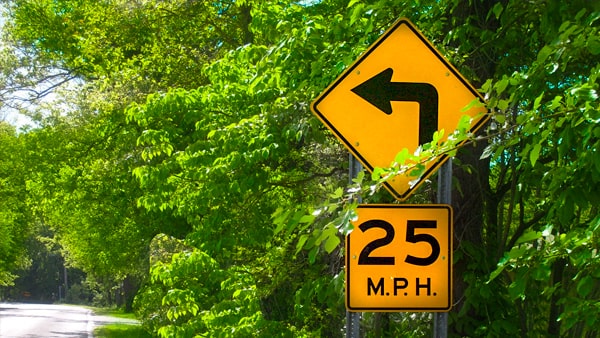
A yellow warning sign shows the road curving left, with a 25 MPH advisory plaque below it. What does the sign indicate?

This sign means:
  1. A A left curve where you must travel at least 25 mph
  2. B A right curve with a recommended speed of 25 mph
  3. C A right curve with a minimum speed of 25 mph
  4. D A left curve with a recommended speed of 25 mph

Correct answer: D – A left curve with a recommended speed of 25 mph

The curve symbol identifies the direction in which the road bends. The supplemental plaque gives the advisory speed for that roadway condition. Drivers must still select a reasonable and safe speed, and weather, traffic, or pavement conditions may require traveling below the advisory speed.

Source: Neb. Rev. Stat. § 60-6,185 – Basic rule; speed, Nebraska Driver’s Manual — § 3B-4, “Warning Signs,” “Curve” and “Advisory Speed Plaque”

Question 4

If open windows, loud music, and similar measures do not keep you alert, what should you do?

  1. A Drink an energy drink and continue
  2. B Drive faster to finish the trip sooner
  3. C Pull over safely and rest
  4. D Follow another vehicle closely to stay focused

Correct answer: C – Pull over safely and rest

Pull over in a safe location if you are struggling to remain awake. Rolling down a window, chewing gum, or increasing the radio volume does not prevent drowsiness. Caffeine and other stimulants are also unreliable, while a short nap can make a meaningful difference in alertness.

Source: Nebraska Driver’s Manual — § 5F, “Drowsy or Fatigue Driving is Dangerous Driving”

Question 5

What should you do if your vehicle begins to hydroplane?

  1. A Maintain speed until the tires regain traction
  2. B Apply the brakes firmly
  3. C Ease off the accelerator and avoid using the brakes
  4. D Accelerate to press the tires against the pavement

Correct answer: C – Ease off the accelerator and avoid using the brakes

Hydroplaning occurs when the tires ride on water and lose contact with the pavement. Release the accelerator to reduce speed gradually and allow the tires to regain traction. Do not use the brakes while the vehicle is hydroplaning, because braking can make control more difficult.

Source: Nebraska Commercial Driver’s License Manual — § 2.6.2, “Hydroplaning”

Question 6

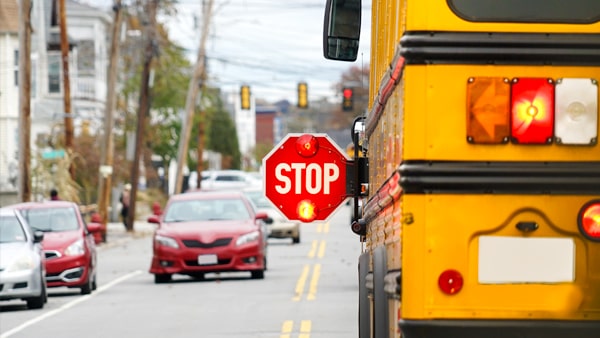
A school bus is stopped with its red warning lights flashing and stop arm extended. What must you do?

What does it mean when a school bus is stopped and its red lights are flashing?
  1. A Pass if no children are visible
  2. B Stop and remain stopped until the required bus signals are deactivated and the bus resumes moving
  3. C Stop only when approaching from behind
  4. D Proceed if the bus driver waves you through

Correct answer: B – Stop and remain stopped until the required bus signals are deactivated and the bus resumes moving

Nebraska requires traffic meeting or overtaking the bus to stop and remain stopped until the red lights are off, the stop arm is retracted, and the bus resumes motion. Opposing traffic is generally exempt when the bus is on the other roadway of a divided highway. A violation is a Class IV misdemeanor carrying a $500 fine and license points.

Source: Neb. Rev. Stat. § 60-6,175(1), (5) – School bus; safety requirements; use of stop signal arm; use of warning signal lights; violations; penalty