


Nebraska DMV Practice Test 3

4.8 out of 5 (40 votes)
80% Passing score
20 Questions
4 Mistakes allowed
A Nebraska DMV practice test is not the official test, but it is a very useful rehearsal for the part most people underestimate: remembering the rule clearly enough when it is phrased like a DMV question instead of like normal human conversation. This Nebraska DMV practice test includes 20 multiple-choice questions covering the material Nebraska drivers are expected to know before getting licensed. You will see questions on traffic laws, road signs, right-of-way, safe driving habits, distracted driving, and handheld mobile device rules. To pass this Nebraska learners permit practice test, you need at least 16 correct answers. That number gives you a simple gut check. If you are missing too many here, it is better to find that out now, on your phone or laptop, than later under fluorescent lighting with your appointment time already slipping away. The feedback is part of the point. After each answer, the test shows whether you were right or wrong and gives an explanation, because a bare score does not teach much by itself. The explanations help connect the rule to actual driving decisions, which is where the knowledge has to end up anyway. Not in a quiz bubble. Not in a lucky guess. In the moment when another driver does something strange and you need to know what Nebraska law expects you to do. For the real Nebraska DMV permit test, adults should pay attention to where the written exam fits into the licensing process. A first-time Nebraska Class O applicant age 18 or older generally has to pass a vision test, a written test, and a drive test. There is an important exception: if you already have a Nebraska Learner’s Permit that is still valid, or expired no more than one year ago, the written test may be waived. Nice little bit of relief there, assuming you qualify. The adult licensing process is also separate from the teen POP track in several ways. Adults are usually not required to hold a permit for six months, certify 50 supervised driving hours, log 10 nighttime hours, or follow POP nighttime and passenger restrictions, unless they are applying through that teen pathway or hold a restricted document. New Nebraska residents age 18 or older who surrender a valid out-of-state license typically need the vision test; the drive test may be required at DMV staff discretion. If the out-of-state license is expired or cannot be surrendered, the written test is required. Updated for 2026 and available on desktop, tablet, or mobile, this Nebraska DMV permit test practice gives you a direct way to review the rules before the DMV version counts.
FREE DMV Practice Test App
Study for your Nebraska permit test or driver’s license with the NextDoorDriving app. 700+ DMV questions and answers, 100% free!
Download on the App Store

Sample Nebraska Permit Test Questions

Question 1

Under Nebraska law, where is passing another vehicle on the left prohibited?

  1. A Within 100 feet of an intersection
  2. B Within 100 feet of a railroad grade crossing
  3. C On a hill or curve where the driver's view is obstructed
  4. D All of the above

Correct answer: D – All of the above

Passing on the left is prohibited when approaching within 100 feet of an intersection or railroad grade crossing. It is also prohibited near a hillcrest or on a curve when the driver's view is obstructed enough to create a hazard. These restrictions reduce conflicts with crossing traffic and vehicles approaching from the opposite direction.

Source: Neb. Rev. Stat. § 60-6,136(1) – Limitations on overtaking, passing, or driving to the left of the center of roadway; when prohibited
Question 2

When parking downhill beside a curb, point your front wheels:

  1. A Toward the curb
  2. B Away from the curb
  3. C Straight ahead and parallel to the curb
  4. D In any direction

Correct answer: A – Toward the curb

When parking downhill beside a curb, turn the front wheels toward the curb. The opposite position—wheels away from the curb—is used when parking uphill beside a curb. Secure the vehicle in the proper parking gear and set the parking brake.

Source: Nebraska Driver's Manual — § 4F-3, “Parking on Hills”, Nebraska Driver's Manual — § 4F-1, “Emergency Roadside Stop”

Question 3

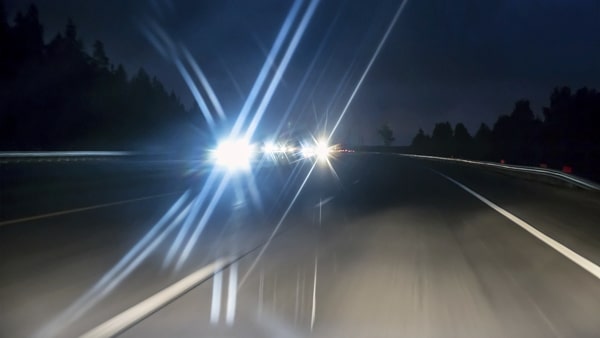
If an oncoming driver's headlights cause glare at night, direct your eyes toward:

At night, if an oncoming vehicle fails to dim its high-beams, look:
  1. A The centerline
  2. B The right edge of the road
  3. C The left edge of your lane
  4. D The approaching headlights

Correct answer: B – The right edge of the road

Do not look directly at an oncoming vehicle's bright headlights. Look toward the right edge of the road to maintain a reference for your lane while limiting glare. Keep your eyes moving rather than staring at the bright spot created by the headlights.

Source: Nebraska Driver's Manual — § 5B, “Driving at Night”

Question 4

In Nebraska, double solid yellow centerlines prohibit you from crossing them to:

  1. A Turn left into an alley when signs do not prohibit it
  2. B Enter a private driveway when signs do not prohibit it
  3. C Pass another vehicle
  4. D Avoid an obstruction when the movement is lawful

Correct answer: C – Pass another vehicle

Double solid yellow lines separate opposing traffic and prohibit passing in either direction. They may be crossed to make a left turn into or from an alley, private road, or driveway unless signs prohibit the movement. The law also provides an exception when an obstruction makes crossing the center necessary and the driver yields to approaching traffic.

Source: Neb. Rev. Stat. § 60-6,137 – No-passing zones; exception, Neb. Rev. Stat. § 60-6,131(1)(b) – Driving on right half of roadway required; exceptions, Nebraska Driver's Manual — § 3C-1, “Yellow Center Line Markings”

Question 5

Which U-turn is lawful in Nebraska?

  1. A A turn across the median of a freeway
  2. B A turn on a curve where approaching drivers cannot see you for 500 feet
  3. C A turn on a non-freeway road where you are visible for 500 feet and no sign prohibits it
  4. D A turn near a hillcrest where your vehicle is hidden from approaching traffic

Correct answer: C – A turn on a non-freeway road where you are visible for 500 feet and no sign prohibits it

A U-turn is prohibited on a curve or near a hillcrest when approaching drivers cannot see the turning vehicle from at least 500 feet away. It is also prohibited wherever signs forbid it. Except for authorized emergency vehicles, no vehicle may make a U-turn on a freeway.

Source: Neb. Rev. Stat. § 60-6,160 – Turning to proceed in opposite direction; limitation

Question 6

If you become drowsy during a long drive, the safest choice is to:

  1. A Turn up the radio and continue
  2. B Drive more slowly until you feel alert
  3. C Pull over in a safe place and take a short rest or nap
  4. D Keep moving your eyes from side to side

Correct answer: C – Pull over in a safe place and take a short rest or nap

Fatigue and falling asleep behind the wheel contribute to crashes involving deaths and injuries. If you become drowsy, pull over in a safe area as soon as possible and take a short nap. Turning up the radio, opening a window, chewing gum, or depending on stimulants is not considered a reliable way to remain alert.

Source: Nebraska Driver's Manual — § 5F, “Drowsy or Fatigue Driving is Dangerous Driving”