Nebraska DMV Practice Test 5

5 out of 5 (35 votes)
80% Passing score
20 Questions
4 Mistakes allowed
A Nebraska DMV practice test should do more than toss a few road-sign questions at you and call it preparation. The real Nebraska knowledge test is based on the Nebraska Driver’s Manual, and that means the material reaches into the everyday stuff drivers actually get tested on: traffic laws, signs, signals, pavement markings, right-of-way rules, speed limits, parking, railroad crossings, and the safer-driving habits that sound obvious until a test question phrases them in the least friendly way possible. This Nebraska DMV permit practice test keeps that bigger picture in view while putting extra weight on alcohol, drugs, and driving. And yes, that section deserves the attention. Nebraska expects drivers to understand blood alcohol content rules, how impairment slows reaction time, how judgment starts getting unreliable before a person feels “drunk,” and what can happen after a DUI. It is not just legal trivia. On rural highways, in winter weather, around school buses, near snow-removal equipment, or anywhere drivers are sharing the road with pedestrians, motorcycles, bicyclists, and large trucks, impaired driving turns ordinary decisions into bad ones very quickly. The format is straightforward: 20 questions using multiple-choice and true/false wording, so you can practice reading carefully, ruling out weak answers, and getting used to the rhythm of a Nebraska permit practice test before the official exam. The actual Class O and learner permit knowledge test is commonly reported by test-prep sources as 25 questions, with 20 correct answers needed to pass. Nebraska DMV materials also make clear that a knowledge test may be required for first-time Nebraska license applicants, drivers without a valid out-of-state license, or anyone whose Nebraska license has been expired for more than one year. Take this learners permit practice test more than once. That is the point, really. One pass may show what you remember; a few passes show what you keep missing, which is usually the more useful part. By the time you sit for the Nebraska DMV written test, you want the rules to feel familiar enough that you are not burning energy decoding every sentence from scratch.
FREE DMV Practice Test App
Study for your Nebraska permit test or driver’s license with the NextDoorDriving app. 700+ DMV questions and answers, 100% free!
Download on the App Store

Sample Nebraska Permit Test Questions

Question 1

Why should you never turn the ignition to the lock position while your vehicle is moving?

  1. A The steering may lock, preventing you from controlling the vehicle
  2. B The vehicle will automatically accelerate
  3. C The parking brake will immediately engage
  4. D The headlights will switch to high beams

Correct answer: A – The steering may lock, preventing you from controlling the vehicle

Many vehicles have a steering-wheel lock that engages when the ignition key is turned to the lock position. Engaging it while the vehicle is moving can leave you unable to steer. The ignition should never be placed in the lock position until the vehicle is safely stopped.

Source: Nebraska Driver’s Manual — § 2L, “Steering Wheel Locking Mechanism”
Question 2

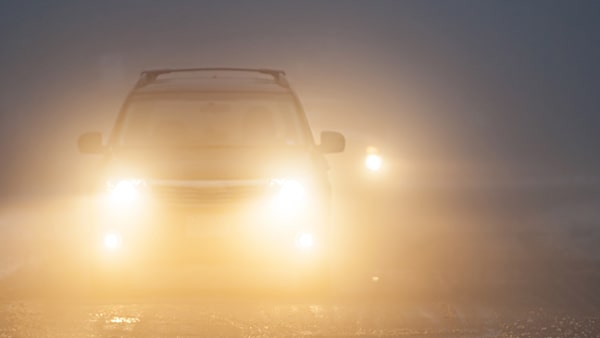
When does Nebraska law require a vehicle’s headlights and taillights to be illuminated?

When should you use your headlights while driving?
  1. A Only after midnight
  2. B From sunset to sunrise and whenever people or vehicles are not clearly visible 500 feet ahead
  3. C Only during rain or snow
  4. D Whenever another driver flashes their headlights

Correct answer: B – From sunset to sunrise and whenever people or vehicles are not clearly visible 500 feet ahead

Lights must be used from sunset to sunrise. They are also required whenever there is insufficient light to clearly distinguish people or vehicles on the highway from 500 feet ahead. This requirement can apply during daytime fog, storms, or other conditions that severely reduce visibility.

Source: Neb. Rev. Stat. § 60-6,219(1) – Motor vehicle; autocycle or motorcycle; lights; requirements; prohibited acts

Question 3

What is the general purpose of a yellow, diamond-shaped traffic sign?

A yellow and black diamond-shaped sign:
  1. A To warn of a condition or hazard ahead
  2. B To provide directions to nearby communities
  3. C To state a traffic law or regulation
  4. D To identify a highway work zone

Correct answer: A – To warn of a condition or hazard ahead

The Nebraska Driver’s Manual identifies the diamond shape as a warning sign. Yellow signs call attention to unexpected roadway conditions, while orange signs alert drivers to construction and road work. Drivers approaching a diamond warning sign should recognize the hazard and proceed cautiously.

Source: Nebraska Driver’s Manual — § 3B-1, “Sign Colors”; § 3B-2, “Sign Shapes”

Question 4

When may you leave your vehicle parked in front of a public or private driveway?

  1. A Never as ordinary parking
  2. B For up to 15 minutes
  3. C Whenever the driveway serves your residence
  4. D Whenever the property owner gives permission

Correct answer: A – Never as ordinary parking

Nebraska prohibits standing or parking in front of a public or private driveway. The statute permits only a momentary stop to pick up or discharge passengers. Leaving the vehicle there as ordinary parking is prohibited regardless of how briefly you intend to stay.

Source: Neb. Rev. Stat. § 60-6,166(1)(b)(i) – Stopping, standing, or parking prohibited; exceptions

Question 5

What should you do if you become too drowsy to drive safely?

  1. A Move into the right lane and keep driving
  2. B Depend on coffee to keep yourself alert
  3. C Pull over in a safe area and take a short nap
  4. D Increase speed to shorten the trip

Correct answer: C – Pull over in a safe area and take a short nap

If you become drowsy, pull over to a safe area as soon as possible and rest. Even a short nap may improve alertness. Caffeine and similar stimulants are not reliable substitutes for sleep, and continuing to drive places you and other road users at risk.

Source: Nebraska Driver’s Manual — § 5F, “Drowsy or Fatigue Driving is Dangerous Driving”

Question 6

Under normal driving conditions, what is the minimum recommended following interval?

  1. A One second
  2. B Two seconds
  3. C Three seconds
  4. D Five seconds

Correct answer: C – Three seconds

The Nebraska Driver’s Manual recommends the three-second rule as the minimum following interval. If you reach a fixed roadside point before three seconds have passed after the vehicle ahead, increase your distance. Add more time for rain, heavy traffic, and other adverse conditions.

Source: Nebraska Driver’s Manual — § 5G-1, “Techniques”