Nebraska Learners Permit Practice Test 6

4.8 out of 5 (36 votes)
80% Passing score
20 Questions
4 Mistakes allowed
This sixth Nebraska DMV practice test is all about turn signals, which feels almost too basic until you remember how many drivers treat the signal lever like optional cabin décor. Nebraska expects you to know when to signal, how early to signal, and why that little blinking light matters whether you are turning through a town intersection, changing lanes near a truck, or easing around slow farm equipment on a rural road. There are 20 multiple-choice questions here, and yes, they are still practice questions, but they are aimed at the kind of driving judgment that actually shows up once you leave the parking lot. You will need at least 16 correct answers to pass this Nebraska learner’s permit test practice. Since you can take it more than once, the smarter move is not to blast through it once and declare yourself road-ready with great confidence and questionable evidence. Miss a question, read why, take it again. That is the whole point. This Nebraska DMV learners practice test gives you room to get the fussy details wrong here, where nobody is stamping paperwork or sending you back to study. The real Nebraska DMV knowledge test is tied to the Driver’s Manual, so the official manual still matters. This practice test helps with the signaling piece, but Nebraska licensing comes with a few other boxes to check too. Permit and operator license applicants should expect a vision screening for visual acuity and peripheral vision. Bring your glasses or contacts if you use them, because if you need corrective lenses to meet the standard, that restriction can go on your permit or license. There is also the document-and-fee portion, which is nobody’s favorite paragraph, but skipping it is a fine way to make an ordinary DMV visit longer than it needed to be. Nebraska applicants generally need proof of identity or lawful status, two proofs of Nebraska address, and a verifiable Social Security number or approved exemption. Original learner-related permits, including the School Learner’s Permit, Learner’s Permit, and School Permit, are listed at $13 with the security fee included, while the Provisional Operator’s Permit is listed at $20. Nebraska does offer useful access options: English and Spanish manuals, an audio manual, sign-language availability for the Class O written test statewide, and alternate formats for applicants who request disability accommodations in advance. So, study the manual, use the DMV permit practice test for repetition, and get comfortable with the small rules before they become very public mistakes.
FREE DMV Practice Test App
Study for your Nebraska permit test or driver’s license with the NextDoorDriving app. 700+ DMV questions and answers, 100% free!
Download on the App Store

Sample Nebraska Permit Test Questions

Question 1

How can alcohol affect a person’s ability to drive?

What does alcohol do to your driving skills and judgment?
  1. A It improves vehicle control but weakens judgment
  2. B It impairs both driving ability and decision-making
  3. C It has no effect on driving or judgment
  4. D It impairs vehicle control but leaves judgment unchanged

Correct answer: B – It impairs both driving ability and decision-making

Alcohol can seriously impair a driver’s ability to make appropriate decisions and control a vehicle safely. It can affect reaction time, attention, vision, coordination, steering, braking, speed control, and judgment of distance. Some drinkers may appear to be in control even though their driving abilities are impaired.

Source: Nebraska Driver’s Manual — § 2A, “Alcohol, Drugs, and Driving”

Question 2

Reaching down to pick up an object from the floor while driving is:

Preparing to smoke and smoking while driving:
  1. A A task that does not affect driving
  2. B A reliable way to remain alert
  3. C A distracting activity
  4. D Safe whenever traffic is light

Correct answer: C – A distracting activity

The official driver’s manual identifies picking up an object from the floorboard as a driving distraction. Distractions interfere with the concentration required to monitor traffic and control the vehicle. Drivers should keep their attention focused on driving.

Source: Nebraska Driver’s Manual — § 5E, “Distracted / Aggressive Driving”

Question 3

Which action is a recommended defensive-driving habit?

  1. A Checking traffic behind you at least every 10 seconds
  2. B Fixing your gaze only on the pavement directly ahead
  3. C Using high-beam headlights in fog
  4. D Following the vehicle ahead as closely as possible

Correct answer: A – Checking traffic behind you at least every 10 seconds

Defensive drivers scan ahead, to the sides, and behind rather than staring at one area. The manual recommends checking traffic behind at least every 10 seconds and when changing lanes, backing, slowing, or descending steep hills. Low beams—not high beams—are recommended in fog, and adequate following space must be maintained.

Source: Nebraska Driver’s Manual — § 5G-1, “Techniques”, Nebraska Driver’s Manual — § 5C-3, “Fog”

Question 4

Under Nebraska law, when may you stop where an official sign prohibits stopping?

  1. A While unloading packages
  2. B When necessary to avoid a traffic conflict or comply with law or official direction
  3. C While dropping off a passenger
  4. D Whenever the stop lasts less than five minutes

Correct answer: B – When necessary to avoid a traffic conflict or comply with law or official direction

Stopping where an official sign prohibits it is generally unlawful. The statutory exceptions apply when stopping is necessary to avoid conflict with traffic or to comply with law, a peace officer, or a traffic control device. Loading packages, discharging passengers, or limiting the stop to a few minutes does not by itself create an exception.

Source: Neb. Rev. Stat. § 60-6,166(1)(a)(ix) – Stopping, standing, or parking prohibited; exceptions.

Question 5

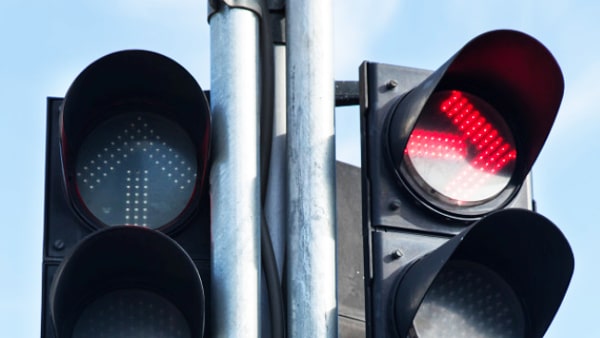
What must you do when facing a steady red arrow pointing right?

A red arrow pointing to the right on a traffic light means you may:
  1. A Stop, then turn right when traffic clears
  2. B Remain stopped until a signal permits the right turn
  3. C Slow down and turn after checking traffic
  4. D Turn if remaining stopped would delay vehicles behind you

Correct answer: B – Remain stopped until a signal permits the right turn

Nebraska law requires a complete stop at the stop line, before the near crosswalk if there is no line, or before the intersection if neither is present. A driver may not enter to make the movement indicated by a steady red arrow. Remain stopped until an indication permitting the movement appears.

Source: Neb. Rev. Stat. § 60-6,123(3)(d) – Traffic control signals; meaning; turns on red signal, when; signal not in service; effect., Nebraska Driver’s Manual — § 3A-1, “Color and Types”

Question 6

Using the three-second following rule, you reach a fixed marker before three seconds have passed. What should you do?

You should usually drive slower when:
  1. A Speed up and pass immediately
  2. B Maintain the same speed and distance
  3. C Slow down and increase your following distance
  4. D Move onto the shoulder to create space

Correct answer: C – Slow down and increase your following distance

The three-second rule provides a minimum method for measuring following distance. If your vehicle reaches the selected marker before three seconds have passed, you are too close to the vehicle ahead. Reduce speed and increase the space between the vehicles, adding more time for adverse conditions such as rain or heavy traffic.

Source: Nebraska Driver’s Manual — § 5G-1, “Techniques”