


Nebraska Permit Practice Test 9

5 out of 5 (34 votes)
80% Passing score
20 Questions
4 Mistakes allowed
A Nebraska school bus question is not just asking if you know what buses look like. The real issue is whether you know what Nebraska expects you to do when the lights are flashing, the Stop arm is out, traffic is stacking up behind you, and a child may be crossing from a place you did not notice until a second too late. This Nebraska learners permit practice test gives that topic its own space. It includes 20 multiple-choice questions focused on school bus safety rules, including when to stop, when not to pass, how to handle flashing red lights, and how much attention you need around bus stops and student loading zones. To pass this Nebraska permit practice test, you need 16 correct answers. That is a useful target, but the better goal is simpler and a little more demanding: understand the rule well enough that you are not guessing because one answer “sounds DMV-ish.” The official Nebraska knowledge test is broader, obviously. It is based on the Nebraska Driver’s Manual and can cover traffic laws, road signs and signals, pavement markings, right-of-way, speed limits, parking rules, railroad crossings, impaired driving, night driving, bad weather, and sharing the road with pedestrians, bicyclists, motorcycles, large trucks, snow-removal equipment, and yes, school buses. Many reputable test-prep sources report the standard Nebraska Class O or learner permit knowledge test as 25 questions, with 20 correct answers needed to pass. That is 80%, which sounds comfortable until you remember that five missed questions can disappear pretty quickly if you are fuzzy on the details. This practice test is narrower than the full DMV test by design. It is not trying to replace the driver’s manual, a road signs review, or a broader Nebraska DMV practice test. It is meant to tighten up one safety category that Nebraska drivers are expected to take seriously. And, well, there is no graceful way to say this: school bus rules are exactly the sort of thing that look basic from a distance and then become very specific once you are reading answer choices. A knowledge test may be required if you are applying for your first Nebraska license, cannot present a valid out-of-state license, or have a Nebraska license that has been expired for more than one year. Start here, then widen your study so you can walk in to the DMV office feeling confident.
FREE DMV Practice Test App
Study for your Nebraska permit test or driver’s license with the NextDoorDriving app. 700+ DMV questions and answers, 100% free!
Download on the App Store

Sample Nebraska Permit Test Questions

Question 1

When is it appropriate to sound your vehicle's horn?

  1. A Whenever you approach a bicyclist
  2. B To give a reasonable warning of an immediate collision danger
  3. C To urge a slower driver to speed up
  4. D To show that another road user made a mistake

Correct answer: B – To give a reasonable warning of an immediate collision danger

A vehicle horn may be used as a reasonable warning. The driver manual recommends a sharp blast when necessary to alert someone to an immediate danger of collision. Unnecessary, unreasonably loud, or harsh horn use is prohibited, and motorists should not blast the horn merely because they are approaching a bicyclist.

Source: Neb. Rev. Stat. § 60-6,285 – Horn; requirements; prohibited acts, Nebraska Driver's Manual — § 5G-1, “Techniques”, Nebraska Driver's Manual — § 6B, “Bicyclists”
Question 2

A driver passes you on the right while both vehicles are on a multilane roadway. When may this be lawful?

  1. A Only when every lane to the left is blocked
  2. B Only when the driver remains in your blind spot
  3. C Whenever the right shoulder is wide enough
  4. D When the roadway has sufficient lanes, is unobstructed, and the pass can be made safely

Correct answer: D – When the roadway has sufficient lanes, is unobstructed, and the pass can be made safely

Passing on the right may be allowed on a two-way roadway with two or more unobstructed lanes moving in the same direction or on a one-way roadway of sufficient width. The movement must be made safely upon the roadway. A motorist may not use the highway shoulder simply to complete the pass.

Source: Neb. Rev. Stat. § 60-6,134 – Overtaking and passing upon the right; when permitted, Neb. Rev. Stat. § 60-6,142 – Driving on highway shoulders prohibited; exceptions

Question 3

When parking downhill on a road without a curb, how should you position the front wheels?

  1. A Toward the center of the road
  2. B Toward the right edge of the road
  3. C Straight ahead
  4. D Wheel direction does not matter if the parking brake is set

Correct answer: B – Toward the right edge of the road

When parking downhill without a curb, turn the front wheels toward the edge of the road. This is the right side when the vehicle is properly parked on a two-way road. Also place the transmission in the proper parking gear and set the parking brake.

Source: Nebraska Driver's Manual — § 4F-3, “Parking on Hills”, Nebraska Driver's Manual — § 4F-1, “Emergency Roadside Stop”

Question 4

A green turn arrow changes to a circular green light. What must you do before making the turn?

  1. A Yield to conflicting traffic and pedestrians lawfully in the intersection or crosswalk
  2. B Turn immediately because the movement remains protected
  3. C Proceed straight because turning is no longer permitted
  4. D Stop and wait for another green arrow

Correct answer: A – Yield to conflicting traffic and pedestrians lawfully in the intersection or crosswalk

In Nebraska, a circular green signal permits a driver to proceed straight or turn unless a sign prohibits the turn. A turning driver must yield to vehicles and pedestrians lawfully within the intersection or adjacent crosswalk. The driver may turn only when the required yielding has been completed safely.

Source: Neb. Rev. Stat. § 60-6,123(1)(a)–(b) – Traffic control signals; meaning; turns on red signal, when; signal not in service; effect

Question 5

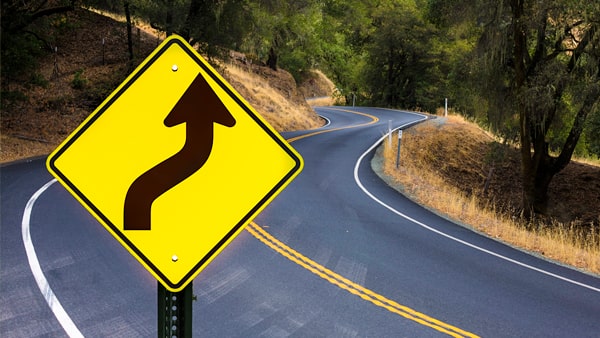
A yellow warning sign shows the road curving right and then left. What does it indicate?

This sign means:
  1. A A single sharp right turn
  2. B A reverse curve, first right and then left
  3. C A reverse curve, first left and then right
  4. D The paved road ends ahead

Correct answer: B – A reverse curve, first right and then left

This is a reverse-curve warning sign. It indicates that the road first curves to the right and then changes direction to the left. Drivers should recognize it as a warning of changing roadway alignment ahead.

Source: Nebraska Driver's Manual — § 3B-4, “Warning Signs”

Question 6

A prescribed medication appreciably impairs your driving ability. Operating a motor vehicle while under its influence is:

  1. A Legal because a medical professional prescribed it
  2. B Legal if the medicine is sold over the counter
  3. C Illegal
  4. D Legal if you carry the labeled container

Correct answer: C – Illegal

Nebraska law prohibits operating or physically controlling a motor vehicle while under the influence of any drug. The rule can include prescription medication when it appreciably impairs the ability to operate a vehicle prudently and cautiously. Drivers should consult a physician or pharmacist about prescription effects and review over-the-counter medication warnings.

Source: Neb. Rev. Stat. § 60-6,196(1)(a) – Driving under influence of alcoholic liquor or drug; penalties, Nebraska Driver's Manual — § 2E, “Health and Driving”