


Nebraska Permit Test Simulator

5 out of 5 (34 votes)
80% Passing score
25 Questions
5 Mistakes allowed
A Nebraska permit test simulator should do more than toss a few random road signs at you and call it preparation. This one is built to feel closer to the real Nebraska DMV permit test, with 25 randomly selected questions on each attempt and a passing target of 20 correct answers. That 80% mark is the number to beat, yes, but honestly, scraping by with exactly 20 is not the kind of confidence anyone should be aiming for before sitting down at the DMV. Each attempt gives you a fresh mix of questions, so you are not just memorizing the shape of one easy quiz. You will work through the material Nebraska expects drivers to know: traffic signs and signals, pavement markings, right-of-way rules, speed laws, parking, railroad crossings, night driving, bad-weather driving, alcohol and drug laws, and the slightly crowded business of sharing the road with pedestrians, motorcycles, bicyclists, school buses, large trucks, and snow-removal equipment. Nebraska-specific rules are folded in too, including headlight use and move-over requirements around stopped emergency or law enforcement vehicles. Small details, sure. Until they are the detail that costs you a question. The review at the end is where this practice test earns its keep. You can see what you missed, check the correct answers, and figure out whether you actually understand the rule or just had a lucky guess that wandered into the right option. Since it works on a phone, tablet, or desktop, it is easy to fit in a few rounds without turning studying into a whole dramatic event. The real written knowledge test comes into play for several Nebraska applicants, including School Learner’s Permit applicants at 14, Learner’s Permit applicants at 15, first-time Class O applicants, and drivers who cannot qualify for a waiver. Some people can skip the written test if they already hold a qualifying Nebraska permit that is still valid or expired for no more than one year. Fine, paperwork has its moments. But the rules still matter once you are driving, and this simulator gives you a cleaner way to find the weak spots before the official test finds them for you.
FREE DMV Practice Test App
Study for your Nebraska permit test or driver’s license with the NextDoorDriving app. 700+ DMV questions and answers, 100% free!
Download on the App Store

Sample Nebraska Permit Test Questions

Question 1

A red-and-white WRONG WAY sign tells you that:
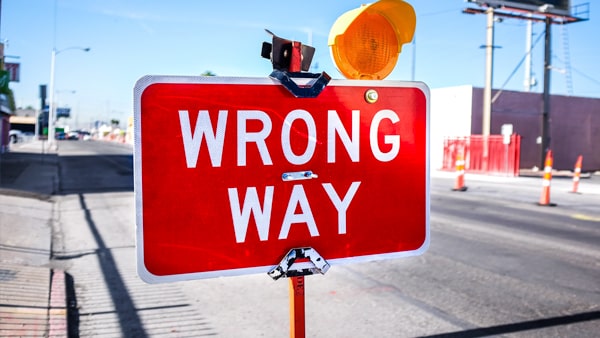
This red and white sign means:
  1. A You may enter after yielding
  2. B The entire roadway is closed
  3. C U-turns are prohibited ahead
  4. D Traffic cannot legally travel in your direction

Correct answer: D – Traffic cannot legally travel in your direction

A WRONG WAY sign indicates that your vehicle is headed against the permitted direction of traffic. It is often paired with a DO NOT ENTER sign on a one-way street or expressway ramp. Do not drive past either sign.

Source: Nebraska Driver's Manual — § 3B-3, “Regulatory Signs”

Question 2

Traffic is too heavy for a safe gap at the end of an interstate entrance lane. If necessary, you may:

  1. A Force your vehicle into a small opening
  2. B Back down the entrance ramp
  3. C Continue along the highway shoulder
  4. D Stop before entering the through lane

Correct answer: D – Stop before entering the through lane

Nebraska law requires a vehicle entering from an acceleration lane or ramp to yield to traffic on the main roadway. Check for a gap, adjust your speed, signal, and merge only when the movement is safe. If no safe gap is available, stop before entering the through lane rather than force your way into traffic or use the shoulder.

Source: Neb. Rev. Stat. § 60-6,146(2) – Vehicles approaching or entering intersection at same time; right-of-way; entering a highway or roadway, Nebraska Driver's Manual — § 5A-1, “Entering the Interstate”, Nebraska Driver's Manual — § 3B-3, “Regulatory Signs”

Question 3

Why does Nebraska phase in driving privileges for teenage drivers?

  1. A Teenagers generally have slower reflexes
  2. B Teenagers are unwilling to take risks
  3. C New drivers need time to build skill and experience
  4. D New drivers usually travel too slowly

Correct answer: C – New drivers need time to build skill and experience

The graduated driver licensing system allows teenagers to gain driving experience in stages. It also limits their exposure to certain situations associated with greater crash risk while they are still developing their abilities. Increasing supervised and restricted experience helps prepare a new driver for full driving privileges.

Source: Nebraska Driver's Manual — § 1B, “Graduated Driver Licensing (GDL) Driving Restrictions”

Question 4

You are traveling below the normal speed of traffic in the left lane of a multilane road. What should you do?

  1. A Use the left shoulder to let traffic pass
  2. B Turn on your emergency flashers
  3. C Remain in the left lane
  4. D Move into the right lane when the change is safe

Correct answer: D – Move into the right lane when the change is safe

A vehicle traveling below the normal speed of traffic must use the available right-hand lane, except when passing or preparing for a left turn. Check your mirrors and blind spot, signal, and move right only when the lane change can be completed safely. The left lane then remains available for overtaking traffic.

Source: Neb. Rev. Stat. § 60-6,131(2) – Driving on right half of roadway required; exceptions, Nebraska Driver's Manual — § 4A, “Slower Traffic – Keep Right”

Question 5

Under Nebraska's basic speed rule, a safe driving speed:

  1. A Is always the posted limit
  2. B Must always be below the posted limit
  3. C Depends on current roadway, weather, and traffic hazards
  4. D Depends mainly on the driver's mechanical knowledge

Correct answer: C – Depends on current roadway, weather, and traffic hazards

The basic speed rule requires a reasonable and prudent speed for the conditions and actual or potential hazards. Weather, highway conditions, curves, intersections, pedestrians, and other traffic can require a lower speed. A posted limit is the maximum lawful speed under suitable conditions, not a guarantee that the speed is safe in every situation.

Source: Neb. Rev. Stat. § 60-6,185 – Basic rule; speed

Question 6

Which choice can help relieve congestion in a Nebraska metropolitan area?

  1. A Using mass or public transportation
  2. B Following other vehicles more closely
  3. C Increasing every posted speed limit
  4. D Removing bicycles from public roads

Correct answer: A – Using mass or public transportation

The Legislature has found that large numbers of motor vehicles can produce severe street congestion in metropolitan areas. It also identifies mass passenger transportation as a way such congestion can be relieved. Following more closely or increasing speed limits does not reduce the number of vehicles using the road.

Source: Neb. Rev. Stat. § 14-1801 – Metropolitan transit authority; declaration of policy