Nebraska DMV Sign Test 3

5 out of 5 (33 votes)
80% Passing score
20 Questions
4 Mistakes allowed
Nebraska road sign questions sit inside the regular Class O knowledge test. That matters, because signs are tested the way drivers actually use them: mixed in with signals, pavement markings, lane rules, railroad crossings, and the general business of knowing what the road is trying to tell you.   This Nebraska road signs practice test gives you a tighter way to study that part of the manual without turning prep into a pile of flashcards you half-remember later. It includes 20 multiple-choice questions, and you’ll need 16 correct answers to pass. The questions lean into the details Nebraska drivers are expected to recognize quickly: regulatory signs, warning signs, guide signs, sign colors, sign shapes, traffic signals, lane markings, pavement markings, and railroad crossing signs and signals. Some of it feels obvious when you are reading slowly at home. Fine. Good. But the official knowledge test does not reward vague familiarity; it rewards knowing the difference before your confidence starts doing that little wobble. The visual side is especially important here. Road signs are not vocabulary words wearing costumes. An octagon, a diamond, a triangle, a rectangle — those shapes are part of the message, and the colors do their share of the talking too. This Nebraska DMV signs practice test uses that to your advantage, with visual-style review that helps you connect the sign to the action, not just the name. That is the piece cheat sheets tend to skip, because memorized answers are brittle. Understanding holds up better, especially when the wording shifts or the sign appears in a slightly different context. And then there is the larger Nebraska licensing process, which is worth mentioning without dragging the whole DMV filing cabinet into the room. Permit and license applicants should expect identity and residency documents, payment, a vision screening, and possibly a driving skills test depending on age, permit history, and waiver eligibility. If you wear glasses or contacts, bring them. If you are relying on a driver safety course waiver or supervised-driving certification, have the paperwork handled properly. The road signs test prep is one piece of the process, but it is a piece you can control before you walk in.
FREE DMV Practice Test App
Study for your Nebraska permit test or driver’s license with the NextDoorDriving app. 700+ DMV questions and answers, 100% free!
Download on the App Store

Sample Nebraska Permit Test Questions

Question 1

Which listed maneuver may lawfully cross double solid yellow center lines?

  1. A Passing a slower vehicle
  2. B Passing only during daylight
  3. C Crossing whenever opposing traffic is absent
  4. D Turning into or from an alley, private road, or driveway when not prohibited

Correct answer: D – Turning into or from an alley, private road, or driveway when not prohibited

Nebraska’s driver manual states that double solid yellow lines prohibit passing in both directions. A driver may cross them to make a left turn into or from an alley, private road, or driveway unless signs prohibit the movement. Crossing to avoid an obstruction is also identified as a lawful exception.

Source: Nebraska Driver’s Manual — § 3C-1, “Yellow Center Line Markings”
Question 2

Why should you check left and right before entering an intersection after the light turns green?

  1. A Another driver may enter against a red signal
  2. B You must stop looking to the sides after entering
  3. C Cross traffic will always have a green arrow
  4. D All pedestrians on the cross street may proceed

Correct answer: A – Another driver may enter against a red signal

Nebraska’s defensive-driving guidance tells drivers to check traffic from both directions before entering after a signal change. A green signal permits movement when the roadway is clear, but another driver may run the red light. Scanning before proceeding can help you detect that conflict.

Source: Nebraska Driver’s Manual — § 5G-1, “Techniques”, Nebraska Driver’s Manual — § 3A-1, “Color and Types”

Question 3

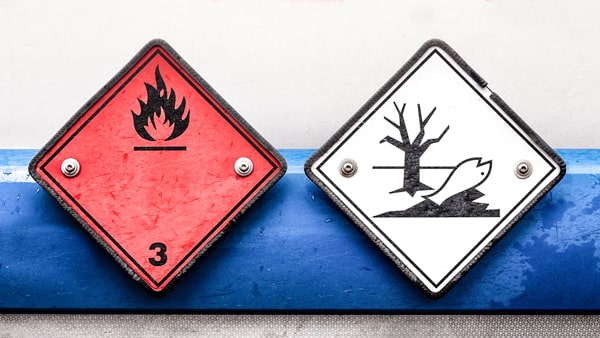
Which rule generally applies to a vehicle required to display hazardous-material placards?

Which of the following is true about vehicles displaying a diamond-shaped sign (indicating a hazardous load)?
  1. A It may not travel on a freeway
  2. B It may never exceed 35 mph
  3. C It must stop before crossing railroad tracks
  4. D It has priority over other traffic

Correct answer: C – It must stop before crossing railroad tracks

Nebraska law generally requires a vehicle subject to hazardous-material placarding requirements to stop between 15 and 50 feet from the nearest rail. The driver must look and listen and may proceed only after determining that the course is clear. Exceptions include direction from a peace officer or flagperson and certain clearly marked abandoned, exempted, or industrial crossings.

Source: Neb. Rev. Stat. § 60-6,173 – Grade crossings; certain carriers; required to stop; exceptions.

Question 4

A diamond-shaped traffic sign normally provides what type of message?

  1. A A warning about a condition or hazard ahead
  2. B An interstate route number
  3. C A school-zone designation
  4. D A regulatory speed limit

Correct answer: A – A warning about a condition or hazard ahead

Diamond-shaped signs are warning signs. They alert drivers to special roadway conditions or possible hazards ahead. Slow as conditions require and proceed with caution.

Source: Nebraska Driver’s Manual — § 3B-2, “Sign Shapes”

Question 5

A curb is painted yellow near a parking area. What should you use to determine whether loading or unloading is permitted?

  1. A The posted sign or wording marked on the curb
  2. B A rule that yellow always permits buses to park
  3. C A rule reserving every yellow curb for emergency vehicles
  4. D The accessibility symbol in another parking space

Correct answer: A – The posted sign or wording marked on the curb

Nebraska’s adopted traffic-control standards do not make a bare yellow curb a universal loading-zone instruction. Local agencies may prescribe curb colors, while signs or legible curb wording generally communicate the applicable parking rule. Read the restriction before stopping, standing, parking, loading, or unloading.

Source: Neb. Rev. Stat. § 60-6,118 – Manual on Uniform Traffic Control Devices; adoption by Department of Transportation., Manual on Uniform Traffic Control Devices, 11th ed. with Revision 1 — § 3B.18, “Curb Markings for Parking Regulations”

Question 6

What does a steady downward green arrow over a traffic lane mean?

This green arrow on a lane use control signal means that:
  1. A Traffic may use that lane
  2. B Traffic is prohibited from that lane
  3. C Traffic in that lane has priority in every situation
  4. D All nearby traffic must merge into that lane

Correct answer: A – Traffic may use that lane

A green lane-direction signal permits vehicles to travel in the lane beneath it. By contrast, traffic must not enter or travel in a lane displaying the applicable red indication. These signals control lane availability, not an unrestricted right-of-way.

Source: Neb. Rev. Stat. § 60-6,126 – Lane direction control signals; signs.