


Nevada CDL General Knowledge Test (NV) 5

5 out of 5 (50 votes)
80% Passing score
50 Questions
10 Mistakes allowed
Welcome to the Nevada CDL General Knowledge Practice Test, the fifth in our series designed to prepare you for the real CDL test in 2026. Our DMV practice test mirrors the official CDL driver's manual, a comprehensive source managed and released by the state. This means every Nevada DMV question you encounter here is aligned with the material you'll find on the actual CDL written permit test. If it's not in the manual, you won't find it on our CDL practice test or the real general knowledge test. Our CDL practice test comprises 50 Nevada general knowledge test questions and answers, covering a wide range of topics pertinent to the CDL exam. To pass, you'll need to correctly answer at least 40 of these questions. What makes our Nevada CDL practice test unique is its consistency: every time you take it, you'll face the same set of DMV questions. This repetition is a powerful tool in reinforcing your knowledge and preparing you for the types of questions you'll face in the actual exam. Unlike many other DMV permit practice tests that come with a price tag, ours is completely free. Despite being cost-free, it offers a full suite of features and learning opportunities akin to any paid version. This accessibility ensures that everyone has an equal chance to study and succeed, regardless of their financial situation. Another standout feature of our Nevada CDL practice test is its customizability. We understand that everyone has different learning needs and areas where they need more focus. Our platform allows you to tailor your study sessions to concentrate on topics you find challenging. You can take the DMV practice test multiple times to improve your score and work on it whenever it fits into your schedule. This flexibility ensures that your preparation is as effective and efficient as possible. In summary, our Nevada CDL General Knowledge Practice Test provides a comprehensive, realistic, and free way to prepare for your CDL written test in 2026. With CDL questions directly sourced from the official manual and customizable practice sessions, you're well on your way to acing your CDL test!
FREE CDL Practice Test App
Pass your Nevada CDL General Knowledge test with the NextDoorDriving app. Real questions and answers—100% free and ad-free.
Download on the App Store

Sample Nevada CDL Test Questions - General Knowledge

Question 1

What does a parking sign displaying the international wheelchair-access symbol indicate?
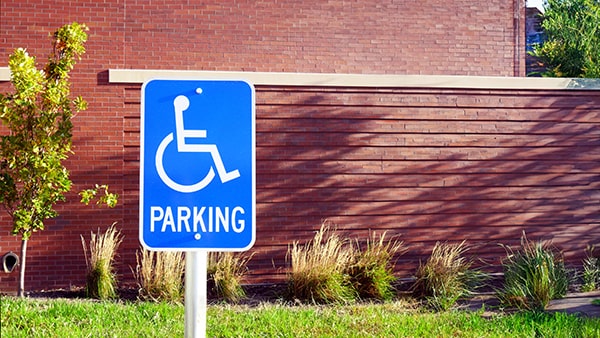
This sign indicates ___________.
  1. A The space is reserved for an authorized person with a disability.
  2. B Parking is prohibited for every vehicle.
  3. C The space is open to any vehicle.
  4. D Parking is permitted only for a limited time.

Correct answer: A – The space is reserved for an authorized person with a disability.

In Nevada, a space marked with the international symbol of access is reserved for qualifying individuals with disabilities. A valid disabled parking placard or license plate must have been issued to a person who is driving or being transported in the vehicle. Other motorists may not use the marked space.

Source: Nevada Driver’s Handbook — Ch. 3, “International Symbol of Access”

Question 2

Which vehicle is generally required to stop before crossing railroad tracks?

  1. A Every commercial motor vehicle without exception
  2. B A passenger bus or a vehicle carrying regulated hazardous materials
  3. C Only a commercial vehicle traveling after dark
  4. D Only a commercial vehicle approaching an unmarked crossing

Correct answer: B – A passenger bus or a vehicle carrying regulated hazardous materials

Nevada law generally requires a bus carrying passengers, a school bus carrying a child, or a vehicle carrying regulated hazardous materials to stop at railroad tracks. The stop must be within 50 feet but not less than 15 feet from the nearest rail. Certain controlled, abandoned, industrial, or officially exempt crossings are exceptions.

Source: NRS 484B.560 — Certain vehicles required to stop at all railroad grade crossings; exceptions; certain commercial vehicles required to decrease speed and confirm tracks are clear at all railroad grade crossings; vehicles required to completely cross railroad grade crossings and obey traffic control devices and peace officers at railroad grade crossings, Nevada Commercial Driver License Handbook — § 2.15.4, “Railroad-Highway Crossings”

Question 3

What does “off-tracking” mean when a combination vehicle turns?

  1. A The vehicle leaves a paved roadway.
  2. B The tractor passes traffic on the right.
  3. C The trailer temporarily travels on the shoulder.
  4. D The rear wheels follow a different path from the front wheels.

Correct answer: D – The rear wheels follow a different path from the front wheels.

During a turn, the rear wheels do not follow exactly the same path as the front wheels. This inward difference is called off-tracking, sometimes called cheating. Drivers must account for it because the rear portion of a long vehicle can strike a curb, vehicle, or other object even when the front clears it.

Source: Nevada Commercial Driver License Handbook — § 6.1.6, “Turn Wide”

Question 4

What is a commercial driver’s primary tool for monitoring traffic beside and behind the vehicle?

  1. A A backing helper
  2. B The mirrors
  3. C The turn signals
  4. D The horn

Correct answer: B – The mirrors

Regular mirror checks help a commercial driver monitor traffic beside and behind the vehicle. Mirrors should be checked more often during lane changes, turns, merges, and tight maneuvers. Because mirrors cannot display every blind spot, the driver must also understand their limitations and remain alert to vehicles that disappear from view.

Source: Nevada Commercial Driver License Handbook — § 2.4.2, “Seeing to the Sides and Rear”

Question 5

Which description best identifies black ice?

  1. A A thin, nearly transparent layer of ice through which the pavement remains visible
  2. B A pile of melting ice beside the roadway
  3. C Snow packed only along the shoulder
  4. D Harmless frost that cannot affect vehicle control

Correct answer: A – A thin, nearly transparent layer of ice through which the pavement remains visible

Black ice is a thin, clear layer through which the road surface can still be seen. It often makes the pavement look wet rather than frozen, making it difficult to recognize. When temperatures are below freezing and the roadway appears wet, a commercial driver should watch carefully for black ice.

Source: Nevada Commercial Driver License Handbook — § 2.6.2, “Matching Speed to the Road Surface”

Question 6

If the normal speed is 55 mph and the road becomes wet, approximately what speed does the CDL handbook recommend?

  1. A 35 mph
  2. B 55 mph
  3. C 45 mph
  4. D 25 mph

Correct answer: A – 35 mph

The Nevada CDL handbook recommends reducing speed by about one-third on a wet road, using a reduction from 55 mph to about 35 mph as its example. Wet pavement can double stopping distance and makes turning without skidding more difficult. Further reduction may be necessary when visibility, traffic, or traction is especially poor.

Source: Nevada Commercial Driver License Handbook — § 2.6.2, “Matching Speed to the Road Surface”