


Nevada CDL Practice Test: General Knowledge (NV) 6

4.8 out of 5 (66 votes)
80% Passing score
50 Questions
10 Mistakes allowed
Welcome to the Nevada CDL General Knowledge Practice Test, your essential tool for preparing for the actual DMV permit test in 2026! This sixth DMV practice test, meticulously crafted to reflect the real test's structure and content, is a comprehensive assessment tool for aspiring commercial drivers. Our Nevada DMV practice test features 50 carefully selected questions, mirroring the format and subject matter of the CDL written permit test. Achieving a score of 40 or more is required to pass, offering a realistic gauge of your readiness. These questions, consistent in every attempt, are derived directly from the Nevada CDL Driver's Manual, ensuring that every topic you study is relevant and up-to-date. This Nevada CDL practice test covers a wide array of topics crucial for every commercial driver. From the intricacies of vehicle equipment, managing road emergencies, and understanding accident procedures, to conducting thorough pre-trip inspections, every aspect is thoroughly covered. Furthermore, we've included essential information on hazardous materials. While not focused on the HazMat endorsement, this knowledge is vital for all drivers to ensure safety and compliance. The format of this Nevada CDL general knowledge practice test, using multiple-choice and true/false questions, is identical to the actual DMV test. This similarity aids in familiarizing you with the 2026 CDL test structure, helping in effectively navigating through questions and honing your skills in identifying the correct answers. By consistently practicing with our Nevada CDL practice test, you'll gain confidence and a deep understanding of the required knowledge, significantly boosting your chances of success in the actual CDL permit test! So, start your preparation today and move closer to achieving your goal of becoming a certified commercial driver in Nevada.
FREE CDL Practice Test App
Pass your Nevada CDL General Knowledge test with the NextDoorDriving app. Real questions and answers—100% free and ad-free.
Download on the App Store

Sample Nevada CDL Test Questions - General Knowledge

Question 1

Which factors affect a person’s blood alcohol concentration?

  1. A The amount of alcohol consumed
  2. B How quickly the alcohol is consumed
  3. C The person’s body weight
  4. D All of the above

Correct answer: D – All of the above

Blood alcohol concentration is affected by the amount consumed, the rate of consumption, and body weight. More alcohol generally produces a higher BAC, and drinking faster gives the body less time to eliminate it. A person with lower body weight typically reaches a given BAC with less alcohol than a heavier person.

Source: Nevada Commercial Driver License Handbook — § 2.22.1, “Alcohol and Driving”
Question 2

Should the trailer hand valve be used before the foot brake during normal driving to prevent a jackknife?

  1. A No; using it while driving can cause the trailer to skid.
  2. B Yes; it always reduces the chance of skidding.
  3. C Yes; it allows the driver to steer with both hands.
  4. D Yes; it is the preferred method for straight-line braking.

Correct answer: A – No; using it while driving can cause the trailer to skid.

The trailer hand valve should be used only to test the trailer brakes, not for normal braking while driving. Applying only the trailer brakes can make the trailer skid and increase the risk of a jackknife. The foot brake applies the vehicle’s service brakes, including the trailer brakes, with less danger of causing this problem.

Source: Nevada Commercial Driver License Handbook — § 6.2.1, “Trailer Hand Valve”

Question 3

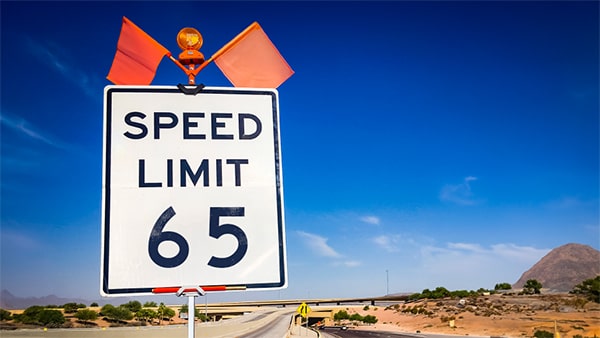
What does a standard black-and-white SPEED LIMIT 65 sign require?

This sign instructs drivers to _____________.
  1. A Travel at exactly 65 mph during daylight.
  2. B Maintain a minimum speed of 65 mph.
  3. C Do not exceed 65 mph, day or night.
  4. D Travel at exactly 65 mph after dark.

Correct answer: C – Do not exceed 65 mph, day or night.

A standard SPEED LIMIT 65 sign establishes 65 mph as the maximum posted speed, regardless of the time of day. It does not require drivers to travel exactly that fast. Nevada drivers must also reduce speed when weather, visibility, traffic, or road conditions make the posted limit unsafe.

Source: Nevada Driver’s Handbook — Ch. 3, “Signs”, Nevada Driver’s Handbook — Ch. 3, “Controlling Speed”

Question 4

Before a helper guides a backing maneuver, which hand signal is most important to establish?

  1. A Slow down
  2. B Pull forward
  3. C Continue straight back
  4. D Stop

Correct answer: D – Stop

The driver and helper should agree on a clear stop signal before backing begins. The helper should remain near the rear of the vehicle in a position where the driver can see them. If the helper disappears from view or signals the driver to stop, the backing movement should be halted.

Source: Nevada Commercial Driver License Handbook — § 2.2.4, “Backing Safely”

Question 5

Which materials may be transported on a passenger-carrying vehicle under the applicable restrictions?

  1. A Small-arms ammunition
  2. B Emergency shipments of hospital supplies
  3. C Emergency shipments of drugs
  4. D All of the above

Correct answer: D – All of the above

Federal hazardous-material rules permit small-arms ammunition and emergency shipments of drugs, chemicals, and hospital supplies on passenger-carrying vehicles under specified conditions. Other hazardous materials are heavily restricted, including limits on type, quantity, and storage location. Explosive materials other than small-arms ammunition may not be placed in the passenger-carrying space.

Source: 49 CFR § 177.870(b)–(e) — Regulations for passenger carrying vehicles, Nevada Commercial Driver License Handbook — § 4.2.2, “Forbidden Hazardous Materials”

Question 6

After a tire blowout, the driver should immediately apply the brakes as hard as possible.

  1. A True
  2. B False

Correct answer: B – False

Hard braking after a tire failure can cause loss of control. Hold the steering wheel firmly and, unless a collision is imminent, stay off the brake while the vehicle slows. Once speed has decreased, brake gently, move off the roadway, stop, and inspect the tires.

Source: Nevada Commercial Driver License Handbook — § 2.17.4, “Tire Failure”