


Nevada DMV Practice Test

4.7 out of 5 (1076 votes)
80% Passing score
20 Questions
4 Mistakes allowed
People do not fail the Nevada permit test because they have never seen a Stop sign before. They miss questions because the official test folds simple-looking driving rules into very specific DMV wording: pavement markings, lane use, right-of-way choices, DUI rules, license requirements, and the small details that are easy to wave off while studying. That is exactly where a Nevada DMV practice test earns its keep. This free Nevada DMV permit practice test gives you 20 multiple-choice questions based on the same general material covered by the Nevada Class C knowledge test. The real test has 25 questions, and you need 20 correct answers to pass with an 80% score. It also stops once you reach 20 correct answers or 6 incorrect ones, which is a polite way of saying the test does not wait around for a dramatic comeback. You either know the material well enough, or you find out quickly that a few chapters in the handbook needed more attention. The practice questions cover Nevada traffic laws, highway signs, pavement markings, safe driving practices, defensive driving, licensing rules, and alcohol and drug laws. After each answer, you get immediate feedback with an explanation, which is the part that makes the practice actually useful. A wrong answer is not just marked wrong and left sitting there like a tiny accusation; it gets explained, so you can see what the rule was asking for and why the better answer is better. Nevada’s licensing path depends on your situation. Teen drivers may apply for an instruction permit at 15½, but they must pass the knowledge test, meet the vision standard, and provide the required under-18 documents, including school attendance certification. Adults 18 and older generally need the knowledge test, vision test, and road skills test, although they are not required to get an instruction permit first. New residents may face different testing requirements depending on age and prior license status. The official Nevada knowledge test can be taken online through KnowTo Drive Nevada or in person at a DMV office. Online testing has a 60-minute limit, is available in English and Spanish, and includes a separate vendor fee. In-person testing is available in English, Spanish, and audio format, with no time limit. This Nevada DMV learners permit practice test gives you a calmer place to sort all of that out before the real test starts counting.
FREE DMV Practice Test App
Study for your Nevada permit test or driver’s license with the NextDoorDriving app. 700+ DMV questions and answers, 100% free!
Download on the App Store

Sample Nevada Permit Test Questions

Question 1

Before moving into another lane, which check should you make?

  1. A Confirm that no vehicle is directly behind you
  2. B Check your mirrors and look over your shoulder
  3. C Look only through the windshield
  4. D Rely only on the side mirror nearest the lane

Correct answer: B – Check your mirrors and look over your shoulder

Use the rearview and side mirrors to check surrounding traffic before changing lanes. You must also look over the appropriate shoulder because another vehicle may be in a blind spot that the mirrors do not show. Move into the new lane only after traffic is clear.

Source: Nevada Driver’s Handbook — Ch. 3, “Lane Changes”
Question 2

Alcohol can affect which driving abilities?

  1. A Brain function
  2. B Information processing
  3. C Hand-eye coordination
  4. D All of these abilities

Correct answer: D – All of these abilities

Alcohol can slow brain functions, interfere with processing information and delay hand-eye coordination. These abilities are essential for recognizing hazards and responding appropriately while driving. Even before a person appears intoxicated, alcohol may reduce skills needed to operate a vehicle safely.

Source: Nevada Driver’s Handbook — Ch. 10, “Driving Under the Influence”

Question 3

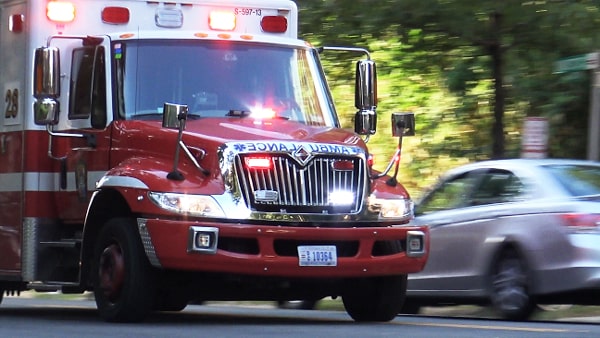
An authorized emergency vehicle with required flashing lights is immediately approaching. If you are clear of an intersection, what must you do?

When you hear the siren or see the flashing red light of a closely approaching emergency vehicle, and you are not in the intersection, you should:
  1. A Continue slowly in the right lane
  2. B Accelerate until it can pass safely
  3. C Pull near the right-hand edge and stop
  4. D Stop immediately in your current lane

Correct answer: C – Pull near the right-hand edge and stop

Nevada law requires you to yield, move parallel and as close as possible to the right-hand edge or curb, remain clear of the intersection and stop. Stay there until the emergency vehicle has passed unless a law enforcement officer directs otherwise. A violation is a misdemeanor.

Source: NRS 484B.267 – Operation of vehicle on approach of authorized emergency vehicle or official vehicle of regulatory agency; penalty

Question 4

Before moving left to pass another vehicle, you should:

  1. A Wait for the other driver to wave you around
  2. B Move left quickly before signaling
  3. C Signal and begin only when the pass can be made safely
  4. D Follow closely to shorten the passing distance

Correct answer: C – Signal and begin only when the pass can be made safely

A driver must signal before leaving a direct course and may make the movement only with reasonable safety. When passing on the left, maintain a safe distance and do not return right until safely clear. The overtaken driver must give way to the right and must not increase speed until completely passed.

Source: NRS 484B.207 – Overtaking vehicle on left side: Duties of drivers of overtaking and overtaken vehicle, NRS 484B.413 – Requirements for turning on highway; signal for stopping or decreasing speed

Question 5

When is it appropriate to use high-beam headlights at night?

  1. A Only while driving on city streets
  2. B Whenever you are on a highway
  3. C When the road is dark and you are not too close to other traffic
  4. D Whenever another vehicle is directly ahead

Correct answer: C – When the road is dark and you are not too close to other traffic

High beams may be used when conditions allow, but Nevada requires a lower beam when approaching an oncoming vehicle within 500 feet. You must also switch from high beams when following another vehicle within 300 feet. These limits protect other drivers from glare while allowing greater illumination on an otherwise dark road.

Source: NRS 484D.215 – Use of equipment for lighting road with multiple beams

Question 6

A steady yellow turn arrow appears before you enter the intersection. What does it warn you about?

  1. A The protected turn is ending and the signal will change to red
  2. B The turn is permitted after yielding to pedestrians
  3. C The signal is malfunctioning
  4. D You should accelerate to complete the turn

Correct answer: A – The protected turn is ending and the signal will change to red

A steady yellow arrow warns that the protected turning movement is ending and the signal is changing to red. It is different from a flashing yellow arrow, which permits the indicated turn after yielding. Do not accelerate merely to enter before the signal changes.

Source: NRS 484B.307 – Traffic controlled by official traffic-control devices exhibiting different colored lights, Nevada Driver’s Handbook — Ch. 3, “Signals”