


Nevada Practice Permit Test 3

4.8 out of 5 (539 votes)
80% Passing score
20 Questions
4 Mistakes allowed
A good Nevada DMV practice test should give you a decent feel for how Nevada asks about driving rules, where the wording can get a little fussy, and which details are worth knowing before you walk into the DMV or before you take the knowledge test online at home. This Nevada DMV permit practice test gives you 20 questions, with 16 correct answers needed to pass. There is no time limit, which is the point. You can slow down, read the question twice, argue with yourself for a second, and then learn from the answer instead of rushing through it like it is some kind of arcade game. The questions cover Nevada traffic laws, safe driving habits, road signs, right-of-way, and distracted driving rules, including the state’s restrictions on texting or using a handheld phone behind the wheel. That matters because the official Nevada knowledge test can be taken in a couple of different ways. The online version, offered through KnowTo Drive Nevada, is available in English and Spanish, runs on a desktop or laptop with a front-facing camera, and gives you 60 minutes. Touch-screen devices are not supported, because apparently even convenience has boundaries. The in-person DMV test is given on touch-screen computers, also in English and Spanish, with audio available and no time limit. So, yes, the format changes a bit, but the core knowledge does not. After you finish this Nevada practice permit test, you will see what you missed and what the correct answers were. Retake it as many times as you need. That is not just comforting; it is practical. The official process includes testing fees, retest fees, and a separate online vendor fee if you use KnowTo Drive, so finding your weak spots here is cheaper and less irritating than finding them later. And the permit test is only part of the Nevada licensing process. First-time applicants need identity documents, proof of Social Security number, and two Nevada residency documents. Everyone takes a vision screening, with 20/40 vision generally required for full driving privileges. If you need glasses or contacts, a restriction may be added. Teen applicants have their own extra paperwork too, including school attendance certification, a parent or guardian signature, driver education proof, and a supervised driving log. Use this Nevada DMV practice test as a full rehearsal, not just a quiz. Learn the rules, get used to the phrasing, and show up knowing what the test — and the paperwork around it — is going to ask from you.
FREE DMV Practice Test App
Study for your Nevada permit test or driver’s license with the NextDoorDriving app. 700+ DMV questions and answers, 100% free!
Download on the App Store

Sample Nevada Permit Test Questions

Question 1

A school bus displaying flashing red lights stops on a two-lane highway. What must traffic approaching from the opposite direction do?
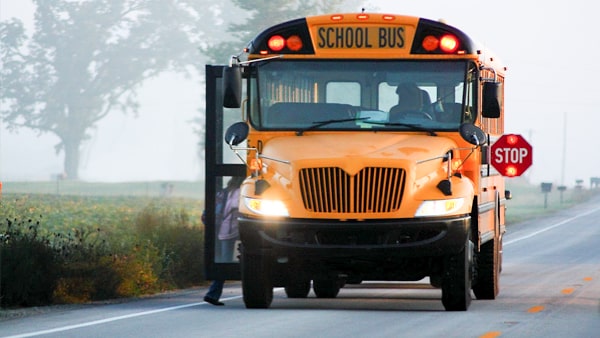
If a school bus stops to unload children on a two-lane highway, vehicles traveling in the opposite direction are:
  1. A Continue because it is traveling in the opposite direction
  2. B Slow down and pass after signaling
  3. C Stop, then pass at reduced speed
  4. D Stop and remain stopped until the red lights cease

Correct answer: D – Stop and remain stopped until the red lights cease

Nevada requires drivers meeting or overtaking a school bus from either direction to stop when the bus is receiving or discharging pupils and displaying flashing red lights. Drivers may not proceed past the bus until the flashing red signal stops. The opposite-direction exception applies when the bus is on the other roadway of a divided highway.

Source: NRS 484B.353 – Overtaking and passing school bus: Duties of driver; exceptions; penalties
Question 2

The handbook’s minimum two-second following check measures the space:

  1. A Beside your vehicle
  2. B Ahead of your vehicle
  3. C Behind your vehicle
  4. D Around the entire vehicle

Correct answer: B – Ahead of your vehicle

For speeds of 40 mph or less, the Nevada handbook describes two seconds as the minimum time to remain behind the vehicle ahead, while noting that many instructors recommend up to four seconds. Count after the vehicle ahead passes a fixed object. Increase the following interval at higher speeds or when roads are slippery or visibility is reduced.

Source: Nevada Driver’s Handbook — Ch. 3, “Defensive Driving Tips”

Question 3

Which driving practice helps keep a towed trailer stable?

  1. A Accelerate whenever the trailer begins moving sideways
  2. B Steer gently and smoothly
  3. C Make quick lane changes
  4. D Brake as late as possible

Correct answer: B – Steer gently and smoothly

A vehicle-trailer combination reacts more strongly to abrupt steering than a single vehicle. The handbook advises steering gently and smoothly because quick lane changes can create a crack-the-whip effect and may overturn a trailer. Looking well ahead and braking early also reduce the need for sudden control inputs.

Source: Nevada Driver’s Handbook — Ch. 7, “Combination of Vehicles”

Question 4

How should you make an emergency stop in a vehicle with four-wheel ABS?

What should you do if you have to stop your vehicle in an emergency?
  1. A Press the brake hard, hold it firmly and steer where you want to go
  2. B Pump the brake pedal rapidly
  3. C Apply the parking brake before the service brake
  4. D Shift the transmission into Park

Correct answer: A – Press the brake hard, hold it firmly and steer where you want to go

With four-wheel ABS, push the brake pedal down hard, keep firm pressure on it and steer toward a safe path. Pumping the pedal can disengage the anti-lock function because the system already controls brake pressure automatically. Pumping may be appropriate with conventional brakes when traction is lost, but it is not the correct technique for four-wheel ABS.

Source: Nevada Driver’s Handbook — Ch. 3, “Anti-Lock Braking Systems”

Question 5

A driver extends the left arm downward from the vehicle. What is being signaled?

  1. A A left turn
  2. B A right turn
  3. C A stop or decrease in speed
  4. D A return to traffic from a parked position

Correct answer: C – A stop or decrease in speed

Nevada’s statutory hand signal for stopping or decreasing speed is the left hand and arm extended downward beyond the left side of the vehicle. A horizontal arm indicates a left turn, while an arm extended upward indicates a right turn. These signals may be used when an appropriate hand-and-arm signal is authorized.

Source: NRS 484B.420 – Methods of giving signals by hand and arm

Question 6

Which situation can make it harder for another driver to see your vehicle or intended path?

Which of the following might cause other drivers not to see you?
  1. A Buildings or parked vehicles restricting the view at an intersection
  2. B Glare or an obstructed windshield
  3. C A driver backing from a parking area with a limited rear view
  4. D All of these situations

Correct answer: D – All of these situations

Obstructions near an intersection can prevent drivers from seeing approaching traffic. Glare and a windshield that is not clear also reduce useful vision, particularly at night or in poor weather. A person backing may have areas behind or beside the vehicle that cannot be seen directly, making careful observation especially important.

Source: Nevada Driver’s Handbook — Ch. 3, “Signs”, Nevada Driver’s Handbook — Ch. 5, “Night Driving”, Nevada Driver’s Handbook — Ch. 4, “Back-up Warning”