Nevada Practice Permit Test 4

4.8 out of 5 (461 votes)
80% Passing score
20 Questions
4 Mistakes allowed
Nevada gives new drivers a pretty clear path, but clear does not always mean light. There is the knowledge test, the permit, the supervised driving rules if you are under 18, the road test, the license restrictions, and somewhere in there you still have to remember what a pavement marking means when it is paired with a sign you only half-recognize. This Nevada DMV practice test keeps the focus where it belongs first: the written test material. The practice test includes 20 multiple-choice questions on Nevada traffic laws, highway signs, road markings, safe driving habits, and child passenger safety. That last topic matters more than people tend to assume, because the DMV does not treat safety-seat rules as decorative knowledge. Use this Nevada DMV permit practice test as a steady check on what you actually know from the Nevada Driver Handbook, not just what sounds familiar after a quick skim. For teens, the permit process starts at 15½. Driver education is not required before getting the instruction permit, but most drivers under 18 will need it before moving on to a license. To get the permit, you will need the application, a vision test, the knowledge test, and a parent or guardian if you are under 18. Minors also need Nevada’s school attendance certification, DMV 301, which is valid for 60 days. A little paperwork-heavy, yes, but it is part of the process. Once a teen has a permit, driving is supervised only. The licensed driver beside them must be at least 21 and have at least one year of licensed driving experience. Before the road test, most teen drivers must be at least 16, hold the permit for 6 months, complete 50 supervised hours with 10 at night, finish driver education, and bring the approved driving log through RoadReady or Form DLD-130. After licensing, Nevada still keeps guardrails in place: no passengers under 18 for the first 6 months except immediate family, and the statewide 10 p.m. to 5 a.m. minor curfew continues until age 18, with limited school and work exceptions. Adults have fewer hoops, though not zero. At 18 or older, you still need the written test, vision test, road skills test, identity and residency documents, fees, and a properly registered and insured vehicle for the road test. An instruction permit is optional for adults, but without one, the drive test has to be scheduled in person. Aim for at least 16 correct answers on this Nevada learners permit practice test. It is a practical benchmark before the real permit test, and, honestly, a better use of study time than rereading the same handbook paragraph three times while retaining almost none of it.

FREE DMV Practice Test App
Study for your Nevada permit test or driver’s license with the NextDoorDriving app. 700+ DMV questions and answers, 100% free!
Download on the App Store

Sample Nevada Permit Test Questions

Question 1

After overtaking another vehicle on a two-lane road, when should you return to the right lane?

After passing a car, it is safe to return to your driving lane when:
  1. A After signaling for exactly four seconds
  2. B When the overtaken driver flashes the headlights
  3. C When the passed vehicle is visible in your inside rearview mirror and you are safely clear
  4. D As soon as the passed vehicle appears in a side mirror

Correct answer: C – When the passed vehicle is visible in your inside rearview mirror and you are safely clear

The passing driver must remain left until safely clear of the overtaken vehicle. The handbook gives a practical clearance check: return after the vehicle you passed is visible in the inside rearview mirror. The overtaken driver must give way upon observing the pass and must not increase speed until completely passed, but the passing driver remains responsible for returning only when the movement can be completed safely.

Source: NRS 484B.207 — Overtaking vehicle on left side: Duties of drivers of overtaking and overtaken vehicle, Nevada Driver Handbook — Ch. 3, “Passing Another Vehicle”

Question 2

According to the driver handbook, only six inches of floodwater may:

  1. A Be safe for every passenger car to cross
  2. B Make a road surface easier to see
  3. C Push a fast-moving car off the roadway
  4. D Guarantee that a vehicle will remain stable

Correct answer: C – Push a fast-moving car off the roadway

The handbook warns that a car traveling at high speed can be pushed off the road by only six inches of water. Less than one inch may cause a driver to lose control, while most vehicles can float in two feet of water or less. Because water depth and damage beneath the surface are difficult to determine, drivers should turn around rather than attempt to cross a flooded roadway.

Source: Nevada Driver Handbook — Ch. 5, “Tips for Driving in a Flash Flood”

Question 3

A vehicle’s blind spot is an area that:

  1. A Is always directly behind the rear bumper
  2. B Is fully visible in the inside rearview mirror
  3. C Is fully visible in a properly adjusted side mirror
  4. D Requires a head check because the mirrors do not show it

Correct answer: D – Requires a head check because the mirrors do not show it

Blind spots are areas around a vehicle that are not fully visible through the mirrors. Before changing lanes, the handbook directs drivers to check the rearview and side mirrors and then look over the appropriate shoulder. The shoulder check allows the driver to see vehicles, motorcycles, or bicycles that may be hidden from mirror view. Change lanes only after confirming that traffic is clear.

Source: Nevada Driver Handbook — Ch. 3, “Signaling, Turning, Lane Changes, and Passing”

Question 4

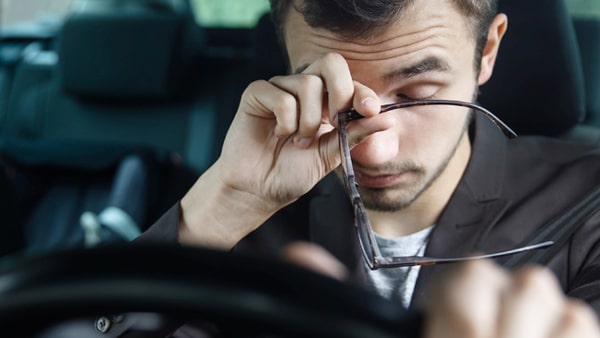
If fatigue makes it difficult to focus or remain alert while driving, what should you do?

If you are driving and you feel that you cannot stay alert and awake, you:
  1. A Continue after opening a window or drinking caffeine
  2. B Turn up the music and ask passengers to keep talking
  3. C Stop driving at a safe place and take a break
  4. D Use any of these methods

Correct answer: C – Stop driving at a safe place and take a break

The official supervised-driving guide describes staying alert as focusing on the road and not driving while fatigued. It identifies difficulty focusing, frequent blinking, and drifting from the lane as warning signs of drowsiness. The guide advises taking regular breaks, including after about two hours or 100 miles, and avoiding driving during times when the driver would normally be sleeping.

Source: Parents Supervised Driving Guide — “Drowsy Driving”

Question 5

At a Nevada railroad crossing with multiple tracks and no gates, a train has just passed. When may you proceed?

  1. A Immediately after the last car clears your lane
  2. B Only after the first train is completely out of sight
  3. C After you have a clear view in both directions and can cross safely
  4. D Only during dry weather

Correct answer: C – After you have a clear view in both directions and can cross safely

The handbook directs a driver stopped at a crossing with more than one set of tracks to wait for a clear view in both directions before starting across. A train or other on-track equipment may approach from either direction on another track. Drivers must also obey warning signals and may not proceed while a train is plainly visible and close enough to present a hazard.

Source: NRS 484B.553 — Obedience to signal indicating approach of railroad train or other on-track equipment, Nevada Driver Handbook — Ch. 3, “Railroad Crossings”

Question 6

When a seating position has a combined lap-and-shoulder belt, how should it be used?

  1. A Use only the lap portion at low speeds
  2. B Wear both portions properly fitted
  3. C Place the shoulder portion behind your back
  4. D Use it only in heavy traffic

Correct answer: B – Wear both portions properly fitted

Nevada law requires occupants covered by the seat-belt statute to wear an available safety belt. It also requires qualifying passenger cars manufactured after January 1, 1970, to have shoulder-harness assemblies for the front seating positions. The handbook refers to protection from a properly fitted shoulder-and-lap belt. Using only one portion or placing the shoulder belt behind the body does not follow that guidance.

Source: NRS 484D.495 — Safety belts and shoulder harness assembly; requirements for driver, child and other passenger; penalties; exemptions, Nevada Driver Handbook — Ch. 2, “Seat Belt Laws”; “Traveling with Babies and Children”