Nevada Road Signs Test

4.7 out of 5 (336 votes)
80% Passing score
10 Questions
2 Mistakes allowed
Nevada road signs are the part of the permit test people think they already know, mostly because they have been looking at them from the passenger seat for years. That confidence is useful, sure, but it can get a little wobbly once the DMV starts asking about shape, color, lane markings, traffic signals, and what a driver is expected to do next — not just what the sign is called. This Nevada road signs practice test focuses on that sign-recognition piece of the larger Class C knowledge test. The official Nevada permit test covers traffic laws, highway signs, pavement markings, safe driving practices, DUI rules, licensing basics, and the regular rules of the road. Road sign questions are mixed into that full exam; there is no separate road-sign-only test for a standard Class C permit. That matters because you are not preparing for a neat little category quiz. You are preparing to recognize signs while everything else is being tested too. The real Nevada Class C knowledge test has 25 multiple-choice questions, and you need 20 correct answers to pass. That is an 80% score. The test stops once you reach 20 correct answers or 6 incorrect answers, so small misunderstandings can pile up faster than people expect. This practice test keeps the DMV permit test format in mind while giving extra attention to regulatory signs, warning signs, pavement markings, lane-use signs, traffic signals, and the visual clues that show up again and again in the Nevada Driver’s Handbook. It is built for teen applicants working toward an instruction permit at 15½, adults applying for a first Nevada license, and new residents who need to get familiar with Nevada’s expectations before testing. Online testing is available through Nevada’s official KnowTo Drive platform, and in-person testing is offered at DMV offices, but either way, the material comes back to the same basic thing: you need to know what the signs mean before the answer choices start sounding almost, but not quite, the same. Use this Nevada DMV road signs practice test as a focused way to sharpen recognition before the official exam. Not in a dramatic way. Just in the practical, slightly boring, very important way that keeps you from mixing up a warning sign with an instruction when it actually counts.
FREE DMV Practice Test App
Study for your Nevada permit test or driver’s license with the NextDoorDriving app. 700+ DMV questions and answers, 100% free!
Download on the App Store

Sample Nevada Permit Test Questions

Question 1

What does a steady yellow turn arrow tell a driver?

  1. A The indicated turn is prohibited until further notice
  2. B The driver should accelerate through the turn
  3. C The arrow is changing to red, and traffic must clear the intersection
  4. D The indicated turn remains protected from all other traffic

Correct answer: C – The arrow is changing to red, and traffic must clear the intersection

The Nevada handbook states that a steady yellow arrow warns that the signal is about to change to red. Drivers already within the intersection should clear it safely rather than accelerate to beat the changing signal. A yellow arrow does not begin a new protected-turn interval or guarantee priority over pedestrians and other traffic.

Source: Nevada Driver’s Handbook — Ch. 3, “Signals”
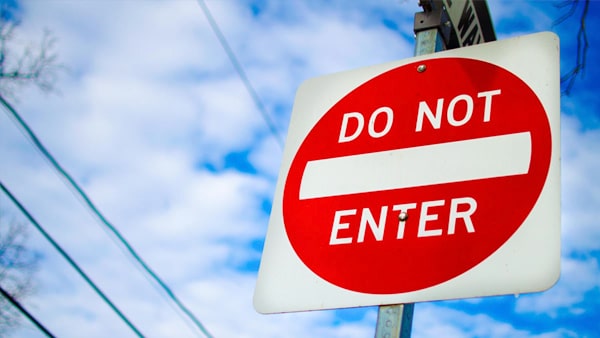
Question 2

A red circular sign containing a horizontal white bar means:

This sign means:
  1. A Stop
  2. B No U-turn
  3. C Yield
  4. D Do not enter

Correct answer: D – Do not enter

This is a DO NOT ENTER sign. It prohibits entering the roadway from the direction in which the sign faces, commonly because traffic beyond the sign travels in the opposite direction. Drivers may encounter this sign at the wrong end of a one-way street or at a freeway ramp intended for traffic leaving the freeway.

Source: Nevada Driver’s Handbook — Ch. 3, “Entering a Freeway”

Question 3

Your signal turns green while vehicles are still moving through the intersection. What should you do?

  1. A Wait until the intersection is clear before entering
  2. B Drive around the vehicles if an opening appears
  3. C Enter and wait in the middle of the intersection
  4. D Sound your horn and proceed immediately

Correct answer: A – Wait until the intersection is clear before entering

Under Nevada law, a green signal permits movement but requires drivers to yield to vehicles and pedestrians lawfully within the intersection or an adjacent crosswalk. Remain outside until the conflicting traffic has cleared and you can proceed safely. Entering merely because the light is green could obstruct traffic or create a collision risk.

Source: NRS 484B.307.2(a) – Traffic controlled by official traffic-control devices exhibiting different colored lights: Rights and duties of vehicular traffic and pedestrians depending upon particular signal displayed; exceptions; signals placed over individual lanes; certain restrictions upon local authorities; additional penalty for violation committed in certain zones

Question 4

If traffic remains in the intersection when your light changes from red to green, you should:

  1. A Pull into the intersection and wait
  2. B Move around the traffic using any available lane
  3. C Remain stopped until the intersection clears
  4. D Proceed because the green light gives you immediate priority

Correct answer: C – Remain stopped until the intersection clears

A circular green signal allows you to proceed, but it does not provide an unconditional right-of-way. Nevada requires drivers facing green to yield to vehicles and pedestrians lawfully within the intersection or adjacent crosswalk. Wait until they have cleared your path, then proceed when the movement can be made safely.

Source: NRS 484B.307.2(a) – Traffic controlled by official traffic-control devices exhibiting different colored lights: Rights and duties of vehicular traffic and pedestrians depending upon particular signal displayed; exceptions; signals placed over individual lanes; certain restrictions upon local authorities; additional penalty for violation committed in certain zones

Question 5

A yellow diamond sign displaying a black plus symbol warns of:

This sign shows one type of:
  1. A A crossroad intersection ahead
  2. B A winding roadway ahead
  3. C A required right turn
  4. D A lane ending ahead

Correct answer: A – A crossroad intersection ahead

The plus-shaped symbol represents a crossroad intersection ahead. Because it is a yellow diamond-shaped warning sign, it alerts drivers to a roadway condition or hazard rather than imposing a stop or turn requirement. Watch for traffic that may enter or cross your path as you approach the intersection.

Source: Nevada Driver’s Handbook — Ch. 3, “Signs, Signals and Markings”, NRS 484A.430 – Adoption of manual and specifications for devices for control of traffic by Department of Transportation

Question 6

When turning right on a circular green signal, which road users must you yield to?

  1. A Only vehicles approaching from behind
  2. B No one, because the signal is green
  3. C Pedestrians and other traffic lawfully within the intersection or adjacent crosswalk
  4. D Only vehicles making left turns

Correct answer: C – Pedestrians and other traffic lawfully within the intersection or adjacent crosswalk

Nevada permits a right or left turn on a circular green signal unless another device prohibits the movement. A turning driver must still yield to pedestrians in the intersection or adjacent crosswalk and to other vehicles lawfully using the intersection. Check that the turn can be completed safely before proceeding.

Source: NRS 484B.307.2(a) – Traffic controlled by official traffic-control devices exhibiting different colored lights: Rights and duties of vehicular traffic and pedestrians depending upon particular signal displayed; exceptions; signals placed over individual lanes; certain restrictions upon local authorities; additional penalty for violation committed in certain zones