


Nevada Road Signs Test 2

4.9 out of 5 (176 votes)
80% Passing score
20 Questions
4 Mistakes allowed
A red octagon does not need much explaining, but Nevada’s road sign questions are not built only around the signs everyone can name half-asleep. They are part of the main Class C knowledge test, mixed in with traffic laws, pavement markings, safe driving practices, DUI rules, licensing requirements, defensive driving, and the rest of the Nevada Driver’s Handbook. So the sign questions are not decorative. They count, and they count the same way every other question counts. This Nevada DMV road signs practice test gives you a focused way to work through that material before taking the real Nevada permit test. The test includes 20 multiple-choice questions on highway signs, warning signs, regulatory signs, traffic signals, lane markings, pavement markings, and the safe driving choices connected to them. Some of it will feel familiar, sure. Stop signs, yield signs, school zone signs — nobody is pretending those are exotic. But the DMV does expect you to know what the sign means in context, what action it requires, and what the safest response should be when the road is doing its usual road thing and not politely waiting for you to remember the handbook. The official Nevada Class C knowledge test has 25 multiple-choice questions. You need an 80% score to pass, which means 20 correct answers, with up to 5 missed questions allowed. The test may stop once you reach 20 correct answers or once you miss 6. Road sign questions are included in that same total. There is no separate road-sign-only test for the standard Class C permit exam, and there is no special missed-question limit just for signs. This Nevada practice permit test is untimed, which gives you room to do the thing most people skip: actually look at the sign, read the question, and think for a second. To pass this 20-question DMV sign test, you should answer at least 16 questions correctly, matching the 80% standard used on the real knowledge test. You can retake the Nevada DMV sign test as many times as you need. Repetition helps here, not because the material is impossibly difficult, but because quick recognition matters. The more often you review signs, signals, markings, and right responses, the more natural they feel when they show up on the DMV permit test — and, more importantly, on an actual Nevada road.
FREE DMV Practice Test App
Study for your Nevada permit test or driver’s license with the NextDoorDriving app. 700+ DMV questions and answers, 100% free!
Download on the App Store

Sample Nevada Permit Test Questions

Question 1

A green turn arrow is displayed with a steady red signal. Which movement is permitted?

  1. A Straight ahead only
  2. B Only the movement indicated by the green arrow
  3. C No movement until the circular signal turns green
  4. D Any movement after a complete stop

Correct answer: B – Only the movement indicated by the green arrow

When a steady red signal appears with a green turn arrow, Nevada law permits entry only for the movement shown by the arrow. The driver must still yield to pedestrians lawfully in an adjacent crosswalk and other traffic lawfully using the intersection. The red signal continues to prohibit movements not authorized by the arrow.

Source: NRS 484B.307(9)(a) — Traffic controlled by official traffic-control devices exhibiting different colored lights, Nevada Driver’s Handbook — Ch. 3, “Signals”
Question 2

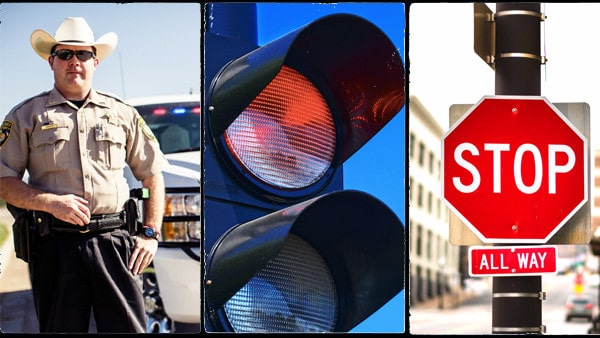
A steady yellow signal warns that which indication will appear next?

  1. A A flashing yellow indication
  2. B A steady green indication
  3. C A steady red indication
  4. D A flashing red indication

Correct answer: C – A steady red indication

A steady yellow signal warns that the related green movement is ending or that a steady red indication will be displayed immediately afterward. Drivers approaching the intersection should prepare to stop. They must not enter once the red signal is displayed.

Source: NRS 484B.307(6)(a) — Traffic controlled by official traffic-control devices exhibiting different colored lights, Nevada Driver’s Handbook — Ch. 3, “Signals”
Question 3

At an intersection controlled by a stop sign, where must you make your first complete stop?

  1. A Where you can see all approaching cross-traffic
  2. B After your vehicle has entered the crosswalk
  3. C At the stop line, or before the near crosswalk if no stop line exists
  4. D Five feet before reaching the stop sign

Correct answer: C – At the stop line, or before the near crosswalk if no stop line exists

Nevada requires you to stop at a clearly marked stop line. If there is no stop line, stop before entering the crosswalk on the near side. If neither exists, stop at the point nearest the intersection where you can see approaching traffic on the through highway, then yield as required before proceeding.

Source: NRS 484B.257.1–.2 – Vehicle entering intersection marked stop or yield, Nevada Driver’s Handbook — Ch. 3, “Signs, Signals and Markings”

Question 4

If a police officer directs traffic differently from a signal or sign, which direction must you follow?

Which of the following must you obey over the other three?
  1. A The traffic signal
  2. B The police officer’s lawful direction
  3. C The posted sign
  4. D The pavement markings

Correct answer: B – The police officer’s lawful direction

In Nevada, drivers must comply with a police officer’s lawful traffic directions. The law requiring obedience to traffic-control devices expressly recognizes an exception when a police officer directs otherwise. For example, if an officer tells you to remain stopped while your signal is green, follow the officer’s instruction.

Source: NRS 484B.100 – Obedience to police officer, NRS 484B.300.1 – Obedience to devices for control of traffic; exceptions; placement of devices; additional penalty for violation committed in certain zones

Question 5

When may you drive left of the center of a two-way highway?

On a two-way highway, you are allowed to drive on the left half of the roadway when:
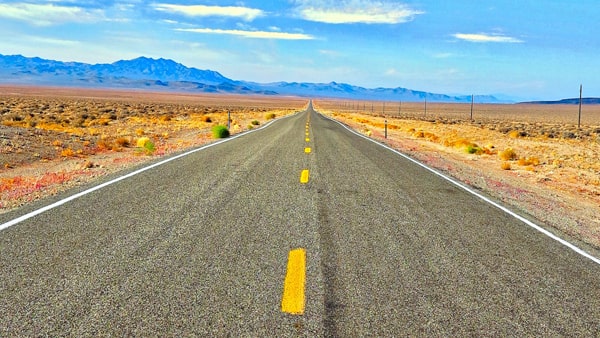
  1. A Whenever the roadway has double yellow centerlines
  2. B When a solid yellow line is on your side
  3. C When making a lawful pass and the left side is clear for a safe distance
  4. D While approaching a curve where you plan to turn left

Correct answer: C – When making a lawful pass and the left side is clear for a safe distance

Nevada generally requires vehicles to remain on the right half of the highway, with an exception for lawful overtaking and passing. Before moving left, the passing driver must have enough clear roadway to complete the maneuver without interfering with an approaching vehicle. Passing is prohibited where signs, markings, hills, curves, or other conditions make it unlawful or unsafe.

Source: NRS 484B.200.1(a) – Driving on right half of highway required; exceptions; additional penalty for violation committed in certain zones, NRS 484B.213.1 – Limitations on overtaking on left side; additional penalty for violation committed in certain zones

Question 6

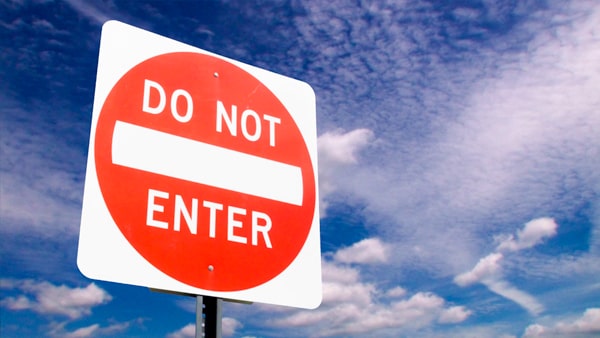
A DO NOT ENTER sign is primarily used to prevent drivers from:

This sign is used to prevent:
  1. A Entering a parking area that has no open spaces
  2. B Traveling through any active construction zone
  3. C Turning onto a street that ends ahead
  4. D Entering a one-way roadway or ramp from the wrong direction

Correct answer: D – Entering a one-way roadway or ramp from the wrong direction

A DO NOT ENTER sign marks a roadway entrance that drivers must not use from that direction. It is commonly encountered where entering would place a vehicle against the legal direction of traffic, including at one-way streets and freeway ramps. On a freeway entrance, DO NOT ENTER and WRONG WAY signs indicate that the driver has selected the wrong ramp or direction.

Source: Nevada Driver’s Handbook — Ch. 3, “Entering a Freeway”