


New Hampshire CDL General Knowledge Test (NH) 5

5 out of 5 (51 votes)
80% Passing score
50 Questions
10 Mistakes allowed
Are you preparing for your CDL in 2026? Our fifth New Hampshire CDL practice test is an essential tool for your preparation, and the best part - it's completely free. Unlike costly alternatives, this DMV practice test offers comprehensive features and study opportunities at no cost, ensuring equal access to high-quality resources for everyone. This specific practice test includes 50 NH CDL general knowledge test questions and answers, mirroring the structure of the actual CDL permit test. To pass, you'll need to answer at least 40 questions correctly. One of the unique aspects of our DMV practice test is its consistency - the same set of questions will appear each time you take it. This allows for focused study and a clear understanding of the areas where you need improvement. What sets our NH CDL general knowledge practice test apart is its state-specific focus. As driving regulations differ across states, it's crucial to prepare with material that's tailored to New Hampshire's unique rules and road signs. Our drivers practice test ensures that you're studying the most relevant and up-to-date information. The questions and answers in this NH CDL practice test are derived directly from the official 2026 New Hampshire CDL driver's manual. This is the same source used for the real CDL test, ensuring that you're studying the most accurate and pertinent information. If it's not in the manual, it won't appear on your written test - or ours. Preparing for the CDL test in New Hampshire has never been more straightforward. Our general knowledge permit practice test is designed to give you a realistic experience of what to expect, helping you to build confidence and knowledge. By taking advantage of this free, state-specific resource, you're setting yourself up for success on your path to obtaining your CDL in 2026!
FREE CDL Practice Test App
Pass your New Hampshire CDL General Knowledge test with the NextDoorDriving app. Real questions and answers—100% free and ad-free.
Download on the App Store

Sample New Hampshire CDL Test Questions - General Knowledge

Question 1

What must be checked when inspecting the kingpin, apron, and fifth-wheel gap?

  1. A The kingpin is not bent or damaged
  2. B The visible apron is not bent, cracked, or broken
  3. C The trailer lies flat on the fifth-wheel skid plate with no gap
  4. D All of these checks are required

Correct answer: D – All of these checks are required

The New Hampshire vehicle-inspection procedure requires all three checks. The kingpin must not be bent or damaged, and the visible apron must be free of bends, cracks, and breaks. The trailer must also rest flat against the fifth-wheel skid plate without a gap between the apron and fifth wheel.

Source: New Hampshire Commercial Driver’s License Manual — § 11.2.7, “Tractor/Coupling—Kingpin/Apron/Gap”
Question 2

Which statement about shifting a manual-transmission commercial vehicle is correct?

  1. A A synchronized transmission always requires double-clutching
  2. B Engine sound can help a driver recognize the proper shift point
  3. C During double-clutching, the clutch remains depressed while the transmission is in neutral
  4. D Road speed should not be used to determine when to shift

Correct answer: B – Engine sound can help a driver recognize the proper shift point

A driver can determine shift points by monitoring engine rpm or by learning the appropriate road speed for each gear. With experience, engine sound can also help indicate when to shift. Double-clutching is generally used with unsynchronized manual transmissions and includes releasing the clutch while the transmission is in neutral.

Source: New Hampshire Commercial Driver’s License Manual — § 2.3.1, “Manual Transmissions”

Question 3

When there is too little room to stop in an emergency, steering around the hazard may be safer than trying to stop.

  1. A TRUE
  2. B FALSE

Correct answer: A – TRUE

Stopping is not always the safest response when the available distance is inadequate. A driver may need to steer away from the hazard because a vehicle can often turn around an obstacle more quickly than it can stop. Emergency steering must remain controlled, especially in top-heavy vehicles or tractors pulling multiple trailers because abrupt movement can cause a rollover.

Source: New Hampshire Commercial Driver’s License Manual — § 2.17.1, “Steering to Avoid a Crash”

Question 4

Which lighting functions must be tested separately during a vehicle inspection?

  1. A Headlights and front clearance lights
  2. B Taillights and rear clearance lights
  3. C Clearance lights and identification lights
  4. D Brake lights, turn signals, and four-way flashers

Correct answer: D – Brake lights, turn signals, and four-way flashers

Brake lights, turn signals, and four-way flashers must each be checked separately. Testing each function individually allows the driver to verify that the corresponding lamps and controls operate correctly. Headlights and front clearance lights, or taillights and rear clearance lights, may be observed together when they are illuminated at the same time.

Source: New Hampshire Commercial Driver’s License Manual — § 11, “Vehicle Inspection—Lights/Reflectors/Reflector Tape Condition”

Question 5

Which hazardous-material restrictions apply to a bus carrying passengers?

  1. A Extremely dangerous Division 6.1 or Division 2.3 materials are prohibited in any amount
  2. B Class 1 explosives, except small-arms ammunition, are prohibited in passenger-occupied space
  3. C Labeled Class 7 radioactive packages cannot be stored in a compartment occupied by people
  4. D All of these restrictions apply

Correct answer: D – All of these restrictions apply

Federal hazardous-material rules impose all three restrictions. Extremely dangerous Division 6.1 or Division 2.3 materials may not be carried on a bus transporting passengers. Class 1 explosives other than small-arms ammunition are barred from passenger space, and labeled Class 7 packages must be placed in the trunk or baggage compartment rather than an occupied compartment.

Source: 49 CFR § 177.870(c), (f), (g) — Regulations for passenger carrying vehicles

Question 6

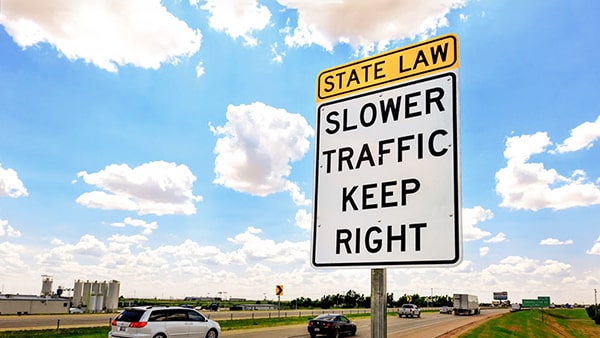
What does a SLOWER TRAFFIC KEEP RIGHT sign direct a driver to do?

This sign indicates that drivers ___________.
  1. A Use the available right-hand lane when traveling slower than normal traffic
  2. B Remain in the right lane even while preparing for a left turn
  3. C Pass slower vehicles only on the right
  4. D Increase speed until matching the fastest traffic

Correct answer: A – Use the available right-hand lane when traveling slower than normal traffic

In New Hampshire, a vehicle traveling below the normal speed of traffic must use the available right-hand lane or stay as close as practicable to the right edge. Exceptions apply when the driver is overtaking another vehicle or preparing for a left turn. The sign reinforces this lane-position rule; it does not direct drivers to exceed a safe or lawful speed.

Source: RSA 265:16, II — Drive on Right Side of Roadway; Exceptions