


New Hampshire CDL Practice Test (NH) 2026

4.7 out of 5 (82 votes)
80% Passing score
20 Questions
4 Mistakes allowed
As a New Hampshirite preparing for the CDL exam, it's essential to have resources that truly support your learning goals. That's why our New Hampshire CDL Practice Test is a vital tool for anyone aiming for their commercial driver's license in 2026. This initial NH CDL practice test is the first of many, designed to lay a solid foundation for your knowledge and skills. Our NH CDL practice test comprises 20 questions, mirroring the format and content you'll encounter in the actual CDL test. It's crucial to answer at least 16 questions correctly to pass, but remember, this is a learning tool, not just an assessment. The CDL practice test covers a wide range of topics, from pre-trip vehicle inspection to handling emergency situations, ensuring you're equipped with the knowledge necessary for safe and responsible driving. What sets our New Hampshire CDL practice test apart is its up-to-date content, reflecting the latest driving laws and regulations as of 2026. This ensures that you're learning the most current information, keeping you ahead of the curve. Another unique aspect is the non-timed nature of our CDL practice test. Unlike the real CDL permit test, which is time-bound, our DMV practice test allows you to take your time with each question. This approach not only aids in better understanding but also reduces the stress often associated with timed exams. Our sample CDL test questions are comprehensive, covering crucial topics for every aspiring commercial driver. Whether you're aiming for a Class A or B license, or seeking additional endorsements, our New Hampshire CDL practice test includes relevant questions for all! With a focus on essential driving knowledge, the DMV CDL practice test ensures you are well-prepared not just for the CDL permit test in 2026, but for real-life driving scenarios. By utilizing our NH CDL practice test, you're not just preparing to pass an exam; you're investing in your safety and the safety of others on the road. So, start your preparation today with our New Hampshire CDL Practice Test and pave the way for your successful driving career in 2026!
FREE CDL Practice Test App
Pass your New Hampshire CDL General Knowledge test with the NextDoorDriving app. Real questions and answers—100% free and ad-free.
Download on the App Store

Sample New Hampshire CDL Test Questions - General Knowledge

Question 1

A yellow warning sign with a black Y-shaped symbol indicates what roadway condition ahead?
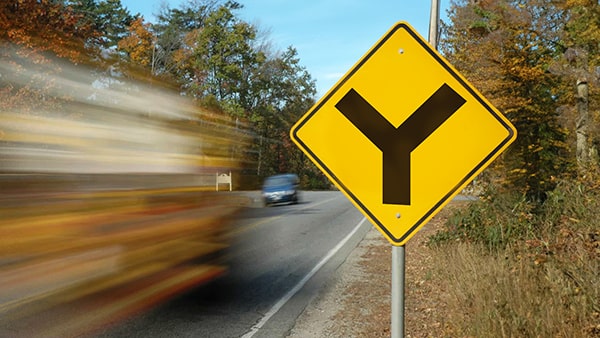
This sign warns drivers to _____________.
  1. A The road ends at a T-intersection
  2. B The roadway branches at a Y-intersection
  3. C A highway work zone begins
  4. D There is a dip within the intersection

Correct answer: B – The roadway branches at a Y-intersection

The Y-intersection warning symbol represents the general configuration of the roadway ahead. It alerts you that the roadway branches at an upcoming intersection rather than ending at a T-intersection. Be prepared to adjust your speed and position for the split.

Source: Manual on Uniform Traffic Control Devices, 11th ed. — § 2C.01, “Purpose of Warning Signs”, Manual on Uniform Traffic Control Devices, 11th ed. — § 2C.41, “Intersection Warning Signs”

Question 2

What can result when cargo placement leaves too little weight on the front axle?

  1. A The steering axle may become too light to steer safely
  2. B The drive-axle tires will be damaged by excessive weight
  3. C The vehicle will handle better in curves
  4. D The vehicle’s stopping distance will decrease

Correct answer: A – The steering axle may become too light to steer safely

The New Hampshire CDL manual explains that shifting cargo too far rearward can underload the front axle. Without enough weight on the steering axle, the vehicle may not steer safely. This is different from poor drive-wheel traction, which can occur when too little weight is placed on the driving axles.

Source: New Hampshire Commercial Driver’s License Manual — § 3.2.4, “Balance the Weight”

Question 3

If you cannot avoid driving through deep standing water, what should you do while crossing it?

  1. A Maintain light pressure on the brakes
  2. B Apply the brakes hard while accelerating
  3. C Disconnect the steering-axle brakes
  4. D Shift into neutral and reduce engine speed

Correct answer: A – Maintain light pressure on the brakes

Water can make brakes weak, uneven, or prone to grabbing. Slow down, select a low gear, and gently apply the brakes before entering the water. Cross while maintaining light brake pressure and sufficient engine speed, then continue light pressure afterward until the brakes have dried and are working properly.

Source: New Hampshire Commercial Driver’s License Manual — § 2.13.2, “Driving—Wet Brakes”

Question 4

As a person’s blood alcohol concentration rises, what happens to driving ability?

  1. A Alcohol’s effects gradually decrease
  2. B The person always recognizes the increasing impairment
  3. C Impairment increases, making driving more dangerous
  4. D The body eliminates alcohol more quickly

Correct answer: C – Impairment increases, making driving more dangerous

Alcohol affects progressively more of the brain as BAC increases. Judgment and self-control are affected first, followed by greater problems with vision, coordination, and muscle control. These effects increase the likelihood of serious driving errors and a crash.

Source: New Hampshire Commercial Driver’s License Manual — § 2.22.1, “Alcohol and Driving”

Question 5

What is the minimum UL fire-extinguisher rating required on a power unit transporting hazardous materials that require placards?

  1. A 10 B:C
  2. B 9 B:C
  3. C 8 B:C
  4. D 7 B:C

Correct answer: A – 10 B:C

A power unit transporting placardable hazardous materials must carry a fire extinguisher with a UL rating of at least 10 B:C. Federal regulation also requires the extinguisher to display its rating, be readily accessible, be securely mounted, and permit confirmation that it is charged. New Hampshire applies these incorporated motor-carrier safety standards to covered commercial operations.

Source: 49 CFR § 393.95(a)(1)(i), (a)(2)–(4) — Emergency equipment on all power units, N.H. Admin. R. Saf-C 901.01 — Applicability, N.H. Admin. R. Saf-C 901.02 — Adoption of Federal Standards

Question 6

Approximately how far ahead can properly working low-beam headlights illuminate?

  1. A 100 feet
  2. B 150 feet
  3. C 200 feet
  4. D 250 feet

Correct answer: D – 250 feet

Low-beam headlights generally let a driver see about 250 feet ahead. High beams provide a longer sight distance, but they cannot always be used around other traffic. At night, adjust your speed so your total stopping distance remains within the distance illuminated by your headlights.

Source: New Hampshire Commercial Driver’s License Manual — § 2.11.4, “Vehicle Factors—Headlights”