New Hampshire DMV Practice 2

4.8 out of 5 (190 votes)
80% Passing score
20 Questions
4 Mistakes allowed
New Hampshire does licensing its own way, and that matters before you even start studying for the NH DMV written test. There is no standard learner’s permit for first-time, non-commercial drivers here. That one detail trips people up, partly because almost every other state has trained new drivers to expect a permit card, a neat little waiting period, and a familiar process. In New Hampshire, you may begin practicing at 15½, but only if you follow the state’s learning-to-drive rules: proof of age in the vehicle, no suspended or revoked driving privilege, and proper supervision. It is simple enough once you know it. It is also exactly the kind of thing people miss when they study with generic material. This free New Hampshire DMV practice test is built around the rules that actually matter for New Hampshire drivers, not vague national driving trivia dressed up as preparation. The 20-question format gives you a practical way to work through the kinds of topics that can appear on the real NH DMV written test, including traffic laws, seat belt rules, safe-driving judgment, licensing requirements, and the smaller details that are easy to read once and immediately forget. Each question gives immediate feedback with an explanation, which is the useful part, honestly, because knowing why an answer is correct usually sticks better than just memorizing the letter choice and hoping the real test words it the same way. For drivers under 18, the process has a few more layers. New Hampshire requires an approved driver education program with at least 30 hours of classroom instruction, 10 hours of behind-the-wheel training with a certified instructor, and 6 hours of observation. Teen applicants also need 40 hours of supervised practice driving, including 10 nighttime hours, plus parent or guardian authorization. After licensing, drivers under 21 receive a Youth Operator License, and drivers under 18 face added restrictions, including no driving from 1:00 a.m. to 4:00 a.m. and passenger limits during the first 6 months. Adults have fewer extra requirements, but the DMV still expects the full sequence: application, identity and residency documents, fee, vision test, knowledge test, and road skills test. So, yes, this DMV permit test practice is about passing the test. But more than that, it helps you sort the New Hampshire-specific rules from the noise—before Manchester traffic, White Mountains winter roads, or summer Seacoast congestion start doing the teaching for you.
FREE DMV Practice Test App
Study for your New Hampshire permit test or driver’s license with the NextDoorDriving app. 700+ DMV questions and answers, 100% free!
Download on the App Store

Sample New Hampshire Permit Test Questions

Question 1

A vehicle moves into the space ahead of you, leaving your following gap too short. What should you do first?
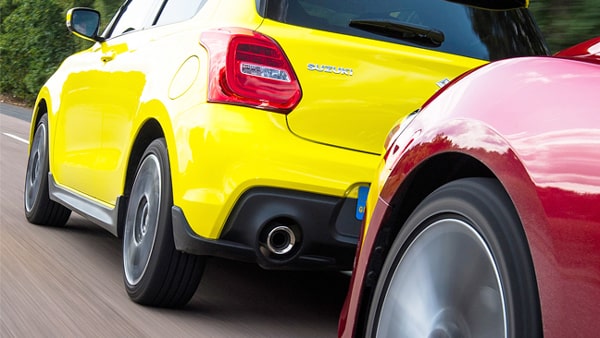
When you follow too closely and another driver cuts suddenly in front of you, what is the best thing to do?
  1. A Move immediately into the next lane
  2. B Apply the brakes as hard as possible
  3. C Steer onto the shoulder
  4. D Ease off the accelerator to rebuild the gap

Correct answer: D – Ease off the accelerator to rebuild the gap

A safe following interval gives you time and space to respond to changing traffic. If another vehicle enters your gap, smoothly reduce speed by easing off the accelerator and reestablish the recommended following distance. Continue monitoring traffic and use the brakes if conditions require further slowing.

Source: New Hampshire Driver’s Manual — §8, “Providing an Adequate Following Distance”

Question 2

At an intersection without painted crosswalk lines or working signals, when must a driver yield to a pedestrian in the unmarked crosswalk?

  1. A When the pedestrian is on the driver’s half of the road or approaching it closely enough to be in danger
  2. B Only when the pedestrian displays a green signal
  3. C Only after the pedestrian reaches the center of the road
  4. D Only if the driver is turning

Correct answer: A – When the pedestrian is on the driver’s half of the road or approaching it closely enough to be in danger

New Hampshire’s definition of a crosswalk includes the area connecting the sides of a highway at an intersection, even without pavement markings. Where signals are absent or not operating, a driver must yield when a pedestrian is on the driver’s half of the roadway or is approaching it closely enough to be in danger. Pedestrians may not suddenly enter the path of an immediate hazard.

Source: RSA 259:17 – Crosswalk, RSA 265:35, I–II – Pedestrian's Right of Way in Crosswalks

Question 3

Which type of drug may impair a person’s ability to drive?

What kinds of drugs, other than alcohol, can affect your driving ability?
  1. A A prescription drug that slows reflexes
  2. B An over-the-counter allergy or cold medicine that causes drowsiness
  3. C A controlled or illegal drug that affects judgment
  4. D All of these choices

Correct answer: D – All of these choices

Prescription, over-the-counter, controlled, and other substances can impair reflexes, judgment, vision, or alertness. Drivers should read medication warnings and consult a doctor or pharmacist if they are unsure about side effects. New Hampshire law prohibits driving under the influence of any drug or chemical substance that impairs the ability to drive.

Source: RSA 265-A:2, I(a) – Driving or Operating Under Influence of Drugs or Liquor; Driving or Operating With Excess Alcohol Concentration, New Hampshire Driver’s Manual — §3, “Other Impairing Drugs and Driving”

Question 4

What is the primary safety purpose of properly adjusting a vehicle’s head restraint?

  1. A To make long trips more comfortable
  2. B To help prevent whiplash injuries in a crash
  3. C To keep the driver’s hair away from the seat
  4. D To support the head when the driver becomes tired

Correct answer: B – To help prevent whiplash injuries in a crash

A properly positioned head restraint is designed to help prevent whiplash during a crash. Adjust it to contact the back of the occupant’s head without placing it below the ears. It is a safety device and should not be positioned merely for comfort or used to support the head of a tired driver.

Source: New Hampshire Driver’s Manual — §4, “Adjusting Seat”

Question 5

Which situation could prevent another driver from seeing your vehicle?

Which of the following might cause other drivers not to see you?
  1. A A building or parked vehicle blocking the sightline at an intersection
  2. B Frost, ice, or snow covering the other vehicle’s windows
  3. C The limited rear view of a driver backing from a parking space
  4. D All of these choices

Correct answer: D – All of these choices

Buildings and parked vehicles can hide traffic near an intersection. Frost, ice, and snow on windows also restrict a driver’s view, while drivers backing from parking spaces have limited visibility behind their vehicles. Recognize blocked-vision situations early and be prepared for vehicles that may enter your path.

Source: New Hampshire Commercial Driver License Manual — §2.8.3, “Drivers Who Are Hazards”, New Hampshire Driver’s Manual — §5, “Backing”, New Hampshire Driver’s Manual — §4, “Snow and Ice Removal”

Question 6

What can happen when alcohol is combined with a prescription or over-the-counter drug?

  1. A The medicine cancels the alcohol’s effects
  2. B The alcohol makes the medicine work safely
  3. C The substances may multiply or add to each other’s impairing effects
  4. D They cannot interact because they are different substances

Correct answer: C – The substances may multiply or add to each other’s impairing effects

Alcohol combined with another impairing drug may multiply alcohol’s effects or produce additional impairment. Reflexes, judgment, vision, and alertness may be severely affected. New Hampshire law prohibits driving while impaired by any combination of alcohol, prescription drugs, over-the-counter drugs, controlled drugs, or other impairing substances.

Source: RSA 265-A:2, I(a) – Driving or Operating Under Influence of Drugs or Liquor; Driving or Operating With Excess Alcohol Concentration, New Hampshire Driver’s Manual — §3, “Combining Alcohol and Other Impairing Drugs”