


New Hampshire DMV Practice 7

4.9 out of 5 (83 votes)
80% Passing score
20 Questions
4 Mistakes allowed
New Hampshire’s licensing process has a few quirks, and the big one is worth getting straight before you start studying: the state does not issue a standard learner permit for first-time non-commercial drivers. So, yes, you can still practice before you are licensed, but you are doing it under New Hampshire’s supervised-driving rules, not with the kind of permit many other states hand out. That detail trips people up more than it should, mostly because everyone casually says “permit test” anyway. This NH DMV practice test is built around the written knowledge you need for the real licensing process, with 20 questions covering traffic laws, road signs, safe driving habits, insurance responsibilities, and those little rule-based details that seem harmless until they show up in official wording. You need 16 correct answers to pass, which is a manageable number, but not an excuse to skim. A good NH DMV written test practice should make the material feel familiar before you are sitting across from the state’s version of “let’s see what you actually remember.” For drivers under 18, the written test sits inside a bigger process. New Hampshire requires an approved Driver Education Program, parent or guardian authorization, and at least 40 hours of supervised driving. Ten of those hours have to be at night, counted from one-half hour after sunset to one-half hour before sunrise, which is oddly precise but very much part of the rule. The supervising driver must be a licensed parent, guardian, or qualified adult over 25. And the certification is not just a friendly note from home; it is part of the official licensing paperwork. Once a qualifying driver is over 16 and under 21, New Hampshire issues a Youth Operator License. Under-18 drivers have extra restrictions, including no driving from 1:00 a.m. to 4:00 a.m., limits on young passengers during the first six months, and the basic-but-serious rule that there cannot be more passengers than available seat belts or proper restraints. These are not decorative details. They are part of how New Hampshire expects new drivers to ease into real traffic, real weather, real back roads, and, frankly, real mistakes avoided early. This free NH drivers practice test can be taken as often as needed, whether you are a teen working toward your first license, a parent trying to decode the process, or someone brushing up after time away from the road. Use it more than once. Miss things here, fix them here, and walk into the real NH driving test practice portion with fewer surprises.
FREE DMV Practice Test App
Study for your New Hampshire permit test or driver’s license with the NextDoorDriving app. 700+ DMV questions and answers, 100% free!
Download on the App Store

Sample New Hampshire Permit Test Questions

Question 1

Driving far below the normal flow of traffic without a safety-related reason can:

  1. A Create a hazard and impede traffic
  2. B Eliminate the need for other vehicles to pass
  3. C Always be considered safe and lawful
  4. D Give the slow vehicle priority over other traffic

Correct answer: A – Create a hazard and impede traffic

Driving far below surrounding traffic can block vehicles and contribute to unsafe lane changes or passing attempts. New Hampshire law prohibits driving so slowly that normal and reasonable traffic movement is impeded, except when reduced speed is necessary for safety or required by law. The posted minimum on the interstate system is 45 mph.

Source: RSA 265:64, I – Minimum Speed Regulation, New Hampshire Driver’s Manual — §5, “Speed Limits”
Question 2

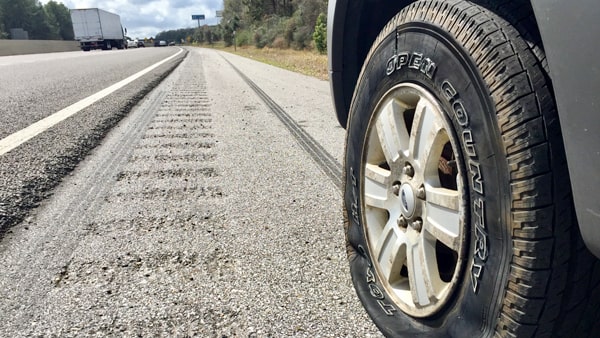
After a tire suddenly goes flat on a highway, where should you stop if assistance is needed?

Where should you park when you need help after your tire suddenly deflates while driving on a highway?
  1. A In the right travel lane
  2. B Off the roadway and away from traffic, if possible
  3. C Anywhere the vehicle is visible from the front
  4. D Immediately beyond a hill or curve

Correct answer: B – Off the roadway and away from traffic, if possible

Keep a firm grip on the steering wheel and slow gradually after a tire blowout. If possible, pull completely off the roadway in a safe place and activate the emergency flashers. A disabled vehicle should be moved away from traffic rather than left in a travel lane or where a hill or curve limits visibility.

Source: New Hampshire Driver’s Manual — §9, “Tire Blowout” and “Vehicle Breakdown”

Question 3

After a train passes at an ungated crossing with multiple tracks, what must you verify before crossing?

  1. A That the first train has cleared your lane
  2. B That the first train is completely out of sight
  3. C That you have a clear view in both directions and no train is approaching
  4. D That the pavement is dry

Correct answer: C – That you have a clear view in both directions and no train is approaching

At a multiple-track crossing, one train can conceal another approaching train. The New Hampshire manual directs drivers to wait until they have a clear view of the tracks in both directions, then look both ways before crossing. State law also prohibits proceeding when a plainly visible train is close enough to present a hazard.

Source: RSA 265:48, I – Obedience to Signal Indicating Approach of Train or Other Maintenance of Way On-Track Equipment, New Hampshire Driver’s Manual — §6, “Railroad Crossing Warning Signs”

Question 4

What is the proper way to drive through a highway work zone?

  1. A Follow traffic controls and flagger directions while proceeding carefully
  2. B Brake sharply immediately before reaching the workers
  3. C Slow down solely to watch the construction activity
  4. D Sound the horn continuously near the workers

Correct answer: A – Follow traffic controls and flagger directions while proceeding carefully

New Hampshire drivers must obey flagpersons directing traffic in marked construction, maintenance, or utility work areas. If a flagperson displays a stop signal, stop at least 25 feet away and wait until directed to proceed and it is safe. Drivers must also yield to authorized vehicles and pedestrians actually working within an indicated construction or maintenance area.

Source: RSA 265:3-b, I – Obedience to Flagpersons, RSA 265:6-a, I – Highway Construction and Maintenance

Question 5

What does a steady yellow traffic signal indicate?

  1. A Emergency vehicles have exclusive use of the intersection
  2. B You may proceed whenever no pedestrians are present
  3. C Only right turns are permitted
  4. D The green movement is ending and a red signal will follow immediately

Correct answer: D – The green movement is ending and a red signal will follow immediately

Under New Hampshire law, a steady yellow signal warns that the related green movement is ending or that a red indication will appear immediately afterward. Once the red signal is displayed, traffic may not enter the intersection except for a lawful turn after stopping when permitted. A yellow signal does not depend on whether you are turning or pedestrians are present.

Source: RSA 265:10, II(a), III – Traffic Control Signal Legend, New Hampshire Driver’s Manual — §6, “Traffic Signals”

Question 6

During which period should a driver be especially alert for reduced visibility and fatigue?

  1. A Morning daylight hours
  2. B Midafternoon
  3. C Nighttime, especially late at night
  4. D Only during the evening rush hour

Correct answer: C – Nighttime, especially late at night

Drivers cannot identify hazards as quickly at night as they can in daylight, leaving less time to respond. Fatigue can also affect vision and increase decision-making time. The driver’s manual advises getting adequate sleep and avoiding late-night driving when possible.

Source: New Hampshire Driver’s Manual — §3, “Fatigue”, New Hampshire Commercial Driver License Manual — §2.11, “Driving at Night”