New Hampshire DMV Test Evaluation

4.7 out of 5 (393 votes)
80% Passing score
10 Questions
2 Mistakes allowed
New Hampshire does driver licensing in its own way, so it helps to know what you’re practicing for. People call it the NH DMV permit test because that’s the familiar phrase, but New Hampshire does not issue a standard learner’s permit for first-time non-commercial drivers. Learners who meet the age and supervision rules can practice first, then apply for a license when they’re eligible. Small distinction, but a pretty important one. This NH DMV practice test is built to help you prepare for the knowledge test part of that process. You’ll answer 10 randomly selected questions on the same general material the state expects you to understand: New Hampshire traffic laws, road signs, traffic signals, pavement markings, right-of-way, safe driving practices, impaired driving, sharing the road, and the everyday driver-responsibility stuff that sounds obvious until a question is worded with just enough precision to make you reread it twice. To pass this practice round, you need 8 correct answers out of 10. The official New Hampshire DMV knowledge test is longer and less forgiving in the casual sense. It has 40 multiple-choice questions, and you need 32 correct answers to pass, which is 80%. The test is taken in person on a computer-based touch-screen system, it is timed, and it can end automatically if you run out of time or miss too many questions. If that happens, you may have to wait at least 10 days before requesting another test appointment. Fine, not the end of the world, but also not a great use of a morning. After each practice attempt, you’ll see what you missed and the correct answers, which is where the actual learning happens. A wrong answer on a sign, lane rule, or alcohol-related question is useful here; at the DMV, it is just one less question you can afford to lose. Drivers under 18 should pay extra attention, since New Hampshire adds requirements like approved driver education, 40 hours of supervised driving, and parent or guardian authorization before licensing. Adults skip those teen-specific steps, but they still need the vision, knowledge, and road tests unless they qualify for a transfer or exemption. Use this DMV learners permit test practice as a focused check before your real appointment. Take it once, then take it again after the weak spots show themselves. That part is not fancy. It is just how you stop guessing.
FREE DMV Practice Test App
Study for your New Hampshire permit test or driver’s license with the NextDoorDriving app. 700+ DMV questions and answers, 100% free!
Download on the App Store

Sample New Hampshire Permit Test Questions

Question 1

On a two-lane New Hampshire highway, what must an opposing driver do when a school bus stops to discharge children with its red lights flashing?
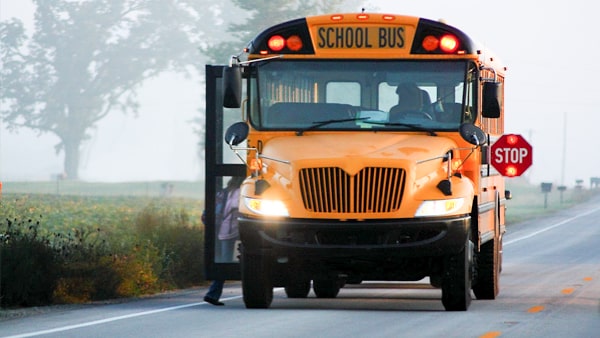
If a school bus stops to unload children on a two-lane highway, vehicles traveling in the opposite direction are:
  1. A Continue at a reduced speed
  2. B Stop, sound the horn, and proceed
  3. C Stop briefly and then pass cautiously
  4. D Stop at least 25 feet away and remain stopped as required

Correct answer: D – Stop at least 25 feet away and remain stopped as required

Drivers meeting or overtaking a stopped school bus must stop at least 25 feet away. They may proceed only when the bus begins moving or its flashing red lights stop. A first violation carries a $150 fine plus penalty assessment; later violations carry a $250–$1,000 fine plus penalty assessment and may result in a 30-day license suspension.

Source: RSA 265:54, I, I-b – Overtaking and Passing School Bus
Question 2

What should you do when another vehicle is following you too closely?

  1. A Brake sharply to make the driver back away
  2. B Find a safe place to pull over and let the vehicle pass
  3. C Increase your speed until the vehicle falls behind
  4. D Move onto the shoulder without slowing

Correct answer: B – Find a safe place to pull over and let the vehicle pass

The driver’s manual advises finding a safe location to pull over when another vehicle is tailgating you unsafely. Do not respond with sudden braking or aggressive driving. Allowing the vehicle to pass removes the immediate following-distance hazard without creating another conflict.

Source: New Hampshire Driver’s Manual — “Stopping Distance,” “Tailgating”

Question 3

Which action can help reduce congestion at a New Hampshire toll plaza?

Choose the situation that would have the best impact on reducing traffic congestion:
  1. A Using a designated E-ZPass lane with a valid transponder
  2. B Following the vehicle ahead more closely
  3. C Changing lanes repeatedly near the booths
  4. D Stopping in an electronic toll lane

Correct answer: A – Using a designated E-ZPass lane with a valid transponder

E-ZPass is an electronic toll collection system that permits drivers to travel through designated lanes without stopping to pay cash. The driver’s manual identifies reduced traffic congestion as a benefit of this system. Drivers must still obey the speed limit posted for the toll lane.

Source: New Hampshire Driver’s Manual — § 7, “Toll Roads”

Question 4

How must you respond to a flashing red traffic signal?

When a traffic signal light is not working, you should:
  1. A Stop only when cross traffic is present
  2. B Slow down without stopping
  3. C Stop, then proceed under the rules for a stop sign
  4. D Proceed as though the signal were green

Correct answer: C – Stop, then proceed under the rules for a stop sign

In New Hampshire, a flashing red signal requires a complete stop before the crosswalk, marked limit line, or intersection. After stopping, the driver may proceed subject to the same right-of-way rules that apply at a stop sign. A flashing yellow signal has a different meaning and requires caution rather than a mandatory stop.

Source: RSA 265:12, I – Flashing Signals

Question 5

What is the safest response when the roadway becomes covered with snow or ice?

  1. A Follow other vehicles closely for guidance
  2. B Make quick steering movements to test traction
  3. C Reduce your speed because stopping and turning are more difficult
  4. D Accelerate rapidly to keep the tires from slipping

Correct answer: C – Reduce your speed because stopping and turning are more difficult

The New Hampshire driver’s manual instructs drivers to reduce speed at the first sign of snow, sleet, ice, or rain. Tires have less grip on slippery pavement, increasing stopping distance and making turns more difficult. Smooth, controlled driving is safer than abrupt acceleration or steering.

Source: New Hampshire Driver’s Manual — “Adjusting to Roadway Conditions,” “Slippery Roads”

Question 6

Which driving habit helps other road users understand what you intend to do?

  1. A Using the appropriate signal before turning or changing lanes
  2. B Waiting until the maneuver begins before checking traffic
  3. C Driving only on less-traveled roads
  4. D Leaving a turn signal on after the maneuver

Correct answer: A – Using the appropriate signal before turning or changing lanes

Turn signals communicate an intended turn, lane change, or movement into traffic. Signal before beginning the maneuver, but still check mirrors, blind spots, and the intended path. A signal gives information to others; it does not establish that the movement is safe or grant the right-of-way.

Source: New Hampshire Driver’s Manual — “Changing Lanes” and § 7, “Turning and U-Turns”