


New Hampshire DMV Practice Simulator

4.7 out of 5 (294 votes)
80% Passing score
40 Questions
8 Mistakes allowed
New Hampshire makes you learn the road before it gives you much paperwork to hide behind. There is no standard learner’s permit for first-time, non-commercial drivers here, which is one of those details people either know early or learn later with a slightly puzzled look at the DMV. Eligible drivers can begin supervised practice at 15½, but the license process still runs through the official sequence: vision test, knowledge test, then road test. This NH DMV practice test is built around the part most people can actually prepare for in advance: the 40-question knowledge test. The real test is multiple choice, computer-based, timed, and given on a touch-screen system at the DMV. You need 32 correct answers to pass, which sounds generous until you remember that missing more than 8 questions ends the attempt. And if you fail or time out, the retest appointment cannot be requested sooner than 10 days later. Tiny calendar punishment, basically. The practice test pulls from the same territory covered in the New Hampshire Driver’s Manual: traffic laws, rules of the road, road signs, traffic signals, pavement markings, safe driving habits, impaired driving, sharing the road, and the general responsibilities that come with operating a vehicle. Road signs are not treated as some separate little bonus round for a standard operator license. They are folded into the full written test, mixed in with right-of-way, lane use, safety rules, and all the other material you are expected to understand together. For teen drivers, there is more attached to the process. Applicants under 18 must complete an approved driver education program, finish 40 hours of additional supervised driving, include the required nighttime practice, and have parent or guardian authorization before applying. Adults do not have those teen-driver requirements, but first-time adult applicants still need the required documents and must pass the vision, knowledge, and road tests unless a transfer or exemption applies. Take this DMV written test online free as many times as you need. Not in a frantic, click-through-everything way, though people do that too. Use it to get comfortable with the wording, the mix of topics, and the New Hampshire-specific rules that can feel oddly easy to forget until they show up on the screen.
FREE DMV Practice Test App
Study for your New Hampshire permit test or driver’s license with the NextDoorDriving app. 700+ DMV questions and answers, 100% free!
Download on the App Store

Sample New Hampshire Permit Test Questions

Question 1

At a New Hampshire intersection, a pedestrian crossing area may be:

  1. A. Present only when pavement lines are painted
  2. B. Either marked with lines or unmarked between opposite roadway edges
  3. C. Present only where traffic signals are installed
  4. D. Present only in a school zone

Correct answer: B. – Either marked with lines or unmarked between opposite roadway edges

A legal crosswalk includes both a crossing distinctly marked on the roadway and the area at an intersection connecting the lateral lines of opposite sidewalks or roadway edges. The latter is an unmarked crosswalk even though no paint is present. When signals are absent or not operating, drivers must yield to pedestrians in a crosswalk under the conditions stated by law.

Source: RSA 259:17 – Crosswalk, RSA 265:35, I – Pedestrian's Right of Way in Crosswalks
Question 2

Which pavement marking normally identifies the right edge of the roadway?

  1. A. A broken white line
  2. B. A single yellow line
  3. C. A single white edge line
  4. D. A broken yellow line

Correct answer: C. – A single white edge line

A single white edge line marks the right edge of a two-way roadway and the right edge of a one-way roadway. On a one-way road, a yellow edge line may mark the left edge. Broken white and yellow lines generally separate traffic lanes rather than identify the roadway’s right boundary.

Source: New Hampshire Driver’s Manual — § 6, “Pavement Markings—Edge Markings”

Question 3

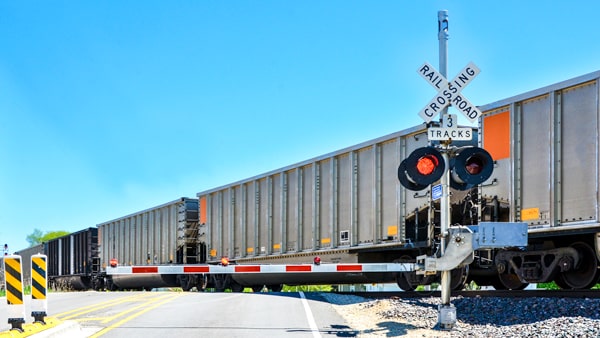
When may a driver go around or under a railroad crossing gate that is closed, opening, or closing?

When may you legally drive around or under a railroad crossing gate?
  1. A. Never while the gate is closed or moving
  2. B. When the tracks appear clear in both directions
  3. C. When the gate appears to be malfunctioning
  4. D. After a train passes, even if the warning lights continue flashing

Correct answer: A. – Never while the gate is closed or moving

New Hampshire law prohibits driving through, around, or under a railroad gate or barrier while it is closed or being opened or closed. When a gate is lowered or another warning indicates an approaching train, stop between 15 and 50 feet from the nearest rail and remain stopped until proceeding is safe. A violation carries a $100 fine plus penalty assessment for a first offense and $250 plus assessment for a subsequent offense within 12 months.

Source: RSA 265:48, I–II – Obedience to Signal Indicating Approach of Train or Other Maintenance of Way On-Track Equipment, RSA 265:50-a – Failure to Stop at Railroad Crossings; Fine

Question 4

What may occur when alcohol is combined with another impairing drug?

  1. A. Their impairing effects may multiply or be added together
  2. B. Neither substance will affect driving ability
  3. C. Alcohol will neutralize the drug
  4. D. The drug will reduce alcohol’s effects

Correct answer: A. – Their impairing effects may multiply or be added together

Alcohol and another drug can interact by multiplying alcohol’s effects or producing additional effects of the drug itself. The resulting impairment may severely affect a driver’s ability to operate a vehicle safely. This risk can involve prescription, over-the-counter, or illegal drugs, so drivers should review medication warnings and consult a doctor or pharmacist when unsure.

Source: New Hampshire Driver’s Manual — § 3, “Combining Alcohol and Other Impairing Drugs”

Question 5

A driver leaves too little space to stop if the vehicle ahead brakes suddenly. What is this unsafe behavior called?

  1. A. Checking the rearview mirror too often
  2. B. Weaving between traffic lanes
  3. C. Following too closely
  4. D. Driving below the speed limit

Correct answer: C. – Following too closely

Under New Hampshire law, a driver may not follow another vehicle more closely than is reasonable and prudent for the vehicles’ speed, traffic, and roadway conditions. The driver’s manual recommends maintaining at least a four-second following distance and avoiding tailgating. Adequate space provides more time to recognize and respond when the vehicle ahead slows or stops. A violation of RSA 265:25 carries a $100 fine.

Source: RSA 265:25, I, IV – Following Too Closely, New Hampshire Driver’s Manual — § 5, “Stopping Distance—Tailgating”

Question 6

Before changing lanes, how should you check an area that cannot be seen in your mirrors?

  1. A. Look only in the inside rearview mirror
  2. B. Look only in the side mirror
  3. C. Make a quick head check over the appropriate shoulder
  4. D. Continue looking straight ahead

Correct answer: C. – Make a quick head check over the appropriate shoulder

Blind spots are areas around a vehicle that are not visible through the mirrors. Before changing lanes, check the mirrors and use a quick head check in the direction of the intended movement. After identifying a safe gap, signal, look again, and move smoothly into the lane.

Source: New Hampshire Driver’s Manual — § 5, “Changing Lanes”, New Hampshire Driver’s Manual — § 4, “Adjusting Vehicle Mirrors”